As a company that works on the web, Google gathers users data through many means.
Traditionally, the company's privacy policy was something difficult to digest. But ahead of the European Union’s General Data Protection Regulation (GDPR), Google is making things very clear so it can comply with the new privacy rules by the European Union.
In a post, the company laid out how exactly Google collects users data that powers its various products.
While there are no significant changes in services or permissions, Google’s way of describing its policy is surprisingly less dense, due to GDPR's requirement for "clear and transparent notice" of how data will be used.
The policy has also been augmented with explanatory videos and illustrations, as Google admits, "a visual description can be easier to understand than text alone."
First of all, Google describes its policy, saying that "We collect information to provide better service to all our users," one section reads.
"When you’re not signed into a Google Account, we store the information we collect with unique identifiers tied to the browser, application, or device you’re using. This helps us to do things like maintain your language preferences across browsing settings."
Google has also improved its user controls, making it easier for them to review Google' security, privacy and ad settings.
One example is the simple switches which toggle location history, web and app activity and YouTube search history, on or off. This feature works across all devices signed into the users' account. Google has also made it easier for users to browse and delete past online activity, do a security or privacy checkup, manage and mute ads, and see all of the Google products they use on the Google Dashboard.
Then there is a parental consent tool called "Family Link." With it, parents can create a Google account for their child and must approve certain types of data processing for minors. The feature also allows parents to block apps, track screen time and remotely lock their child's device.
There is also an update for exporting data.
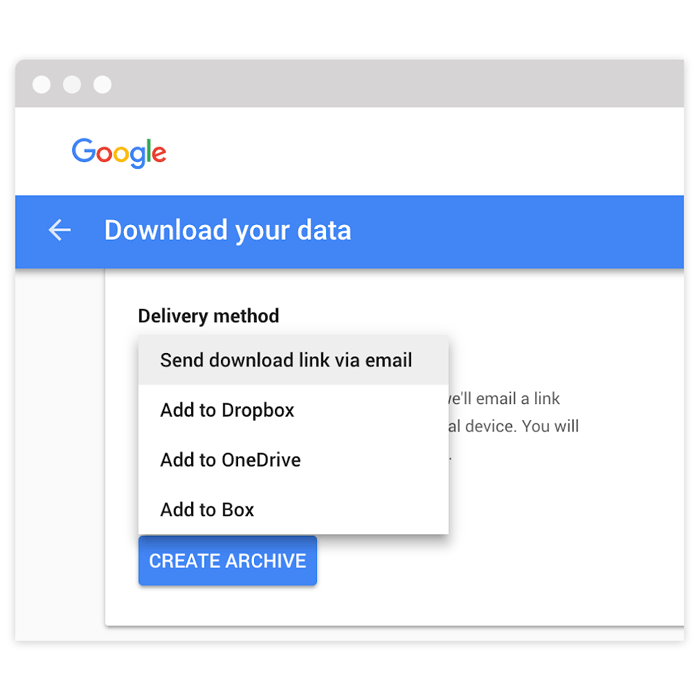
Previously, Google has offered users to export their data using the 'Download Your Data' tool. Using it, users can export data from products like Google Photos, Drive, Calendar, Google Play Music and Gmail, either to their own computer or cloud storage services.
"We are further improving and expanding this feature, adding more Google services, including more contextual data controls, and creating a new setting that helps people schedule regular downloads."
As GDPR encourages companies to enable direct service-to-service data transfers where feasible, Google initiated the Data Transfer Project on GitHub, an open-source system that would make it easier for users to move data between services.
Google in updating its privacy policy, isn't at all based on its "don't be evil" motto. As earlier mentioned, Google's privacy policy update is only for it to comply with the GDPR. So here, the change is only for Google to play nice to GDPR, not users.
But one good thing is that Google is making things easier to understand.
Privacy policies are too complicated that most people just opt in without even bothering. With the update, it's becoming much easier to understand how Google is collecting data all along, and if users aren't liking it, they can opt out whenever they want.
To let everyone know about the changes, Google is sending emails to notify every single one of its billions of users.




















































































































































































































































































