
Google is a vast and complex tool—so layered with options, toggles, and fine print that it can feel like navigating a labyrinth of switches.
But for those concerned with privacy, there’s one particularly important corner to know: the Activity section. This dashboard lets users review what Google knows about them, and more importantly, control what it keeps.
With just a few clicks, users can turn off tracking, auto-delete history, or scroll through the digital footprints they've unknowingly left behind.
Now, enter Google Gemini—Google’s AI darling, its response to the rise of OpenAI's ChatGPT.
Gemini has its own Activity section too, where conversations can be saved to help “improve the AI’s performance.” That’s the pitch, anyway. Users can choose to turn this off, just like they can with Search history or YouTube tracking.
But here's the twist: that control may not be so permanent.
Google is quietly reshaping how Gemini works—and where it listens. The trend is clear: more integration, more access, more presence. Gemini is being woven deeper into Google’s products, inching closer to being always on, always watching, always ready. That tidy little Activity toggle for Gemini is becoming less of a privacy safeguard, and more of a formality.
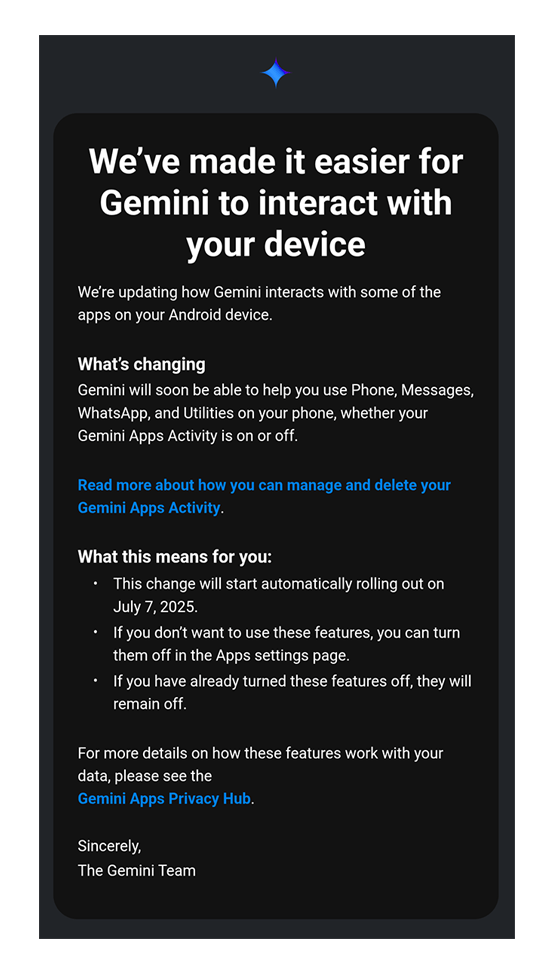
At least, that is what people think when first reading an email Google sent to all Gemini users.
In the email, Google has stirred anxiety across the tech world, with many users fearing that Google’s Gemini AI is about to start digging through their personal data—even when their privacy settings say otherwise.
The email, sent to Android users ahead of a July 7 rollout, includes a particularly unsettling line: “Gemini will soon be able to help you use Phone, Messages, WhatsApp and Utilities on your phone, whether your Gemini Apps Activity is on or off.”
Understandably, that sentence set off alarm bells. To many, it read like Google was giving Gemini free rein to access private communications, regardless of user consent.
But as is often the case with privacy updates, the truth is more nuanced—and far less apocalyptic than the bolded text implies.
Until now, users had to enable the Gemini Apps Activity setting in order to use Gemini’s more advanced extensions, like making calls or sending messages. Enabling that setting meant allowing Google to store conversations on its servers, where they could be used to improve and train its AI models. Without it, those features were off-limits.
The new update actually relaxes that requirement.
Users will now be able to access those same extensions even with their activity history turned off.
What this means, users can ask Gemini to send a WhatsApp message or use their phone’s Utilities without having to agree to long-term data storage or model training. Instead, Google will store those interactions temporarily—up to 72 hours—purely to ensure the task completes properly. This temporary storage has been in place since the early Bard days, and it’s still not used for AI training when the activity setting is off.
In short, the update doesn’t remove users' control over their data. Instead, it expands users' access to Gemini’s tools while keeping training opt-outs in place.
If users don’t use Gemini extensions, nothing changes. If they do, users can now enjoy them with fewer privacy compromises. The only catch is the short-term 72-hour storage window, which is more a technical necessity than a privacy overreach.
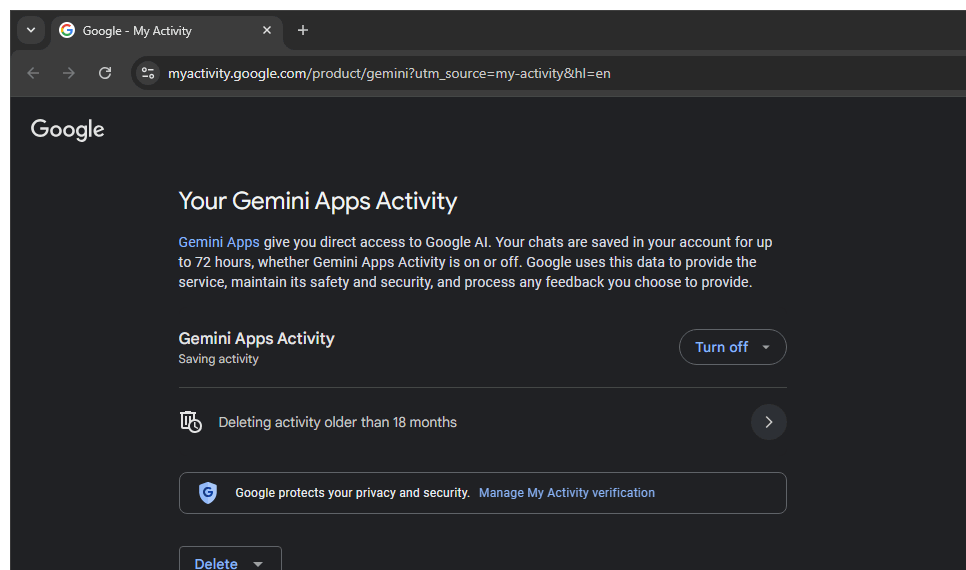
The real problem here lies not in Google’s intentions but in its communication. The email’s wording, stripped of technical context, sounds ominous and invasive—suggesting a loss of control over personal data. In reality, the update is meant to loosen the restrictions on accessing Gemini’s features, but the delivery left users feeling suspicious and misled.
This isn't a new pattern. Tech giants like Google are masters of language, often painting idyllic pictures of convenience, speed, and personalization—while subtly burying the more invasive aspects of tracking, data storage, and profiling.
Reading the fine print, including the Terms of Service and Privacy Policy, is even more difficult to digest for most people.
The result? Users are given the illusion of control, while the fine print quietly narrows their real options. Many find themselves lost in the wording, unsure of what they’ve agreed to or what exactly they’ve opted out of.
In other words, tech companies are experts at crafting half-truths. While these may protect their legal liability, privacy-conscious individuals often see them as doing too little to reassure people living in an increasingly data-driven world.






















































































































































































































































































