
Mozilla, renowned for its Firefox browser, has consistently championed user privacy and security.
Over the years, the organization has introduced several features aimed at enhancing online privacy. One notable feature is Enhanced Tracking Protection (ETP), which blocks known trackers that monitor users' online activities.
Another significant advancement is Total Cookie Protection, which confines cookies to the site where they were created by maintaining a separate "cookie jar" for each website.
These features prevent tracking companies from properly tracking users and their behavior across the internet, thereby enhancing privacy.
Then, out of a sudden, things went south.
Mozilla updated its Terms of Use and Privacy Notice, and made it seem that Mozilla may be shifting towards data-trading practices reminiscent of companies like Google.
Before the commotion, Mozilla had not established specific Terms of Use for its Firefox browser.
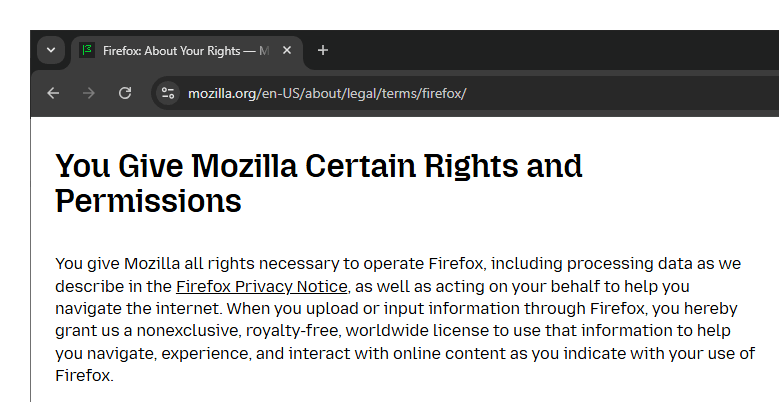
The introduction of the terms alone, should be enough to raise some eyebrows. But in this case, Mozilla specifically wrote that using Firefox means that users grant Mozilla a nonexclusive, royalty-free, worldwide license to use user-uploaded information.
The particular language that drew criticism was:
The idea is "to make these easy to read and understand — there shouldn’t be any surprises in how we operate or how our product works," the company’s blog post stated.
But this explanation create even more confusion than ever before, that forced the company to update its blog post to state that its terms do not give Mozilla ownership of user data or a right to use it beyond what’s stated in the Privacy Notice.
Following the backlash and outrage, Mozilla quickly clarified what it really meant.
It then updated the Terms of Service with the following words:
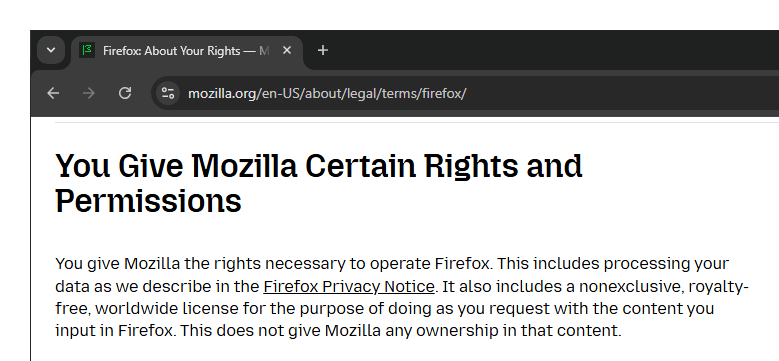
While the both statements describe how Mozilla can use the information users input or upload while using the browser, there are some key differences in tone, scope, and clarity.
The original clause stated that by uploading or inputting information through Firefox, users granted Mozilla a "nonexclusive, royalty-free, worldwide license" to use that information to assist in navigating and interacting with online content. This broad language led to concerns that Mozilla might claim extensive rights over user-provided data, potentially including personal information.
In the revised terms on the other hand, specify that users provide only the rights necessary to operate Firefox. This includes processing data as described in the Firefox Privacy Notice and clarifies that while Mozilla has a license to use user-inputted content to fulfill user requests, it does not claim ownership of that content.
The key differences include the scope of license.
Imagine hating on us when we're literally just minding our own business and browsing the web
— Firefox (@firefox) January 28, 2025
The initial terms granted Mozilla a broad license to use user information, whereas the revised terms limit this license strictly to operating Firefox as intended by the user. As for ownership clarification, the revised terms explicitly state that Mozilla does not obtain ownership of user content, addressing concerns about potential overreach present in the original wording.
Mozilla is an underdog that competes in an industry where giants like Google with Chrome, Microsoft with Bing, Apple with Safari rule.
The organization's quick response underscores its dedication to maintaining trust while adapting to the evolving digital landscape, because business is business, and smaller businesses like Mozilla need to be agile, even when it concerns things like changing Terms of Service, which are legal agreements often overlooked by ordinary users.
Mozilla was set to receive $3.55 million in U.S. federal funding over the next three years. However, this funding is now unlikely to materialize.
Despite the setback, we're staying committed to this work, but we need your help to keep up out momentum: https://t.co/smHmJqbcLx— Mozilla (@mozilla) February 28, 2025






















































































































































































































































































