Bitcoin, the original cryptocurrency that ignited the entire digital asset revolution, was explicitly designed with decentralization at its core.
Satoshi Nakamoto's whitepaper envisioned a peer-to-peer electronic cash system where no single entity could control the network, and mining, which is the process of validating transactions and securing the blockchain through computational proof-of-work, was meant to distribute power widely among participants worldwide.
Yet in practice, particularly around mining, Bitcoin has faced persistent criticism for falling short of that ideal.
Tether, the issuer of the world's leading stablecoin USDT, has taken a significant step towards addressing this particular issue.
And that is by launching 'MiningOS,' or referred to as MOS.
The operating system is essentially an open-source tool that represents a direct challenge to the proprietary and often closed systems that have long dominated Bitcoin mining operations.
Tether Bitcoin
Tether Mining OS is now fully opensource.
A complete operational platform that can scale from a home setup to industrial grade site, even across multiple geographies.
Super modular, P2P encrypted networking layer.
It supports a long list of miners,… https://t.co/VzXywA6IZc— Paolo Ardoino (@paoloardoino) February 2, 2026
In Bitcoin’s early days, mining was accessible to everyday users with home PCs and laptops. In fact, Laszlo Hanyecz, who later became famous for spending 10,000 BTC on two pizzas, accumulated those coins by mining on his own computer.
Now, that is practically impossible. This time, mining requires specialized hardware (ASICs), massive electricity, and cooling infrastructure, creating high barriers that favor large-scale industrial operations over individuals or small setups.
As a result, hashrate, the measure of total computational power securing the network, has increasingly clustered among a handful of major mining pools.
Top pools command a huge percentage of the global hashrate, and together, those leading few often control well over half the network's power. This raised concerns about potential coordinated actions, such as censoring transactions or attempting a 51% attack, though economic incentives and game theory make such moves unlikely and self-destructive.
What's more, the U.S. now dominates a substantial portion of global hashrate (often cited around 75% in recent analyses), making the network vulnerable to regional events like power outages or regulatory shifts.
Post-halving economics exacerbate these dynamics.
With initiative like MOS, the hardware-agnostic operating system can manage mining operations, with the goal of pushing back against this trend.
By eliminating reliance on proprietary "black box" software from hardware vendors, MOS promotes transparency, reduces vendor lock-in, and lowers barriers for smaller operators, from hobbyists running a few rigs to coordinated industrial sites.
"MiningOS is an open, modular OS for Bitcoin mining and energy orchestration. Built and improved through real-world use and open-source collaboration, it scales from smaller garage miners to large-scale gigawatt farms—empowering users to evolve, expand, and refine the infrastructure that powers Bitcoin," Tether wrote.
"Built for resilience. Designed for scale. Licensed for sovereignty."
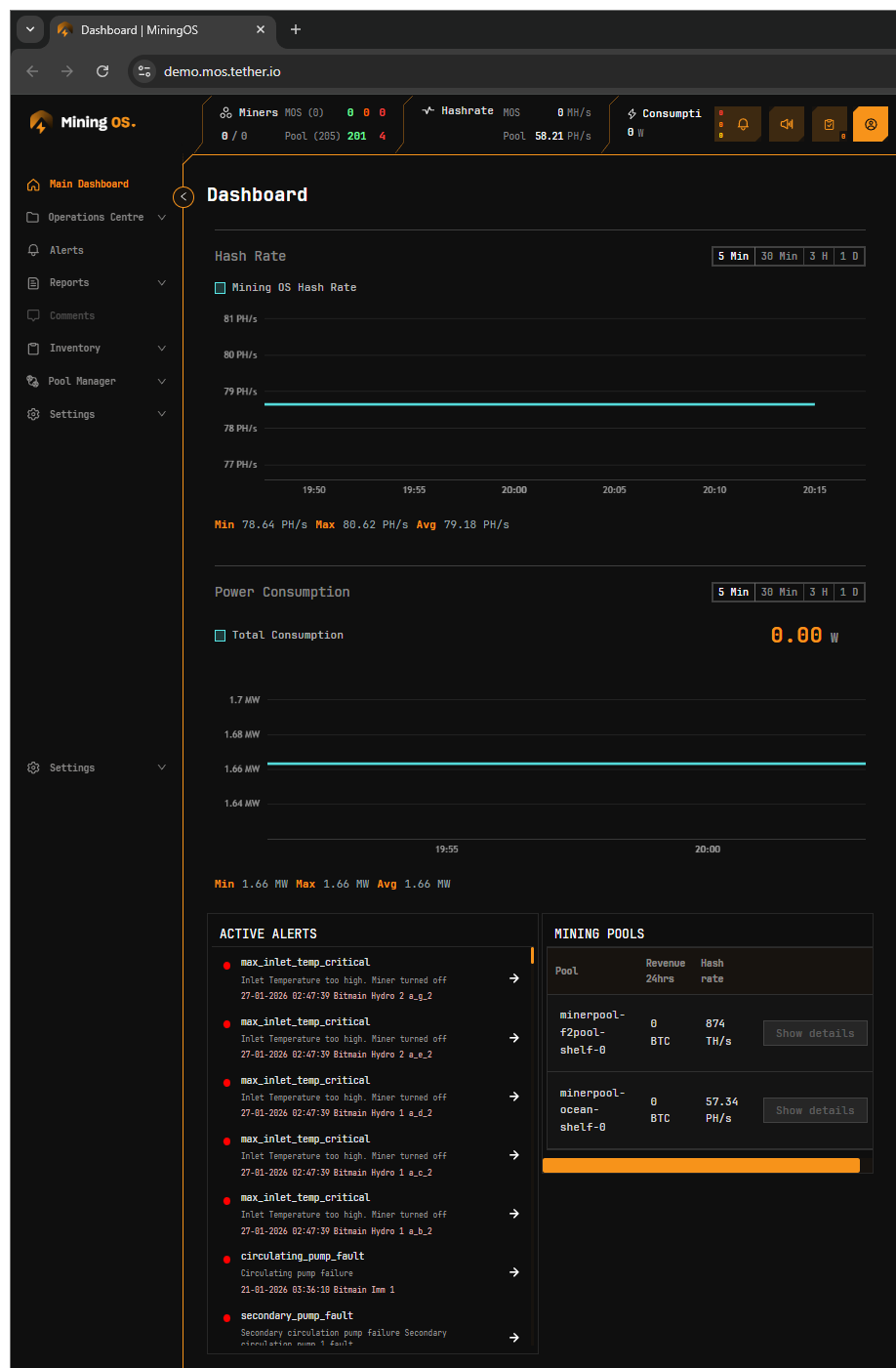
Built on peer-to-peer protocols and released under Apache 2.0, it enables self-hosted management without centralized dependencies, potentially allowing more diverse participants to compete effectively and distribute hashrate more broadly.
The effort can have a huge impact, since such tools align with efforts to reinforce Bitcoin's decentralized ethos by making infrastructure more accessible and collaborative.
Bitcoin's mining isn't monolithic in its centralization risks.
The difficulty adjustment mechanism self-corrects to maintain roughly 10-minute block times, preventing any sudden dominance, and the network has withstood shocks like bans, storms, and halvings. Moreover, growing use of sustainable energy (now over 50% in some estimates) and innovations in efficiency help sustain participation.
Still, the gap between Bitcoin's foundational vision and its current mining reality remains a valid point of debate.
True decentralization requires not just protocol rules but ongoing economic and technological pressures that encourage broad, global involvement rather than oligopolistic control.






















































































































































































































































































