 Microsoft Windows 8 may have a slow start. But in July 2014, the operating system has gained sufficient traction. Starting with the current operating system, Windows 8.1 which had 6.56 percent of market share at the end of July, bumped up its number to 7.09 percent. Windows 8 has also shown some improvements, having its number increased to 6.28 percent from the 5.92 percent it had a month earlier. In early September Windows 8 and Windows 8.1 are running on 13.37 percent of the computers around the world, according to the latest data by Net Applications.
Since the modern browser war, Internet Explorer browser (IE) has had a poor performance if compared with other web browsers. Earlier built was a grief to many and people thought that its decreasing market share is inevitable. This gave a lot more freedom for Firefox and Chrome to flourish. But Microsoft is not going down without a fight.
Net Applications calculates user share by mining data from the approximately 160 million unique visitors each month who browse to the sites it monitors for customers. And the results have shown that Microsoft is winning the game once again.
The increase of Windows' market share also improves IE. IE 8, the default browser in Windows 7 that had over 50 percent of the market share, now has 21.4 percent. But the current IE 11 is quickly closing the gap, aiming for the top spot, with 17.54 percent market share (up from 16.78 percent a month earlier).
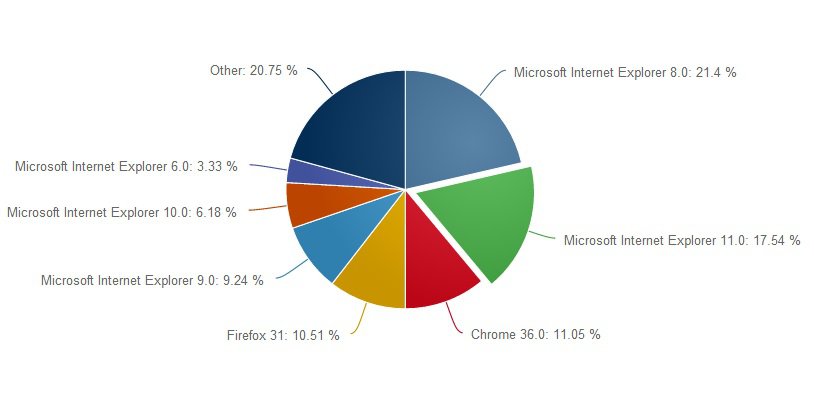
One of the reason IE is quickly getting traction is because since version 9, IE is automatically updating. This means that IE 10 and IE 11 are pushed to users as early as day one of its release. As a result, they spread much more quickly than their predecessors.
Improvements are also seen from other web browsers. Mozilla Firefox version 31 has now 10.51 percent of the market, up from 9.27 percent. Google Chrome 36 became the third most popular web browser on the list with 11.05 percent.
IE 11 at its Alpha phase was leaked on March 25th, 2013. The web browser was first introduced at its release in June 2013 during the Build 2013 conference. The most notable advantage that IE 11 has is its performance. Reviewers have scored the web browser to be faster than Google Chrome 30 and Firefox 26 in two of four benchmarks. IE 11 was also observed to use less memory when users open multiple tabs, if compared to Chrome and Firefox.
The Moment to Move On
As Microsoft continues to release newer versions of IE, the company drops support for older versions. Microsoft has supported IE for a long time. Each new version of Windows comes with a minimum of five years of mainstream support and five years of extended support. The end of Internet Explorer 8 is coming in 2016 as Microsoft is aiming to shed some weight and move users over to the latest versions of the browser.
"After January 12, 2016, only the most recent version of Internet Explorer available for a supported operating system will receive technical support and security updates. For example, customers using Internet Explorer 8, Internet Explorer 9, or Internet Explorer 10 on Windows 7 SP1 should migrate to Internet Explorer 11 to continue receiving security updates and technical support," stated Microsoft on its blog.
Users are opted to switch to newer versions of IE to keep getting features and security updates. The same scenario has happened to Windows XP when Microsoft ended its support.




















































































































































































































































































