WhatsApp has rolled out a new security feature, which aims to make its platform a lot more secure.
Calling it the 'Strict Account Settings,' it offers a lockdown-style mode that significantly strengthens protections against sophisticated cyberattacks and spyware. This optional enhancement builds on the app's existing end-to-end encryption by applying the most restrictive privacy controls automatically, making it harder for advanced threats to exploit the platform.
It's particularly aimed at high-risk individuals, such as journalists, activists, human rights defenders, and public figures who face targeted surveillance or mercenary spyware like Pegasus from NSO Group.
When enabled, the feature blocks media, attachments, and documents from senders not in your contacts, silences incoming calls from unknown numbers, disables link previews, and locks down visibility of details like your last seen status, online presence, profile photo, About section, and profile links.
It also automatically activates two-step verification and restricts other functionalities that could potentially serve as entry points for exploits, including zero-click attacks that don't require user interaction.
These changes reduce the app's attack surface by limiting interactions from non-contacts and minimizing ways malicious content could be delivered.
Users can turn on Strict Account Settings with just a few taps.
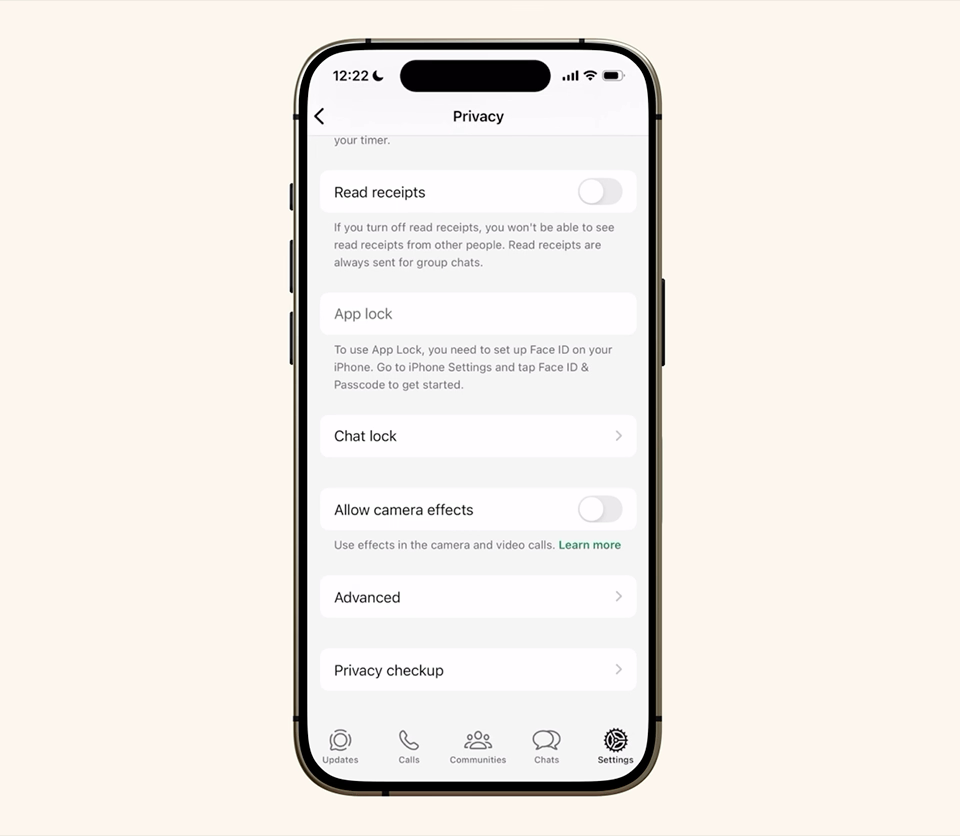
They can do this by navigating to Settings of their WhatsApp app on your primary device, and then select Privacy. Then, they can select the Advanced. From there, they can toggle the option
Meta emphasizes that this is not necessary for most people, as standard end-to-end encryption already provides strong safeguards for everyday users. The mode trades some convenience for extreme security, similar to Apple's Lockdown Mode introduced in 2022 or Google's Advanced Protection program. The rollout began in late January 2026 and is happening gradually worldwide over the coming weeks.
Alongside this user-facing toggle, Meta is also making backend improvements, including migrating parts of WhatsApp's media processing to the Rust programming language for better memory safety and resistance to certain exploits.
This is part of a broader defense-in-depth strategy involving hardened code practices, control flow integrity, and safer handling of data like photos, videos, and messages.

While these updates represent a proactive step in bolstering privacy for vulnerable users, questions about WhatsApp's core encryption claims persist.
A class-action lawsuit filed against Meta alleges that the company's end-to-end encryption does not fully prevent access to message contents as advertised, claiming internal tools allow employees to view chats in near real-time or historically without proper decryption barriers.
Meta has strongly denied these accusations, calling them false and absurd, and reaffirmed that WhatsApp has used the Signal protocol for true end-to-end encryption for over a decade, ensuring only senders and recipients can access message contents.
At this time, the case remains ongoing and highlights ongoing scrutiny of how privacy promises align with platform operations.
Your WhatsApp messages are private. We use the open-source Signal protocol to encrypt them.
• Encryption happens on your device
• Messages are encrypted before leaving your device
• Only the intended recipient has the keys to decrypt messages
• The…— WhatsApp (@WhatsApp) January 27, 2026






















































































































































































































































































