The rapid evolution of one open-source AI project has captured the tech world's attention.
And Clawdbot was one of them. It managed to become a viral phenomenon, thanks to its innovative cloud deployments, its reband to Moltbot, facing security debates, and more. Now, it's changing its name again, and its name is now OpenClaw.
Created by Austrian developer Peter Steinberger, the now called OpenClaw. He said that the name is essentially the "final form," combining "open" for its open-source ethos with "claw" to honor the lobster heritage. Trademark checks were completed, domains secured, and migration tools prepared to avoid past pitfalls.
The official site moved to a new domain, but the core code and functionality remained unchanged.
The cute lobster mascot, originally named Clawd, added a playful touch, symbolizing the project's ambitious "claw" into everyday productivity.
The lobster has molted into its final form
Clawd → Moltbot → OpenClaw
100k+ GitHub stars. 2M visitors in a week.
And finally, a name that'll stick.
Your assistant. Your machine. Your rules.https://t.co/d39LXKRE9h— OpenClaw (@openclaw) January 30, 2026
OpenClaw is a personal AI agent promised something beyond typical chatbots: it could actually perform real-world tasks.
Running locally on user hardware, it integrated seamlessly with messaging apps like WhatsApp, Telegram, Slack, Discord, and iMessage. The agent can monitor inboxes, managed calendars, booked flights, organized files, executed commands, handled emails, and even initiated proactive updates or reminders.
With persistent memory, it remembered conversations indefinitely, acting like a reliable digital sidekick or "full-time AI employee."
Amid the popularity and whurlwind of Clawdbot, which was then renamed to Moltbot, and now OpenClaw, Cloudflare stepped in with a timely innovation.
The American technology company that provides a wide range of internet infrastructure services, helping make websites, applications, networks, and even AI agents fasterm announced that it has released 'Moltworker.'
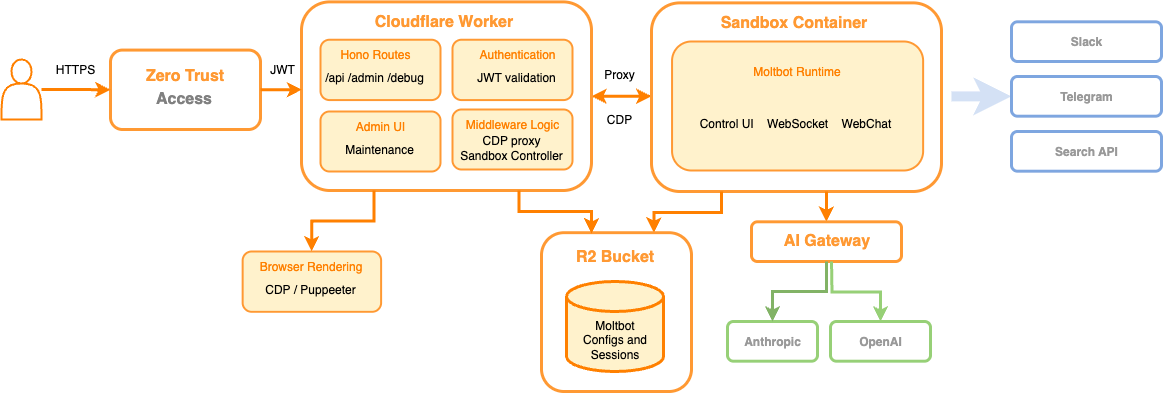
Adapted to work with OpenClaw, the tool is literally a middleware solution to allow users to run the agent serverlessly on Cloudflare's infrastructure instead of local hardware.
Leveraging Workers, Sandbox SDK for isolated execution, R2 for persistent storage, AI Gateway for model proxying (with Bring Your Own Key support), and Browser Rendering for web automation, it promised low-cost deployment, plus enhanced security through Zero Trust access and edge isolation.
The idea si to turn the viral repo from once a hardware-heavy hobby into an accessible, scalable option without buying dedicated machines.
Despite the turbulence, OpenClaw represents a compelling glimpse into the future of personal AI.
In a world where closed models push convenience at the cost of control, open-source alternatives like this invite users to build something truly their own. It's customizable, private, and powerful. The project's chaotic journey from viral darling to rebranded survivor highlights both the promise and perils of democratizing advanced AI agents.
— terminal (@terminaldotshop) January 30, 2026
As the community refines best practices and hardens deployments, tools like Moltbot could evolve from experimental novelties into indispensable daily companions, proving once again why open-source LLMs continue to offer a uniquely liberating path in the ongoing LLM wars.
This saga underscores the double-edged nature of agentic AI: immense potential for personal empowerment and automation, tempered by real risks that demand careful configuration and community vigilance.
As OpenClaw settles into its new identity, the project continues inspiring experimentation, from everyday productivity boosts to wild offshoots like AI agents building their own social networks.
Whether running locally or via Cloudflare, it represents a bold step toward truly autonomous, privacy-focused personal assistants, one molt at a time.






















































































































































































































































































