
Quantum computing is regarded as the evolution of traditional computing.
Using qubits instead of bits, quantum computers work using superposition which frees it from binary constraints found on traditional computers. What this means, quantum computer works with particles that can take on the value 0, or 1, or both, not using usual bits that can only have either 0 or 1.
This field requires new programming type, which developers may not have knowledge of.
To meet this demand, Microsoft announced the release of Quantum Katas, which is "a series of self-paced tutorials aimed at teaching you elements of quantum computing and Q# programming at the same time."
Quantum Katas, as the name suggests, are coding katas from Microsoft that teach developers the fundamentals of the company’s quantum computer programming language called Q#.
Available as an open-source project on GitHub, it allows developers to learn for free.
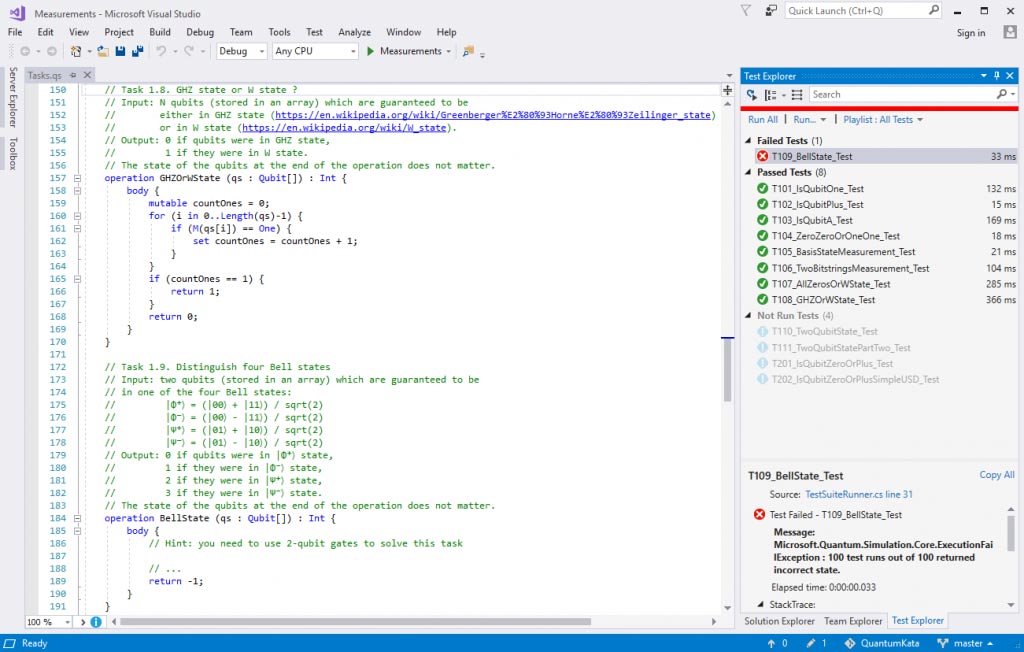
According to a Microsoft blog post:
There are four different katas, with each covering one topic. Initially, the topics are:
- Basic quantum computing gates. Tasks which focus on main single-qubit and multi-qubit gates.
- Superposition. Tasks which focus on preparing certain superposition state on one or multiple qubits.
- Measurements. Tasks which focus on distinguishing quantum states using measurements.
- Deutsch–Jozsa algorithm. Tasks which focus on writing quantum oracles which implement classical functions, and the Bernstein–Vazirani and Deutsch–Jozsa algorithms.
Quantum computing is the future of computing, with the potential to change everything we know about computation.
In theory, because they work using qubits that can have multiple states at any given time, quantum computers can be much more powerful than any traditional "classic" computers we all know.
One one part of the equation, is of course the hardware. One of the greatest challenges is controlling or removing quantum decoherence by isolating the system from its environment as interactions with the external world would cause the system to decohere.
To do this, quantum computers are required to have their qubits cooled down to 20 millikelvins (very close to absolute zero) in order to take advantage of superconductivity and prevent significant decoherence.
But to make those quantum computer hardware work, they need software written on them.

Among a few tech companies that have launched their own initiatives, including Google with Cirq, Microsoft is also eager to get programmers into the quantum bandwagon.
With quantum computing industry expected to worth tens of billions of dollars in a decade, according to analysts, Microsoft and some other tech companies are expecting the field to have a high demand in a short amount of time. And here, the race for quantum supremacy continues.
"We hope you find the Quantum Katas project useful in learning Q# and quantum computing," said Microsoft in the announcement. "As we work on expanding the set of topics covered in the katas, we look forward to your feedback and contributions!"






















































































































































































































































































