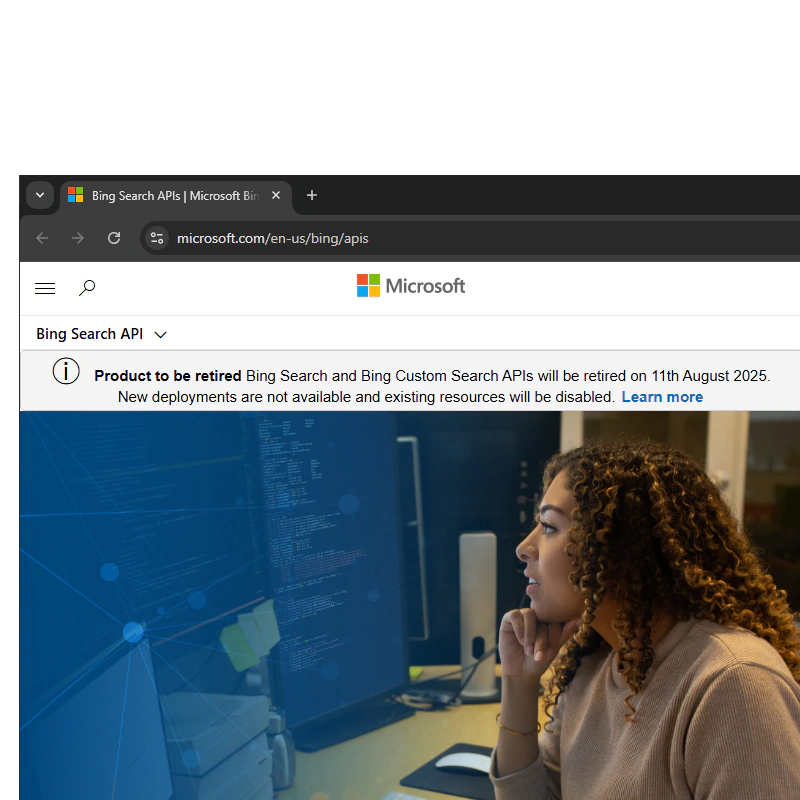
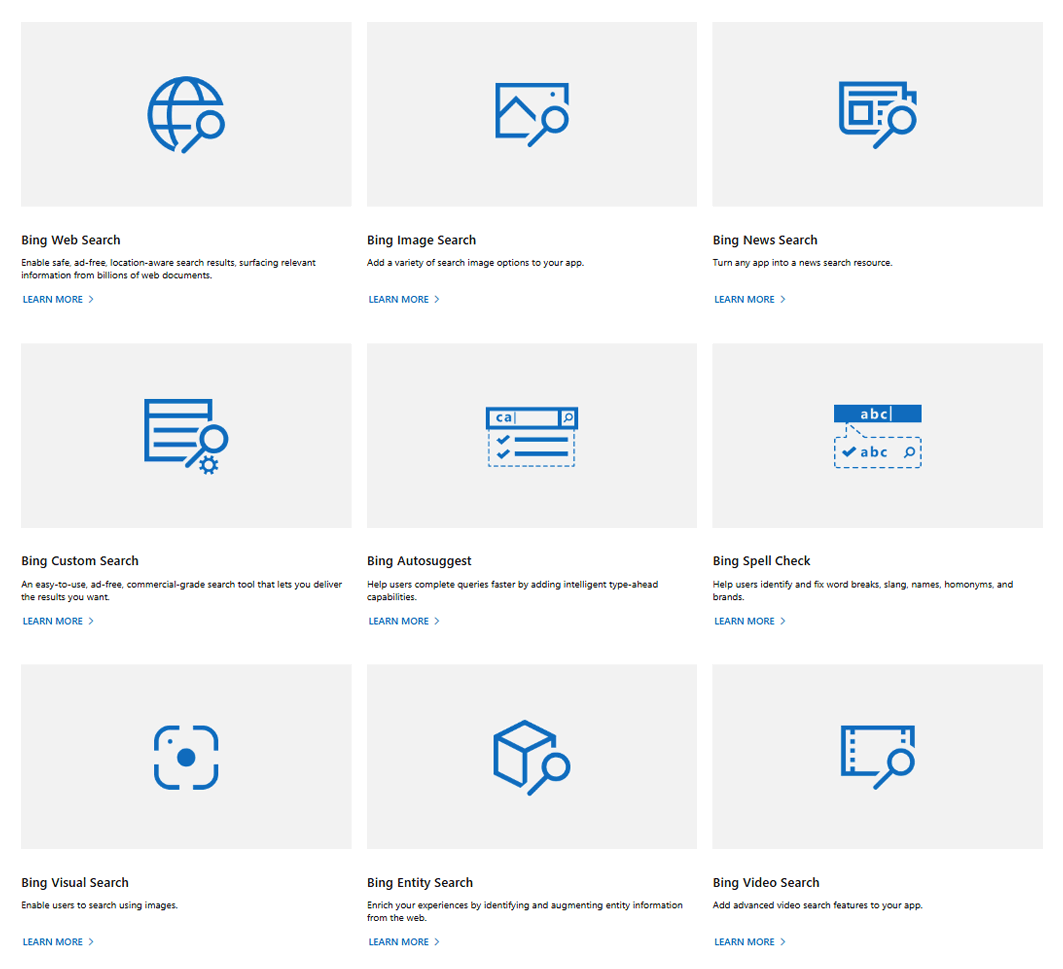
The Bing Search API is a tool from Microsoft that lets apps, websites, or software do what Bing.com does: search the internet for information.
Instead of typing into a search box on a browser, your program sends a request to the Bing API, and Bing sends back search results in a way your code can understand—usually in JSON format (which is like a nicely organized data menu). It's essentially Bing's brain, delivered through an API, so you can pull in search results—web pages, images, videos, news, and more—programmatically.
In other words, the Bing Search API, which is part of Microsoft Azure Cognitive Services, allows developers to integrate web search capabilities into apps, websites, and tools using Bing’s massive search index.
And this time, Microsoft wants to pull its plug.
As a replacement for it, Microsoft wants to direct customers toward AI products instead.
Microsoft confirmed this, and further explained that:
"Customers may want to consider Grounding with Bing Search as part of Azure AI Agents. Grounding with Bing Search allows Azure AI Agents to incorporate real-time public web data when generating responses with an LLM."
Microsoft plans to decommission on August 11, and what that means, the close would affect a number of smaller search engine startups and independent developers. The service acted as a backbone for innovation, enabling nimble players to compete without building full-scale search engines from scratch.
For years, Microsoft, through the Bing Search API, offered a practical and affordable solution for those without the infrastructure to crawl and index the web themselves.
Search engines like DuckDuckGo, Brave, and You.com, all rely heavily on APIs to deliver search results.
But over time, the appeal of these APIs began to fade, all because of large language models.
While Microsoft hasn't explicitly explained the reason for the closure, Microsoft significantly increased pricing following the rise of OpenAI ChatGPT, citing enhanced result quality as justification.
The loss of the Bing APIs adds another layer of complexity to the already uncertain future of search engines, which have long been the most visible gateway to the web.
The emergence of ChatGPT and other AI chatbots that can help users find information more efficiently has fueled fresh competition in the market for the first time in years.
To fill the gap the company is making, Microsoft is promoting a new tool called 'Grounding with Bing Search,' part of its Azure AI Agents suite.
The feature is designed to enhance chatbot responses with real-time web data, allowing generative AI systems to fetch and cite updated content. However, Grounding with Bing Search lacks the flexibility and transparency of the legacy APIs, offering mostly summarized data rather than raw search results, and it’s optimized for only a narrow range of use cases.
Then, there is the cost.
For many, the higher costs outweighed the benefits. In response, several companies began developing their own in-house indexing technologies—something that had once seemed out of reach, but has now become more viable thanks to rapid advancements in computing and machine learning.

















































































































































































































































































