A child’s digital footprint often begins long before they ever touch a keyboard.
In a world where nearly every interaction leaves a trace, data about a person can start accumulating the moment someone else decides to post a photo, sign up for a service, or use a connected device in their presence. What feels like harmless sharing, like baby photos, first steps, family moments, is quietly fed into a much larger system designed to observe, categorize, and predict behavior.
By the time that child grows old enough to understand the concept of privacy, a version of them may already exist in databases they’ve never seen and cannot access.
This isn’t the result of a single bad actor or a careless mistake. It's the innevitable natural outcome of how the modern internet is built.
Many of the platforms people rely on every day operate on a model where data is the currency. Every click, scroll, interaction and even a pause becomes part of a larger profile used to tailor ads, refine algorithms, and maximize engagement. Over time, these fragments form detailed portraits: interests, habits, routines, even emotional tendencies, constructed without explicit awareness or meaningful consent.
Even for children, this process happens passively and continuously, making it even harder to challenge or escape.
Proton wants to give parents a way to eliminate that, for the sake of their children.
Protect children online
Protect children onlin
Protect children onli
Protect children onl
Protect children on
Protect children o
Protect children
Protect childre
Protect childr
Protect child
Protect chil
Protect chi
Protect ch
Protect c
Protect
Protec
Prote
Prot
Pro
Pr
P
Pr
Pro…— Proton VPN (@ProtonVPN) March 24, 2026
Best known for Proton Mail, the Switzerland-based company has built its reputation around a simple premise: your data should belong to you, not the platform hosting it.
Unlike traditional email providers, Proton Mail uses end-to-end encryption, meaning messages are encrypted before they leave your device and can only be read by the intended recipient. Not even Proton itself has access.
Over time, Proton has expanded into a broader ecosystem of privacy-focused tools, but the philosophy remains the same: collect as little data as possible, and design systems that don't depend on surveillance to function.
That philosophy is now being applied earlier than ever.
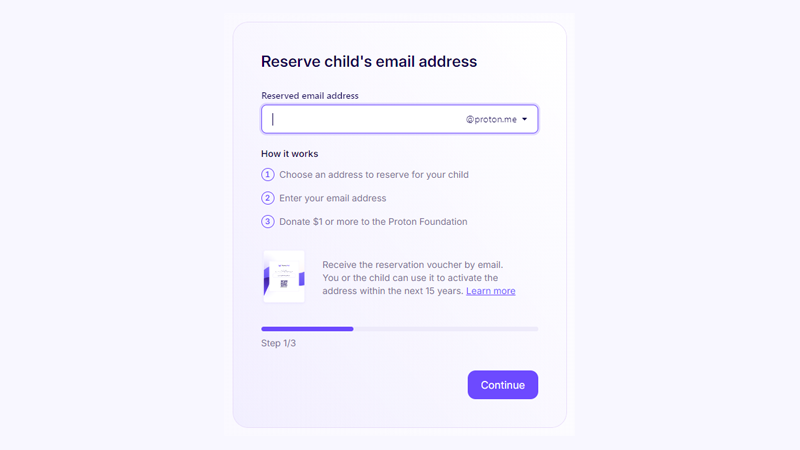
With its 'Born Private' initiative, Proton is attempting to give parents a way to preserve their child's digital identity before it's shaped by the wider internet. The concept is simple but unusual: parents can reserve a private email address for their child, one that remains inactive, sealed, and untouched for years. No inbox activity, no tracking, no behavioral data. Just one clean slate.
According to Proton, the address can be held for up to 15 years and later activated securely when the child is ready, either by the parent or the child themselves. Until then, it exists without generating the kind of data trail that typically begins the moment an account is created elsewhere.
This directly challenges one of the internet’s default patterns.
Today, most online services require accounts, and those accounts are often tied to a single email address, frequently a parent's. Over time, that shared identity becomes a gateway into multiple platforms: games, school tools, shopping, social apps. Each interaction adds another layer to a growing profile, quietly linking behavior across services.
Proton’s approach interrupts that process at the starting point.
Governments worldwide are rushing to "protect children online" with age verification laws.
Meanwhile Big Tech ad surveillance and profiling on kids & teens goes completely unchecked.
It's time to change that: https://t.co/M9zq2xS8Sb— Proton VPN (@ProtonVPN) March 24, 2026
Rather than asking users to manage privacy through complex settings or opt-outs, it leans into privacy by design: minimizing data collection from the outset instead of trying to contain it later. It's a shift away from the idea that tracking is an unavoidable trade-off for convenience, and toward the idea that technology can function without constantly observing its users.
In that sense, the product isn’t just an email service. It’s a different model of how digital identity can begin.
Of course, Proton isn't trying to out-class giants like Google or compete directly with Gmail on scale. Its approach is more fundamental: instead of asking what more can be done with user data, it asks what happens when that data is never collected in the first place.
The challenge, however, is bigger than any single product.
Data-driven business models are deeply embedded in the modern internet, and moving away from them requires more than awareness. It demands alternative systems, user adoption, and sustained pressure for change.
Still, the fact that these ideas are gaining traction signals a shift.






















































































































































































































































































