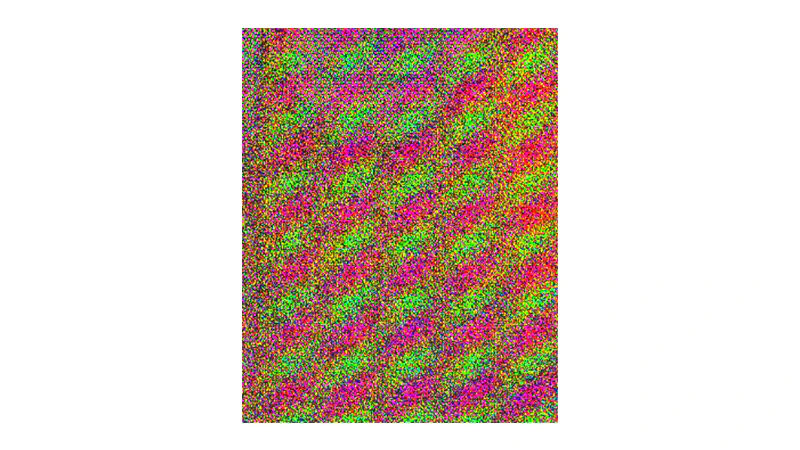
Someone on Reddit claimed to have extracted the SynthID watermark that Google embeds in every Gemini-generated image. If this is true, the implications could be big.
SynthID, developed by Google DeepMind, is designed to invisibly watermark AI-generated images, making them recognizable even if someone crops or edits them. According to Google, these watermarks survive typical image transformations, including filters, cropping, compression, color shifts, and casual editing while remaining invisible to human viewers.
Built to work across images, video, audio and even text, SynthID embeds subtle, hard-to-notice signals into content during generation so only detectors can later flag material as machine-made.
However, on Reddit, a user claimed they boosted contrast on a Gemini-generated image and could faintly see the watermark:
"If you oversaturate any image generated with nano banana, it produces this pattern. Looks to be their 'SynthID.'"
The person also said that they found this completely by accident while experimenting Gemini-made images with Photomosh's color correction.
"I was trying to upscale an image with Topaz and it kept turning out horrible. That's when I noticed that the dark/black parts of the image were riddled with these patterns," adding that it "Turns out it's everywhere."
The watermark in question, seems to be a peculiar pattern/grain, that the user claims to be the colored lattice watermark Google uses.
The Reddit post went viral because it seemed to show the watermark made visible after a crude image tweak can reveal faint pattern where nothing was visible before.
Online, that kind of demo spreads fast: people want to know whether the provenance signal can be read, faked, or neutralized. To be blunt: a blurry screenshot of a faint artifact is not the same as a validated method to extract or remove SynthID, but it’s the kind of claim that forces the community to pay attention.
SynthID is Google DeepMind’s answer to a growing problem: how to mark AI-generated content in a way that survives whatever users do with it.
The goal is to make it a practical tool in the fight against deepfakes, misinformation, and uncredited AI content.
But if attackers can reliably strip or spoof those marks, the tool’s utility shrinks, and consequences can include:
- Authentication breakdown: The watermark is supposed to help prove an image was generated by Google’s AI. If it can be reversed or removed, that proof loses value.
- Forgery and misuse: Bad actors might swap or spoof watermarks, making fake images masquerade as authentic, AI-verified content.
- Privacy and attribution: Reveal the embedding method, and one might trace image origins or tie AI outputs back to prompts or users.
- Legal and ethical risks: Watermarks help in copyright and provenance claims. If they can be neutralized, it weakens one guard in the fight against misuse.
In other words, if it's true, the implications ripple far beyond a single forum post. If false, it’s still a useful reminder that the arms race between watermarking and watermark-removal is very much alive, and messy.
Even partial weaknesses are dangerous: attackers don’t need perfection to profit from deception, and organizations relying on watermarking as a single line of defense would find themselves exposed.
That said, the Reddit claim is just that: a claim.
But people need to keep perspective, because one Reddit post isn’t a verified exploit.
Real security research needs reproducibility, independent testing, and peer review. The smarter move is to treat this claim as a prompt for investigation. Labs do this routinely: someone posts a bold claim, others test it, and either it’s confirmed and patched or quietly debunked.
If a genuine flaw exists, the implications are clear. Companies will need layered defenses. They need to engage in watermarking plus metadata, provenance logs, and human oversight. Detectors must grow stronger and perhaps integrate cryptographic signing. Regulators, too, will demand stricter standards and traceable media chains.
For now, organizations can act by keeping auditable records, treating watermark signals as probabilistic, and promoting transparency in how detection systems work.
For everyone else, like journalists, creators, and casual everyday users, the takeaway is simple: watermarking helps, but it’s not foolproof.
For all it’s worth, Google Gemini, along with its lightweight sibling, the Nano Banana image generation system, have evolved into one of the most influential visual AI tools in use today.
The technology has quietly but profoundly reshaped the digital landscape. From blog illustrations and marketing campaigns to viral social media posts, a surprising amount of the imagery circulating online today can be traced back to Gemini’s visual models.
Its accessibility and sheer creative power have made it a go-to solution not only for individual creators experimenting with AI art, but also for businesses looking to cut costs and speed up production. Companies now use Gemini to design ad concepts, create lifestyle mockups, and even generate promotional visuals that would’ve once required full photo shoots or expensive graphic design work.
What’s striking is how deeply these AI-generated visuals have blended into mainstream content. Many users scrolling through their feeds might not even realize that what they’re seeing wasn’t photographed or drawn by a human, or was synthesized by Google' AI products.
The line between authentic and artificial has never been thinner, and that’s both a testament to Gemini’s technical prowess and a growing challenge for those trying to preserve transparency online.
The Reddit claim, real or not, is a timely reminder that trust in digital media depends on many safeguards, not just one hidden mark.
In the meantime, Google has already taken steps to increase transparency: it launched a SynthID Detector tool at Google I/O 2025, letting anyone upload images or media to check whether they carry a SynthID watermark.




















































































































































































































































































