The AI field was kind of boring and dull, until the rise of generative AI tools came into play.
Since OpenAI introduced ChatGPT, pretty much all tech companies, big and small, began experimenting with the technology. And not just that, because many others are also developing new and unique ways of using the AI.
One of which, is a team of scientists from the U.S. and Denmark, who developed a tool called 'Life2vec.'
At first, it may look like an ordinary chatbot, but the AI is essentially a financial and life expectancy prediction tool.
And uniquely, the chatbot has a claimed 78% accuracy rate in predicting mortality.
Released in December, this tool has not yet been made public, but it didn't take long until people became obsessed with it.
This is where the issue came.
Although death can be frightening, humans are curious creatures.
They can be attracted to even the things that they want to avoid.
And in this digital-laced world, people can provide pretty much any imaginable tools to answer pretty much any people's problems.
Death is everyone's problem, and because death will come to everybody, some people are simply curious.
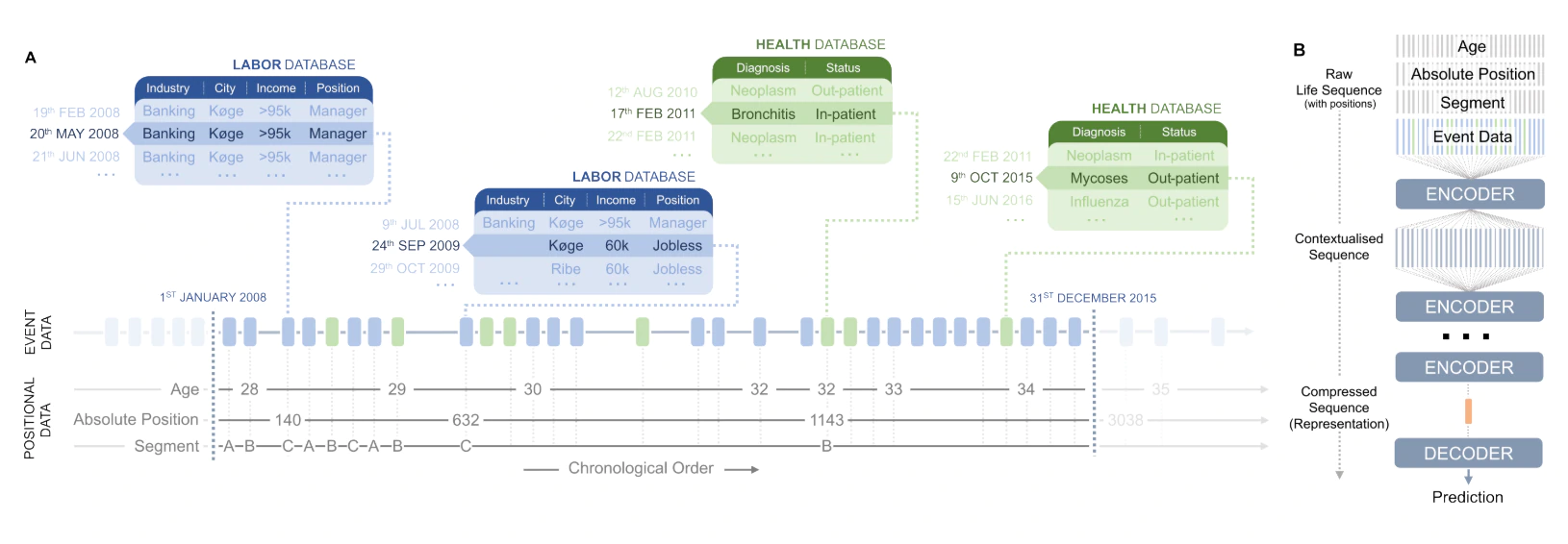
Life2vec was trained on information about people, gathered between 2008 and 2015, to make its predictions about whether they would likely live for at least four years beyond 1 January, 2016.
After that, the researchers then checked these predictions against the subjects' actual outcomes, which include some six million Danes, an ethnic group and nationality native to Denmark, between the ages of 35 and 65, recorded between 2016 and 2020.
To their surprise, the AI managed to guess their death with 78.8% accuracy.
The tool works by providing information to its users on when they will die based on a few questions.
It works based on OpenAI's ChatGPT AI, which asks users about their wealth, profession, residence and health history. The tool then uses trained deep learning models and vast data sets to "examine the evolution and predictability of human lives," the company states on its website.
Professor Sune Lehmann, the study’s lead author highlights AI’s ability to forecast financial success and health consequences.
"We use the fact that in a certain sense, human lives share a similarity with language," explained Sune Lehmann, the lead author of the study published in December 2023.
"Due to their structural similarity to written language, transformer-based architectures," Lehmann added in the team's preprint paper.
In fact, according to Lehmann, such tool can also be made to predict fertility or obesity, or that users could maybe predict who will get cancer or who doesn't get cancer, among other things.
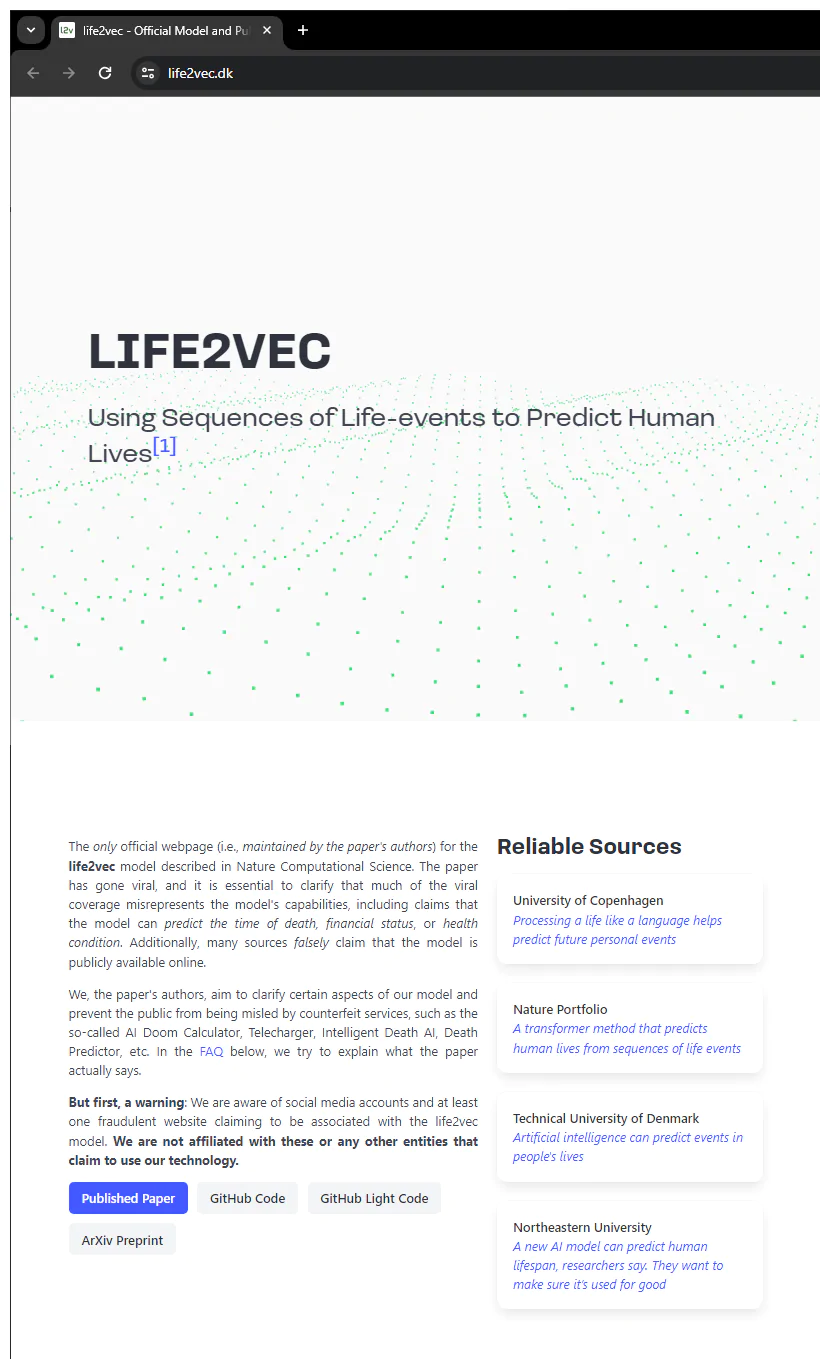
But because Life2vec quickly gained fame, it didn't take long until the financial and life expectancy prediction tool is being imitated by bogus websites.
The makers of Life2vec caution that users who are naive are likely to fall for these fake websites, which bear little resemblance to the genuine chatbot.
Many of these fake websites are known to provide information on whether the users will become rich or not apart from predicting their death age.
These fake websites target personal data, such as email addresses, phone numbers, and credit card information, and may potentially infect devices with malware.
The makers of this tool conducted deep research into this matter before arriving at various conclusions, and that they aren’t associated with any of these fake websites..

















































































































































































































































































