
Maria Eduarda Rodrigues de Freitas was only 21 years old when she lost her life in a tragedy that has left families, friends, and countless strangers reeling.
A bright and active young woman from Jandira in São Paulo state, she held degrees in physical education and sports management and often posted about her love for fitness, nature, and outdoor challenges. But then, a terrible mistake was proven fatal.
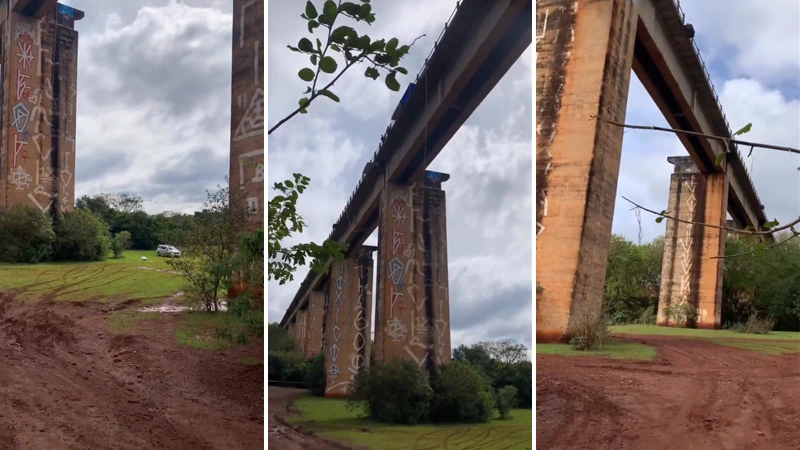
She lost her life during her daring jump at the Skeleton Bridge in Limeira, a city in the eastern part of the Brazilian state of São Paulo.
She thought it was going to be an exhilarating rope-jumping adventure.

Just hours earlier she had shared her excitement on social media, posting photos of the old bridge, the colorful wristbands issued for the activity, and a banner from one of the operating companies.
But nothing made her prepare to what was waiting for her that day: a 40-meter plunge to her death.
Bystanders shouted, but the staff chillingly responded with nothing.

The Ponte do Esqueleto is an abandoned structure that has become a popular, if unregulated, spot for extreme adventure tourism in the interior of São Paulo.
Operators set up rope-jumping sessions from its high platforms, offering participants the chance to experience a dramatic pendulum swing after being released from roughly 40 meters above the ground. The activity is often performed in a Superman-style pose, with instructors physically carrying or guiding the jumper to the edge before letting go.
On that fateful morning the jump was supposed to be a controlled thrill.
Instead it turned into a fatal fall because one of the most basic safety steps was completely missed.
It happened on the the morning of Saturday, June 13, 2026.
Maria traveled to Limeira to visit the Ponte do Esqueleto, better known as the Skeleton Bridge. In one of her story posted on Instagram, timestamped around 7:31 a.m., she wrote a playful caption wondering who the "crazy person" was who had let her come jump off a bridge.
Three staff members from the companies running the event, identified in reports as Luis Felipe Feliciano Egoroff (leader of the informal group/"empresa" (Entre Cordas / Ih Voei), described as the 32-year-old civil volunteer firefighter, Vitor de Freitas Gonçalves, and Maicon Fernandes Cintra. These are the three people who appear in the videos.
These three men, failed to attach the safety rope that should have been secured to her harness. In the videos that have since went viral, the rope remained coiled on the platform floor, completely unused.
She dropped straight down without any rope to catch or slow her descent.
Almost the moment she launched from the platform in a Superman-style dive, several bystanders realized something had gone terribly wrong. Their frantic shouts and desperate warnings can be heard clearly in multiple recordings as they tried to alert the staff to the catastrophic mistake. But by then, it was already too late. She was already in freefall, and there was nothing anyone could do to stop what was about to happen.
Maria Eduarda fell the full distance, and her body absorbed the whole impact of the fall.
Firefighters and SAMU emergency medical teams arrived quickly, yet there was nothing they could do.
Maria died on the spot.
Her fiancé, who had come with her for the day, was overcome and collapsed in shock as the reality of what had happened sank in.
The response from those responsible for her safety has struck many observers as chilling in its casual detachment.
When police questioned the staff members directly involved in preparing her for the jump, they reportedly stated that they could not remember what had gone wrong in the moments before she was released. They could not say who was supposed to have attached the rope or why no one had performed even a basic visual check.
It's worth noting that Maria's jump was not the first jump of the day.
A number of other participants jumped, completed their swings, all without any incident or error. And this fact made the case harder to understand.
Some of the workers attempted to leave the area right after the tragedy, fleeing into nearby woods. They were later located and detained with assistance from a police helicopter.
In total six people connected to the rope-jump operation were taken into custody.
Several remain under investigation and face charges that include forms of negligent manslaughter as the Civil Police continue their inquiry through the 2nd Police District of Limeira.
Public reaction has been swift and intense.
Videos of the incident circulated widely on social media platforms, prompting waves of shock, grief, and anger. Viewers expressed disbelief that multiple instructors and onlookers could miss something so fundamental, especially when the rope was plainly visible on the ground in the footage. Some questioned why people who noticed the problem shouted only after she had already fallen instead of stopping the jump in time.
Others pointed out the disturbing sight of bystanders filming rather than intervening.
Calls for justice have been loud, with many demanding that those responsible face the full consequences of what happened. The companies involved have not issued any public statements as the investigation proceeds.
Local officials in Limeira have used the tragedy to highlight long-standing safety concerns at the Skeleton Bridge. City Hall announced plans to sue the federal government, arguing that responsibility for inspection, maintenance, and access control at the site rests with federal authorities. They stated that repeated requests for improved safety measures had gone unanswered.
The mayor described the loss as the direct result of federal omission and said the tragedy should prompt a serious examination of risks at the location.
In adventure rope activities, the first rule is simple: no one jumps without a complete system check. Adventure tourism standards, such as ABNT NBR ISO 21101, address the need for safety management, risk identification, and the implementation of processes to reduce accidents. But responding to this case, the lawyers for some of the detained staff have noted that rope jumping is not formally regulated in the area, though it is also not prohibited, and that participants had been enjoying the activity for years without previous accidents.
Around one hundred people reportedly attended the event that day.
Maria Eduarda's story has become a painful reminder of how quickly excitement can turn to devastation when basic safety protocols are neglected.
She was a young woman with her whole life ahead of her, someone who had worked hard for her education and who found joy in movement and adventure. Her final social media posts captured that spirit of anticipation. Now her family and loved ones are left to grieve an unimaginable loss while investigators work to establish exactly how the critical error occurred and who bears responsibility.
The footage continues to circulate, forcing difficult conversations about trust in adventure operators, the need for stricter oversight of informal extreme sports, and the human cost when those safeguards fail.
As the days pass and more details emerge from the official inquiry, one truth stands out clearly: a single overlooked connection, a moment of inattention during what should have been a routine check, cost a vibrant 21-year-old her life.
The chillingly casual explanations offered afterward have only deepened the sense of preventable tragedy.
Her memory and the questions raised by her death will linger long after the immediate headlines fade. For everyone who has followed the story, the hope is that real change will come from this loss so that no other family has to endure the same heartbreak.