The higher a person's rank, the greater the weight they must carry. With authority comes a mountain of responsibility, and with every decision, the stakes rise. Mistakes can ripple across a nation; success can carve a name into history. Power is not just a privilege—it is a constant balancing act between duty and risk.
When someone rises to the office of president, they are no longer just an individual. They become a symbol of leadership, hope, and national direction. Every word they speak is amplified. Every choice they make shapes the destiny of millions. The pressure is immense, and the expectations are relentless.
Yet with such a role comes a rare opportunity: the chance to be remembered. To steer a country through crisis. To be the voice in times of uncertainty. To earn not just recognition, but legacy. For those brave enough to embrace the burden, the presidency is not just a job—it is the summit of public service, where triumph and turmoil walk hand in hand.
And U.S. President Donald Trump is playing his cards well.
And he wants a piece of the Nobel Prize recognition.
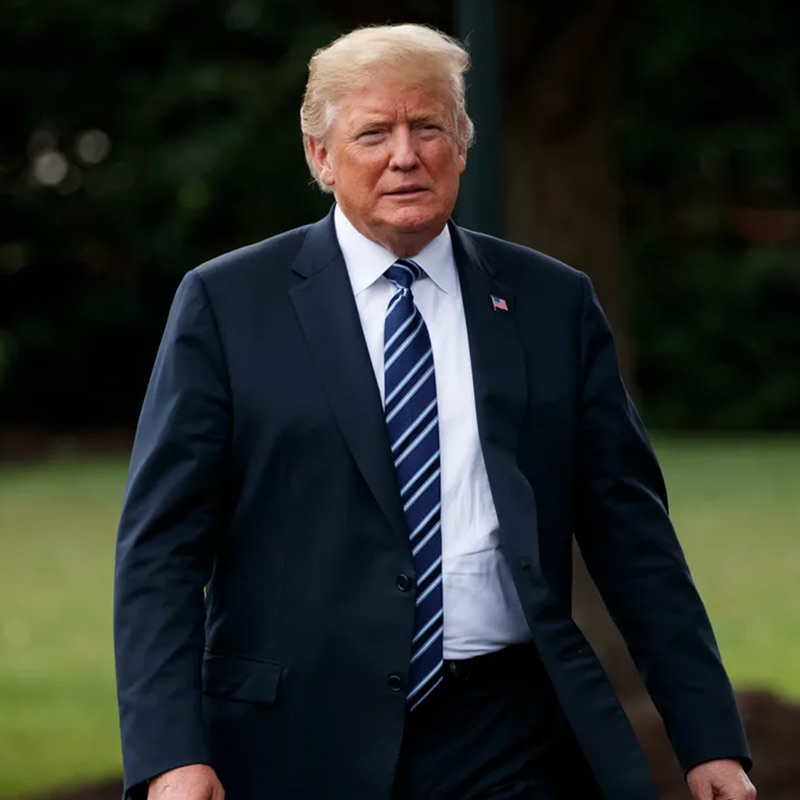
When Trump took office in 2017, he came in as a businessman with no prior political or military background—something that, for many, was either deeply refreshing or gravely concerning. His presidency became a test of conventional norms, reshaping political rhetoric into an unfiltered, often unpredictable chapter in American leadership.
From day one, Trump faced intense risk and pressure.
Critics accused him of sowing division, while supporters hailed him as a fearless disruptor. He defied traditional political playbooks, operating through instinct, gut decisions, and a direct connection to his base.
Whether navigating economic policies, foreign diplomacy, or the COVID-19 pandemic, Trump bore the immense weight of his office under a magnifying glass far brighter than most predecessors faced.
Regarding wars, Trump did not initiate new military conflicts like Harry Truman, Lyndon Johnson, Richard Nixon, George H. W. Bush, Bill Clinton, George W. Bush, or Barack Obama—who all engaged in military actions through Congressional Authorizations for Use of Military Force (AUMF) or executive decisions.
However, his tenure was marked by aggressive escalation of existing conflicts, making him one of the most war-active presidents, even without starting fresh combat.
And this is where Trump places himself as a peacemaker.
Government of Pakistan Recommends President Donald J. Trump for 2026 Nobel Peace Prize
The Government of Pakistan has decided to formally recommend President Donald J. Trump for the 2026 Nobel Peace Prize, in recognition of his decisive diplomatic intervention and pivotal…— Government of Pakistan (@GovtofPakistan) June 20, 2025
In June 2025, Pakistan nominated former U.S. President Donald Trump for the Nobel Peace Prize, citing his role in mediating a ceasefire between India and Pakistan during a brief conflict in May.
Pakistan praised Trump's "decisive intervention" and "pivotal leadership" in de-escalating the situation.
"President Trump demonstrated great strategic foresight and stellar statesmanship through robust diplomatic engagement with both Islamabad and New Delhi, which de-escalated a rapidly deteriorating situation," Pakistan said in a statement. "This intervention stands as a testament to his role as a genuine peacemaker."
This came shortly after Pakistan's army chief, Field Marshal Asim Munir, met Trump for lunch at the White House — marking the first time a Pakistani military leader had been invited while a civilian government was in power in Islamabad.
However, India disputed this claim, stating that the ceasefire was a bilateral agreement between the two countries and that no third-party mediation occurred.
India’s foreign secretary, Vikram Misri, stated that in a 35-minute phone call with Trump, Prime Minister Narendra Modi made it "absolutely clear" that hostilities ceased only after Pakistan requested a ceasefire, with no third-party mediation involved.
India has continuously denied any U.S. role in curbing tensions triggered by Operation Sindoor — launched in response to the Pahalgam terror attack on April 22.
Despite the nomination, Trump also expressed skepticism about receiving the award.
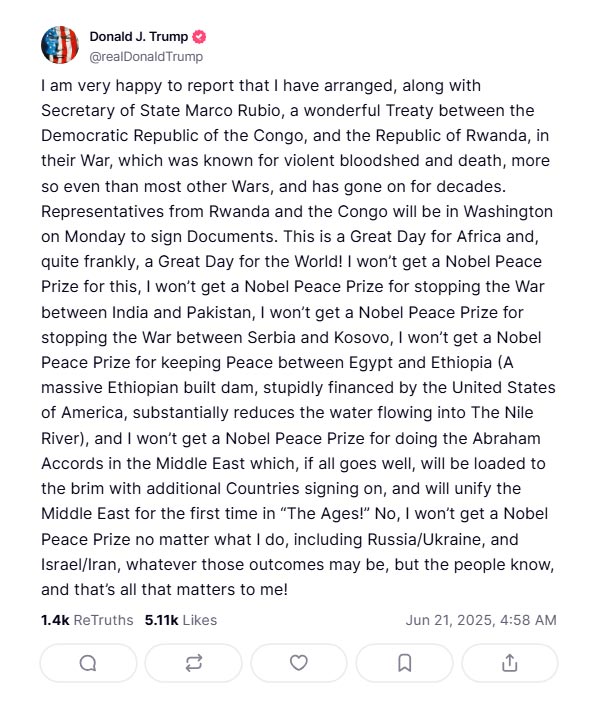
In a social media post on his platform Truth Social, Trump gave a long list of conflicts he said he had resolved, including India and Pakistan and the Abraham accords in his first term between Israel and some Muslim-majority countries.
"No, I won’t get a Nobel Peace Prize no matter what I do, including Russia/Ukraine, and Israel/Iran, whatever those outcomes may be, but the people know, and that’s all that matters to me!" he said.
Trump, however, continued to claim credit for the ceasefire.
"Well, I stopped the war between Pakistan - I love Pakistan - I think Modi is a fantastic man, I spoke to him last night. We are going to make a trade deal with Modi of India... And I stopped the war between Pakistan and India. This man (possibly referring to Asim Munir) was extremely influential in stopping it from the Pakistani side, Modi from the India side, and others. And they were going at it, they are both nuclear countries. I got it stopped," he said.
Complaining that the press had failed to take note of this, he said: "I don't think I had one story written, did I have one story written? I stopped a war between two major nations, major nuclear nations. I did not have a story written about it, but that's okay. You know why, the people know."
Regardless, this "nomination" adds to Trump's complex legacy as an America First-doctrine "peace broker."
In 2020, he brokered the Doha Agreement with the Taliban, setting a timeline for the complete withdrawal of U.S. forces from Afghanistan by May 2021. In exchange, the Taliban committed to preventing terrorist groups from using Afghan soil to threaten the U.S. and its allies. However, the exclusion of the Afghan government from the negotiations and the subsequent rapid collapse of the Afghan military led to the Taliban's return to power in August 2021, raising questions about the agreement's effectiveness and the execution of the withdrawal.
Under Trump's direction, U.S. forces intensified the campaign against ISIS in Iraq and Syria, leading to the fall of ISIS's last urban strongholds—Mosul and Raqqa—by December 2017, effectively dismantling its territorial "caliphate." While the group continues to exist as an insurgency, Trump's efforts accelerated its collapse and removed a major global threat.
Arguably Trump's signature diplomatic accomplishment, the Abraham Accords in 2020 normalized relations between Israel and several Arab countries (UAE, Bahrain, Sudan, Morocco). The accords broke a decades-long diplomatic impasse, spurring economic and technological cooperation and creating new regional ties. Still, they drew criticism for excluding Palestinians and failing to resolve core conflicts.
In early 2025, Trump leveraged the Gaza ceasefire—an agreement to halt hostilities and exchange hostages between Israel and Hamas—to build broader Arab–Israeli normalization. He also proposed unconventional plans, including relocating Gaza's population and redeveloping the territory under U.S. oversight, sparking mixed reactions across regional players.
Trump authorized several high-impact military operations: the 2017 missile strike on a Syrian airbase after chemical weapon use; the 2019 killing of ISIS leader Abu Bakr al-Baghdadi; and the 2020 strike that killed Iran's Quds Force General Qasem Soleimani. These operations, while not full-scale wars, disrupted hostile actors and underscored a more confrontational U.S. posture.
Trump's tenure as a peace broker is marked by significant achievements and controversies. His efforts in Afghanistan, the defeat of ISIS, the Abraham Accords, and the Gaza ceasefire negotiations demonstrate a complex and multifaceted approach to international diplomacy. While his actions have led to tangible outcomes, they have also sparked debates about their long-term effectiveness and the ethical implications of his strategies.
As the world reflects on Trump's legacy, it is clear that Trump is making himself seen globally by getting involved when others are in crisis or conflicts.
While the Pakistani government praised Trump for his role, the Nobel Peace Prize nomination was far from universally celebrated, even within Pakistan.
Critics pointed to his unwavering support for Israel, including his consideration of involving the U.S. in its conflict with Iran. Despite ongoing airstrikes in Gaza that killed thousands of civilians, Trump remained noticeably silent and refrained from intervening.
Pakistan is clearly closer to Iran than Israel, supporting its sovereignty and forging deeper strategic ties—but stops short of formal military alliances. Concurrently, it firmly opposes Israel’s actions in Gaza and Iran, supports Palestinian rights, and keeps diplomatic distance from Israel.
It's also notable that Trump made his remarks about being overlooked for the Nobel Prize while taking credit for a peace deal negotiated in Washington between the Democratic Republic of Congo and Rwanda.
"This is a Great Day for Africa and quite Frankly, a Great Day for the World. I won't get a Nobel Peace Prize for this..," he said in a post on Truth Social.
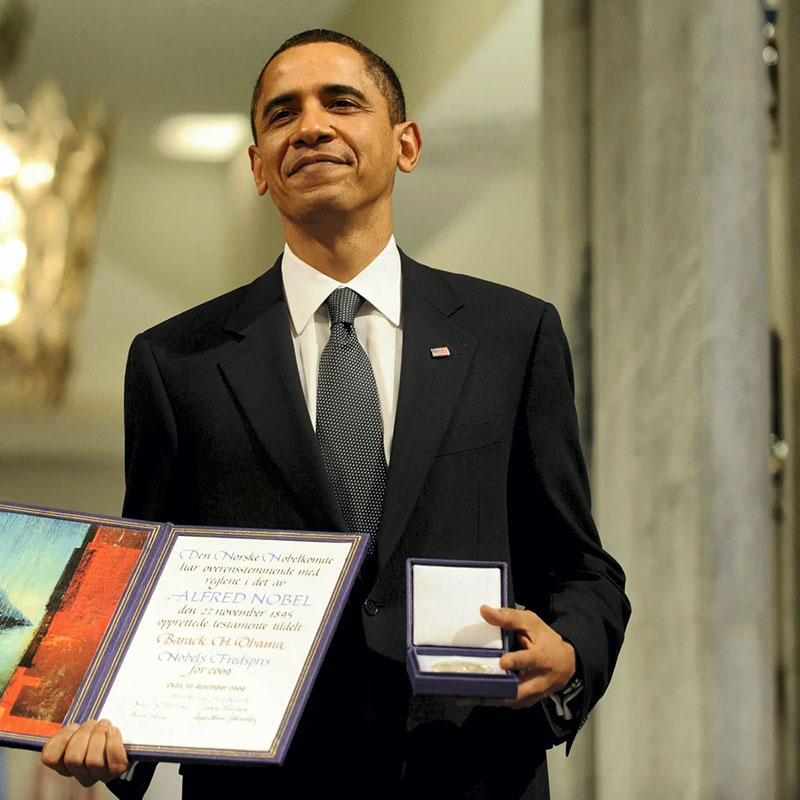
In the past, Trump has frequently criticized President Barack Obama for winning a Nobel Peace Prize in 2009 after less than eight months as U.S. president.
For example, in 2013, Trump called on the Norwegian Nobel Committee to rescind the award.
In just days after this, Trump announced that the U.S. has entered the Iran-Israel war by dropping bombs on Iranian nuclear facilities in Fordow, Natanz and Esfahan.
President Trump’s full address to the nation from The White House following the U.S. military strikes Iran. pic.twitter.com/6ghmPfXvmI
— America (@america) June 22, 2025














































































































































































































































































