
DuckDuckGo is a privacy-focused search engine that unlike Google, it doesn't want to bother profiling its users for monetization.
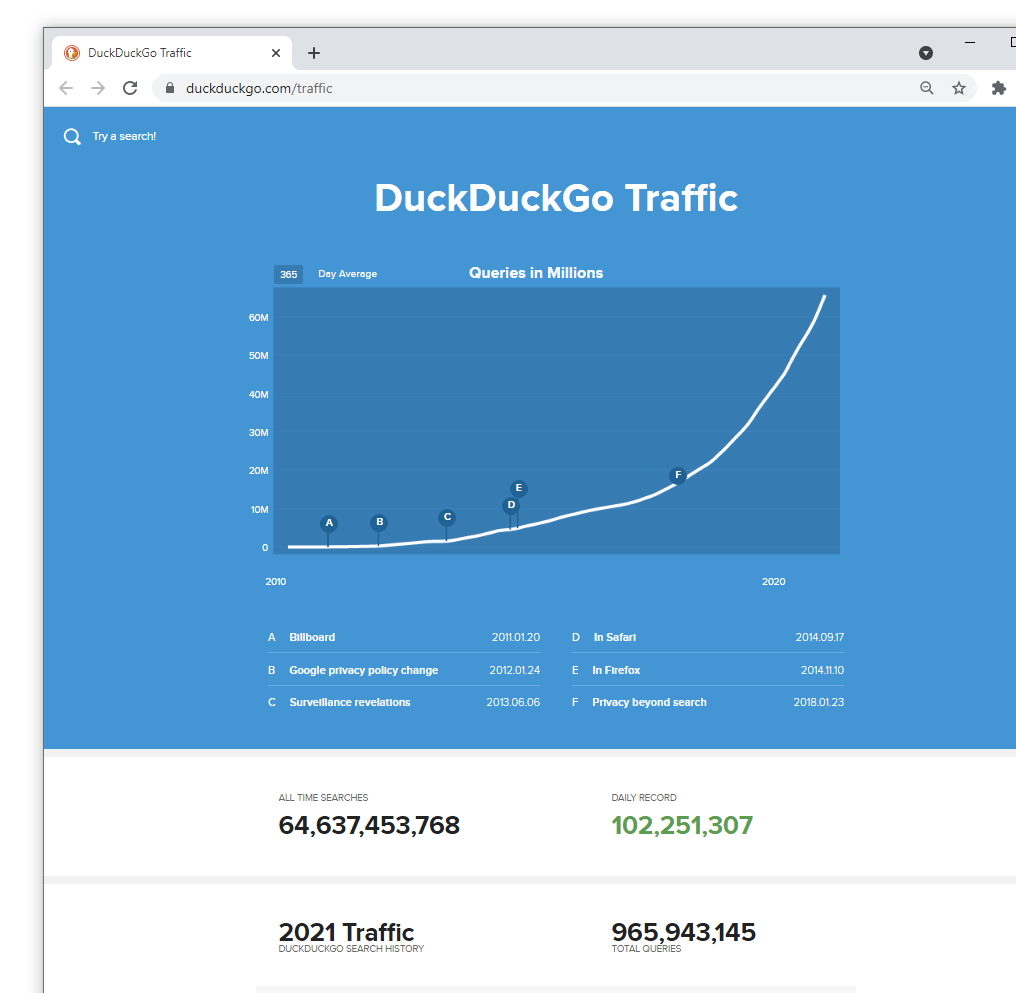
On January 11, the search engine founded by Gabriel Weinberg served 102,251,307 search queries, breaking past the 100 million query milestone for the first time, according to the search engine’s traffic page.
While DuckDuckGo is getting increasingly popular, no search engine can directly compete heads on with Google. Even combined, DuckDuckGo and other search engines won't pose a serious challenger to Google.
As a very niche search engine, as of December 2020, DuckDuckGo controlled 2.3% of the U.S. market share. This is followed by Yahoo! at 3.05%, Bing, at 6.45%, and Google as the largest with 87.81%.
While Google has not made its search volume data publicly available, but according to HubSpot and Kenshoo, Google serves over 5 billion searches per day.
DuckDuckGo will reach 1 billion searches per day by 2027, if it maintains a predicted level of growth.
But there is this thing in the search engine industry, that does not necessarily require competitors of Google to serve a billion or more users per day to succeed.
In DuckDuckGo's case, its ability to create a niche for itself among privacy-minded internet users may serve as a playbook for other businesses. The search engine has also been included as an option on numerous web browsers.
And during this 'COVID-19' coronavirus pandemic, where the pressure over consumer privacy has prompted Apple and Google to block third-party cookies from tracking users across the web, DuckDuckGo that doesn't track its users gained an increased trust from users.
DuckDuckGo's success is modest, and is still lagging behind many of is competitors.
But still, DuckDuckGo's achievement may provide new or existing search engines with a roadmap to eat away more of Google’s dominance, or avoiding the competition altogether by concentrating on only the underserved user base.