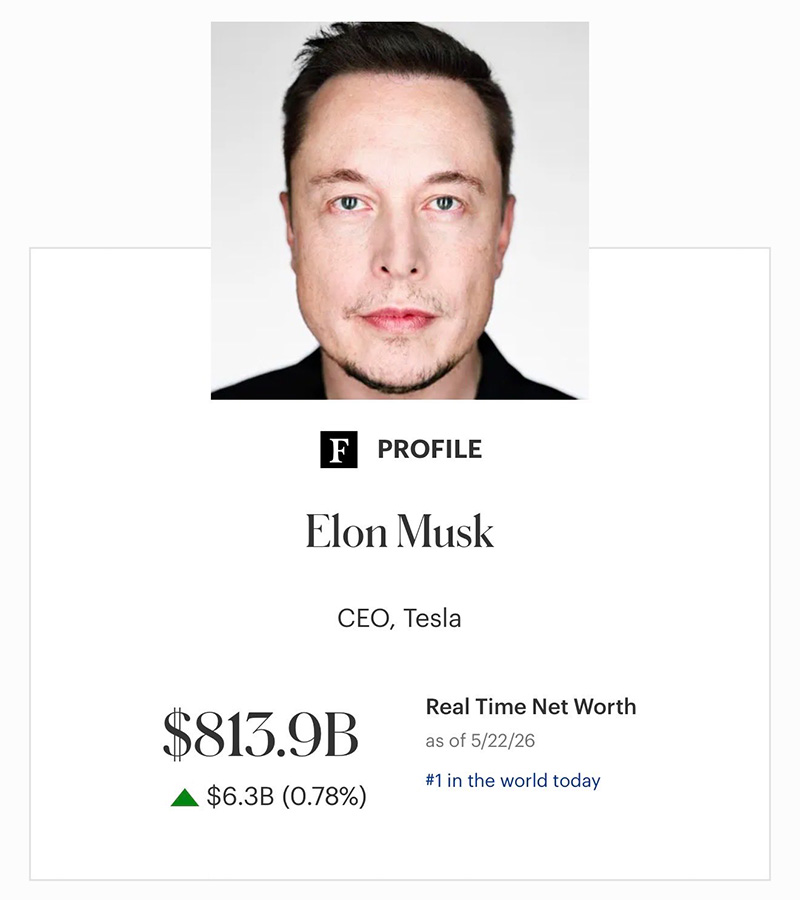
Elon Musk's fortune has surged past the $810 billion mark, according to recent estimates from Forbes, further cementing his position as the richest person in modern history.
The staggering rise has been fueled largely by the soaring valuations of companies tied to Musk, particularly Tesla, SpaceX, and xAI, as investors continue betting heavily on electric vehicles, private spaceflight, artificial intelligence, and robotics.
The scale of Musk's wealth now places him in a category that barely resembles traditional billionaire rankings.
His estimated net worth sits hundreds of billions above the world's second richest individuals, with figures such as Larry Page, Sergey Brin, and Jeff Bezos trailing far behind. In other words, Musk's net worth is so far above others that his wealth could make centibillionaires look poor.
The gap highlights how dominant Musk's business empire has become across multiple industries at once, from automotive manufacturing and satellite internet to AI infrastructure and reusable rockets.
Musk's rise did not happen overnight.
Born in South Africa in 1971, he first gained major attention during the dot-com era after co-founding Zip2 and later X.com, which eventually became PayPal. After selling PayPal to eBay in 2002, Musk reinvested much of his fortune into ambitious ventures that many considered unrealistic at the time. Tesla was dismissed by critics who doubted electric vehicles could replace gasoline cars, while SpaceX faced repeated rocket failures before becoming the first private company to reliably transport astronauts and cargo into orbit.
Today, those once risky ventures form the backbone of one of the largest personal fortunes ever recorded.
To put the numbers into perspective, Musk could theoretically purchase every residential property in high value regions such as San Diego County or large portions of Hawaii without exhausting his wealth.
He could buy major luxury automakers many times over, fund massive infrastructure programs comparable to government budgets, or acquire entire industries outright. His fortune also exceeds the annual gross domestic product of most countries on Earth, illustrating just how concentrated modern technological wealth has become.
In fact, he could theoritically buy entire regions of America, or even buy his own country.
Still, much of Musk's net worth exists on paper rather than in cash.
The overwhelming majority is tied to ownership stakes in companies whose valuations can rise or fall dramatically. Selling large portions of those shares would not only reduce his control over the companies but could also impact market prices significantly. That distinction has become central to debates surrounding billionaire wealth, taxation, and economic inequality.
Everything SpaceX And Tesla Say Elon Musk Must Do—Mars Colony, Robots, More—For More Billionshttps://t.co/cjDrA0ul2K pic.twitter.com/7Eyh9WPXXE
— Forbes (@Forbes) May 22, 2026
Online reactions to Musk's new milestone have ranged from admiration to criticism.
Supporters praise his role in accelerating electric transportation, expanding access to space technology, and pushing AI development forward at an unprecedented pace. Critics argue that no individual should command resources larger than the economies of entire nations, pointing to widening wealth inequality and the growing influence of tech billionaires over society and politics.
Social media users have also turned the moment into a flood of memes and mathematical thought experiments.
One of the most widely shared examples involves dividing Musk's wealth among the global population. With the world population now approaching 8.3 billion people, giving every person $100 would cost roughly $830 billion, effectively consuming nearly all of his estimated net worth. Even smaller amounts distributed globally would still total astonishing sums, offering a striking reminder of how enormous these figures really are.
Whether viewed as a symbol of innovation or a warning sign of extreme wealth concentration, Musk's financial ascent continues to captivate the public.
His fortune represents not just personal success, but the immense power and value now concentrated in the worlds of technology, artificial intelligence, and space exploration.
My “net worth” will just track SpaceX+Tesla market cap, so will be whatever that is as a percentage of GDP
— Elon Musk (@elonmusk) March 14, 2026






















































































































































































































































































