Computers don't breathe, meaning that they don't need oxygen to operate and function.
And if heat is a consideration, since all computers generate heat and need to be cooled, the Moon can be pretty cold.
This time, a groundbreaking startup company announced that is working to deploy small data centers on the surface of the Moon, in order to save "Earth's data one byte a time."
Lonestar Data Holdings Inc. announced that it has successfully closed its $5 million seed funding, led by Scout Ventures and joined by Seldor Capital, 2 Future Holding, The Veteran Fund, Irongate Capital, Atypical Ventures, and KittyHawk Ventures.
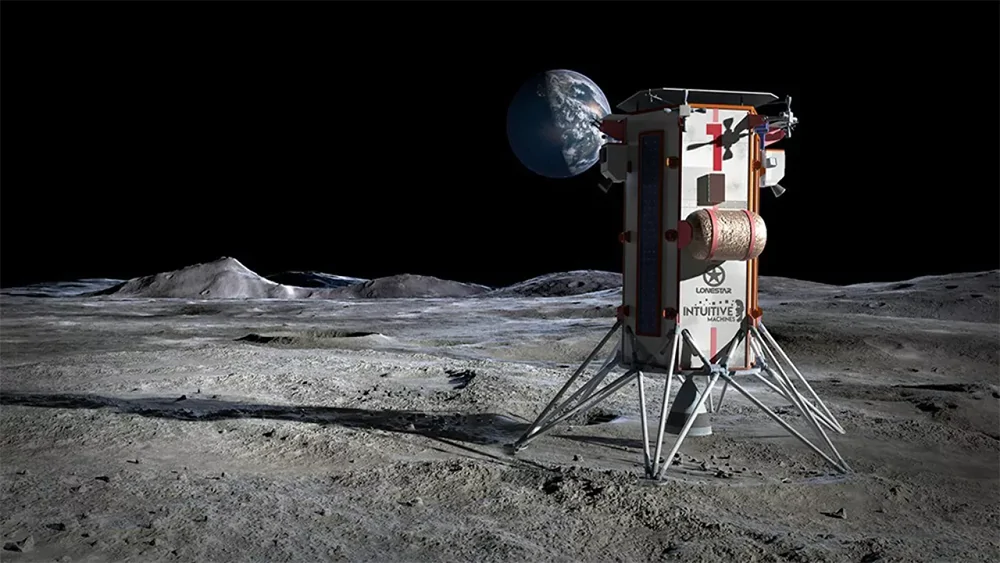
With the goal of pioneering "a future for data at the edge," the company plans to use the cash to bring a series of data centers to the Moon through multiple launches, in order to revolutionize premium mission critical data services and communications from the Earth's largest satellite.
According to Christopher Stott, CEO of Lonestar:
"We are dependent upon it for nearly everything we do and it is too important to us as a species to store in Earth’s ever more fragile biosphere. Earth’s largest satellite, our Moon, represents the ideal place to safely store our future."
"We are thrilled to have completed this successful seed round and are sincerely grateful for the support and vision of our investors."
"The $5 million is financing our first two missions this year [...] The hardware is complete and awaiting launch."
The data centers in question, not only act a way to ease communication to and from the Moon, but also as an edge processing and data storage.
By bringing processing and storage abilities closer to the source, the plan is to reduce latency and improve bandwidth on the lunar surface.
On top of that, it also offers ways for disaster recover backup services.
In short, Lonestar wants to pioneer a Moon-based data storage and processing to commercial, government and academic lunar missions.
Initial deployments include a server and storage module the size of a book, powered by solar energy.
This miniature data center weighs about 1 kilogram, and has a capacity of 16 terabytes.
The hardware itself is built by space logistics firm Skycorp, and contains multi-core RISC-V processors.
Following this, would be launching a series of larger data centers with more capacity.

According to Brad Harrison, Scout Ventures founder and managing partner:
The St. Petersburg, Florida-based Lonestar is not focused on lunar exploration. And because of that, the startup would not have been able to close its business case without the Artemis and CLPS programs, Stott said.
"NASA has created an incredible marketplace for access to earth’s largest satellite," he added.
NASA is providing funding through the Commercial Lunar Payload Services (CLPS) program for Intuitive Machines, Astrobotic, Draper and Firefly Aerospace to deliver payloads to the moon. CLPS is part of the space agency’s Artemis lunar exploration program.
According to reports, Lonestar initiates its mission through Intuitive Machines’ second lunar mission, the IM-2.
Intuitive Machines’ first lunar mission is scheduled to launch in June on a SpaceX Falcon 9 rocket, whereas the IM-2 is slated to follow later this 2023.

Data centers are essentially buildings or inclosed spaces that are used to house a specialized computer systems and their associated components, such as telecommunications and storage systems.
In the modern era of tech and internet, data centers have become increasingly crucial for business and IT continuity.
The thing about data centers is the way it consumes power.
In order to power many of its components, which include, and not limited to: backup components and infrastructure for power supply, data communication connections, environmental controls, and various security devices, a large data center with an industrial-scale operation can consume as much electricity as a small town.
By building data centers on the Moon, humanity could alleviate this problem, in addition to provide a more secure way to store the data.
Back in December 2021, Lonestar successfully ran a test of its data center on board the International Space Station (ISS).
"The moon is a fantastic platform for this," Stott said. "There is no climate, no climate change and access to renewable energy. You can build out amazing equipment up there."






















































































































































































































































































