
Hristo Bogdanov Georgiev is known as "The Sadist" and a rapist.
Born in 1956, he has murdered five people, mainly women, between 1974 and 1980. He was then executed by a firing squad.
"Hristo Georgiev" on the other hand, is totally a different person.
While they share the same name, Hristo Bogdanov Georgiev is known as a killer, and Hristo Georgiev is an engineer based in Zürich, Switzerland.
Apparently, Google was confused.
Seems like Google falsely associated a photo of mine with a Wikipedia article of a serial killer. I don't know if this is hilarious or terrifying. pic.twitter.com/rmAL7uQYy4
— Hristo Georgiev (@hggeorgievcom) June 24, 2021
The search engine's algorithm mistakenly put his photo, and linked him to the notorious murderer Hristo Bogdanov Georgiev's Wikipedia article.
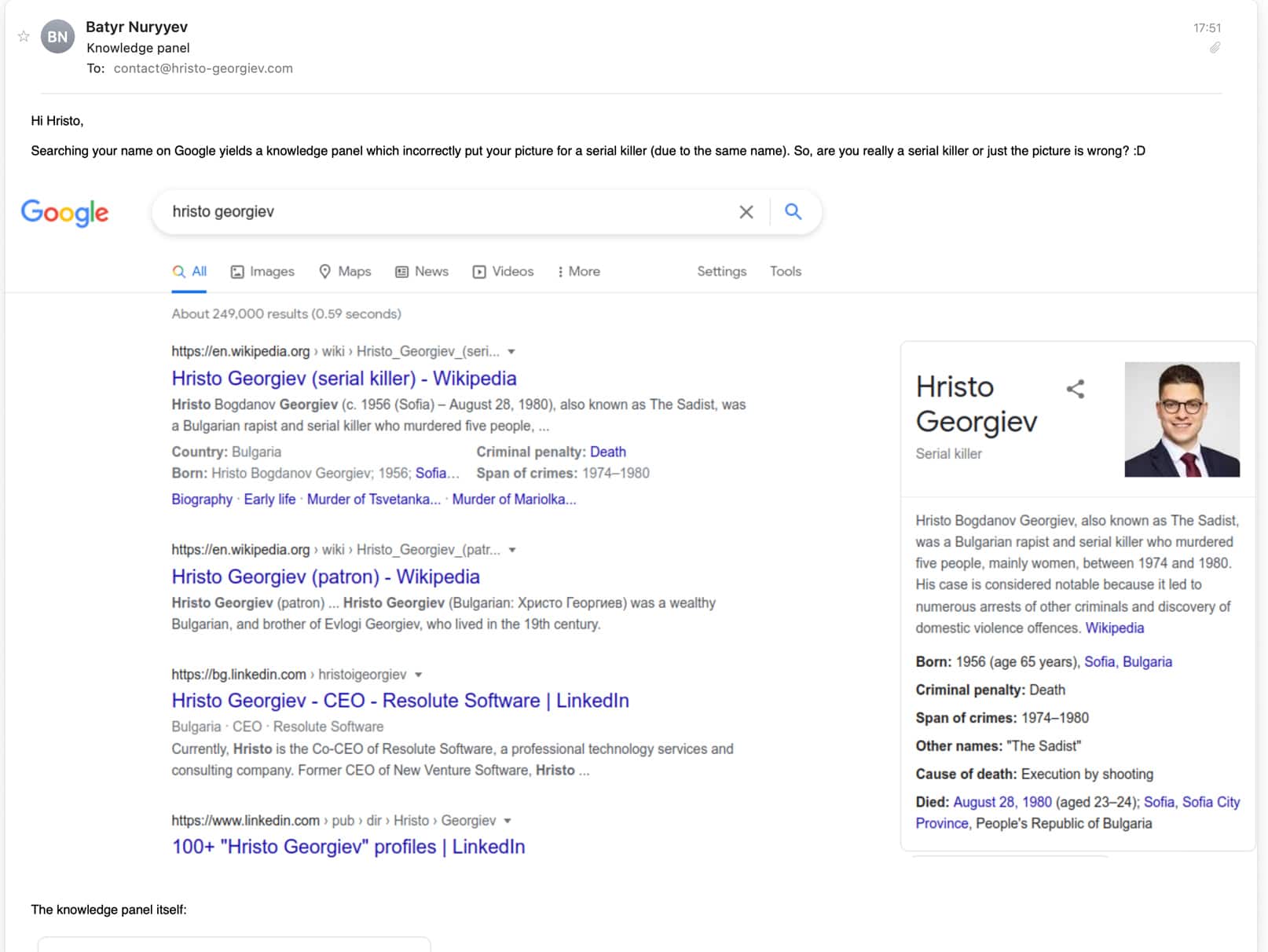
Hristo Georgiev realized this when he was informed by his former colleague in an email.
The person informed Hristo Georgiev that a Google Search of his name returns a picture of him, linked to a serial killer who happens to have the same name.
"I quickly popped out my browser, opened Google and typed in my name. And indeed, my photo appeared over a description of a Bulgarian serial killer," said Georgiev in a blog post.
“My first reaction was that somebody was trying to pull off some sort of an elaborate prank on me, but after opening the Wikipedia article itself, it turned out that there’s no photo of me there whatsoever.”
But it turns out, it was Google mistake.
Google's algorithm that powers its Knowledge Graph somehow "falsely associated my photo with the Wikipedia article about the serial killer."
This is not very common, since his name isn't special or unique at all.
"There are literally hundreds of other people with my name, and despite of all that, my personal photo ended up being associated with a serial killer. I can't really explain to myself how this happened, but it's weird."
Google is the largest search engine in the world. And to many people around the world, the search engine is the source for them to find information.
And this, is an example of Google's hiccup that can mislead people into believing a misinformation.
"After sharing the news with some friends and getting a good laugh out of the whole situation, a short rumination on what had happened made me consider how this could have gone down a much darker path. Sure, after taking the time to read the Wikipedia article, one can easily figure out that I'm not a serial killer though one can never be so sure. However, the fact that an algorithm that's used by billions of people can so easily bend information in such ways is truly terrifying," the engineer added.
With fake news capable of spreading like wildfire, thanks to the internet, Google can make "literally everyone who's not anonymous vulnerable."
This is why the engineer suggested that "whoever has presence on the internet today has to look after their 'online representation.'"
This incident is a small mistake, but considering the size of Google and its reach, anything from a minor inconvenience can create a disaster that can decimate careers and reputations of people in the matter of days.
"Maybe letting a single internet company 'organize the world's information' probably isn't such a great idea. Some food for thought," said Hristo Georgiev, the engineer.
Read: How Google Search Works, And How It Can Show You The Things You Want