Just when the world thought the metaverse was fading, Mark Zuckerberg revealed what his company had been quietly working on all along.
Apple made waves with the introduction of its Vision Pro headset, aiming to redefine virtual and augmented reality under the term "spatial computing."
At the time of Vision Pro's launch, Meta's own metaverse ambitions and Quest headset sales had begun to slow. The buzz surrounding Apple's Vision Pro caught Meta's attention to a degree that the company seized the moment to reignite interest in its headsets.
Meta was riding the wave of excitement Apple had stirred, with Mark Zuckerberg even called Meta's inferior Quest 3 headset a "better" product.
Fast forward, the Meta founder and CEO, unveiled 'Orion,' a device that, in many ways, leaves Apple's Vision Pro in its wake.
This is because unlike the Vision Pro, which is significantly high tech and sophisticated, and also heavy and bulky, Meta's Orion is literally a glasses.
They're also cheaper.
At Meta’s Menlo Park campus, during the 2024's Connect conference, where just about every product Meta has is on display, Zuckerberg introduced Orion as a smart wearable that Meta hopes people will on day wear.
When Meta introduced its Ray-Ban smart glasses, they weren't full-fledged AR glasses since they have no screen to display information. Despite having having powerful AI, the glasses are just glasses with sensors.
Orion on the other hand, is built different.
Zuckerberg described the Orion as the first-ever full holographic augmented reality glasses.
He said that the glasses are a result of a decade of research and development. The idea is to miniaturize all the computing needed for glasses to project full holograms into the world.
Meta took its time to quietly develop Orion due to the technical challenges it faced.
Mixed reality headsets such as Meta Quest 3 and Apple Vision Pro rely on "passthrough" technology, in which they use external cameras to capture real-time video of users' surroundings. This information is then displayed inside the headset, with digital elements overlaid.
In contrast, Orion uses holographic projection that allows users to directly see through transparent lenses.
It's like Google Glass, but a lot more advanced.
Meta’s chief tech officer, Andrew Bosworth, said that: "In consumer electronics, it might be the most advanced thing that we’ve ever produced as a species."
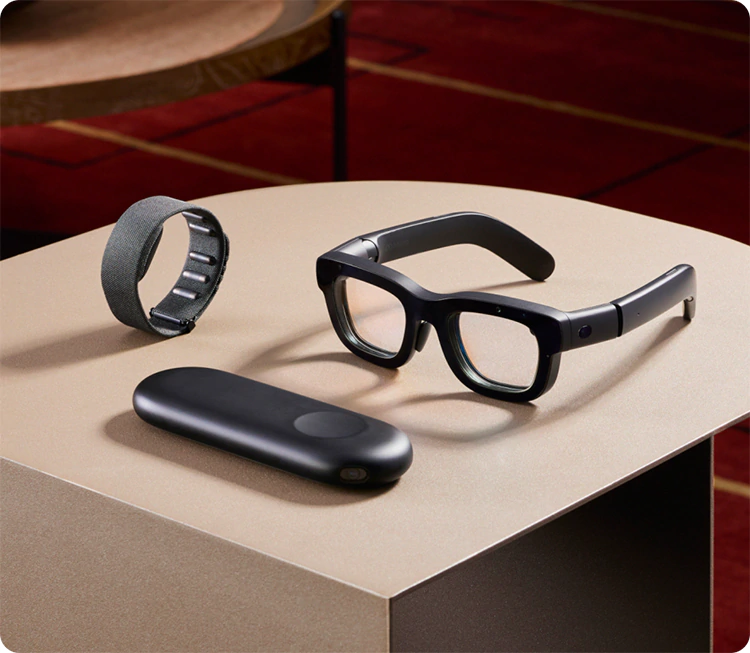
Orion comes with a neural interface wristband that "listens" to nerve impulses from the brain to the hand, allowing users to control the device using subtle finger gestures such as pinching and swiping thumb against index finger.
This is an improvement to mixed reality headsets such as Apple Vision Pro, which are controlled similarly, but rely on external cameras to interpret hand movements.
The advantage of tapping into nerve impulses directly is that gestures do not require line of sight, and eventually might not even require the person to perform the full gesture – only to think about it.
The technology also opens up brand new input methods, such as texting via mimicking handwriting.
Not to mention its field of view of 70° means that the innovation allows Orion to become an unobtrusive wearable device.
"That’s the north star our industry has been building towards: a product combining the convenience and immediacy of wearables with a large display, high-bandwidth input and contextualized AI in a form that people feel comfortable wearing in their daily lives,"
Meta added that Orion is unlike others because "it is unmistakably a pair of glasses in both look and feel – complete with transparent lenses."
" [...] you can still see other people’s eyes and expressions, so you can be present and share the experience with the people around you."

With Orion, users could, for example, read messages while watching a virtual screen on the wall, playing games, collaborative work - all the things you can do with mixed-reality headsets, but shrunk down to a pair of glasses. And since Meta owns a bunch of social media platforms and messaging apps, the company could make the device a portal where users can teleport friends into their living room, by creating a video call where the participants occupy the same space.

"So you can open up your refrigerator and ask for a recipe based on what’s inside. Or video call a friend while adjusting a digital family calendar as you wash the dishes," said Meta on a dedicated web page on its website.
"You can take a hands-free video call to catch up with friends and family in real time, and you can stay connected on WhatsApp and Messenger to view and send messages. No need to pull out your phone, unlock it, find the right app and let your friend know you’re running late for dinner – you can do it all through your glasses."
And with generative AI, Meta can make Orion a device that can see what users' see, hear what users hear, talk to them, answer questions and follow their commands.
Meta wants people to use this kind of wearable in the future, and make computers part of their eyes and ears.
Long story short, Meta’s Orion may be an underdog in terms of performance and features when compared to the Vision Pro, but the cheaper mixed-reality headset promises more real-world use cases.
Then, there is the fact that the glasses come in a variety of classic Ray-Ban styles, meaning that they're also fashionable.
What this means, Orion can be part of users' attire.
This is why the Orion introduction is considered by many as a Meta "iPhone moment."
The sleek augmented reality glasses showcase how the cutting-edge technology within could revolutionize the way people interact with the digital world. Mark Zuckerberg expressed his belief that Orion could become the next major computing platform.
"I think that the trend in computing is it gets more ubiquitous, it gets more natural, and it just gets more social right, so you want to be able to interact with people in the world around you, and I think that this is probably going to be the next major platform after phones," he stated.
Zuckerberg initially believed holographic technology would be necessary for smart glasses to offer functionality beyond the basic features of these Ray-Bans. But following the introduction of OpenAI's ChatGPT, Meta began realize how AI voice-powered assistant can make a smart glasses a lot smarter, and also a lot more useful.
Meta realized that smart glasses can be developed from the ground up as a new consumer product category.