
When common computers require data to be encoded into binary digits (bits), which is either 0 or 1, quantum computation uses quantum bits, or qubits for short, which can be in superpositions of states.
These qubits can be constructed in various ways, many of which involve super-cooled superconductors to take advantage of the quantum mechanics. As a result, a qubit can represent both 0 and 1 simultaneously. And, whereas the status of each conventional bit is independent of all the other bits in a computer, qubits influence one another.
In theory, this could make quantum computers solve a a problem in milliseconds that it would take a normal computers thousands of years to solve.
Microsoft is one of those companies that develop the technology, and that it's among those that pioneer the technology.

And this time, the company said in a blog post, that it is looking forward to compressing "250 years of chemistry and materials science progress into the next 25" after it claimed a breakthrough in physics that may form the basis of the supercomputer of the future.
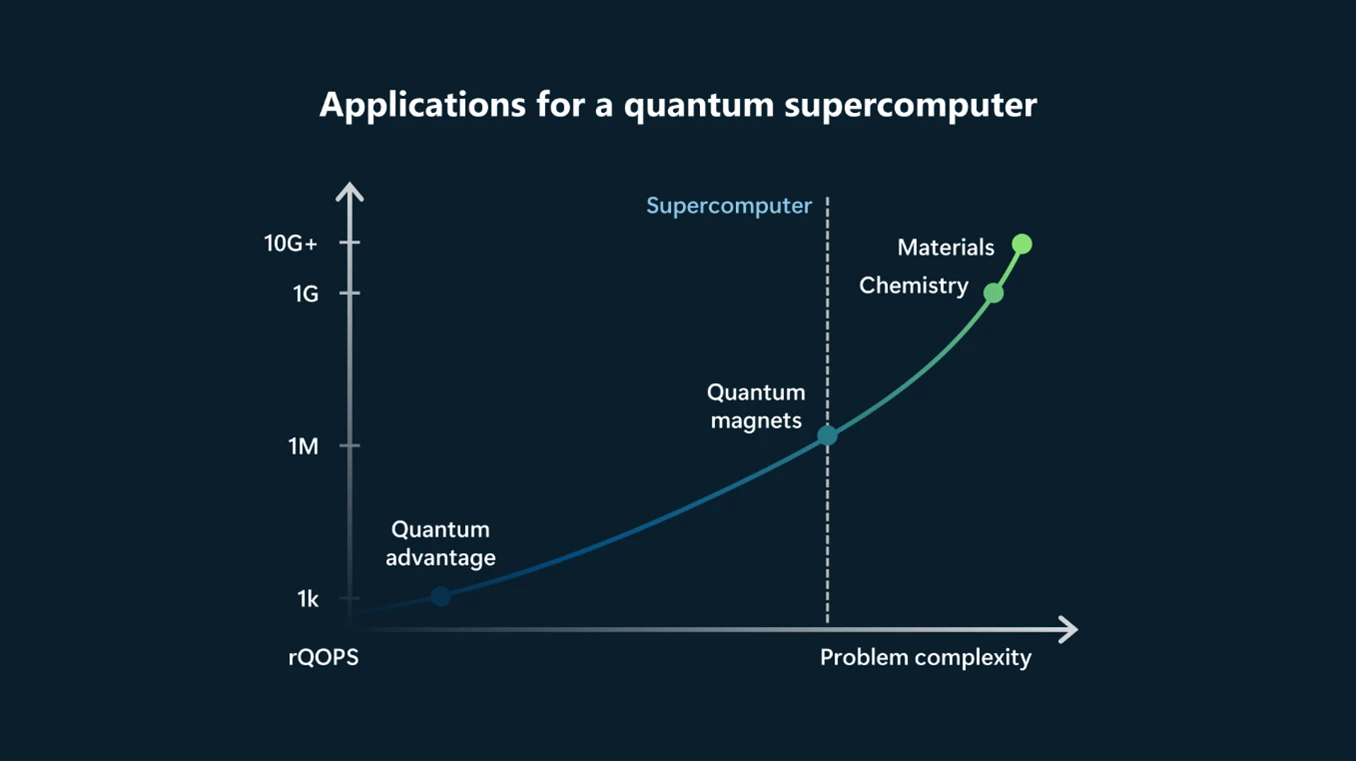
At this time, there is no measurement to really calculate the capacity of quantum computers, and because of that, Microsoft has proposed a new measure called reliable Quantum Operations Per Second (rQOPS).
Microsoft estimates that the first quantum supercomputer is required to deliver at least one million rQOPS with an error rate of 10-12, or one in every trillion operations, to be able to provide valuable inputs in solving scientific problems.
But since quantum computers at this time could only deliver an rQOPS value of zero, the industry as a whole has a long way to go.
Microsoft is trying to change this.
On its research, the so-called reliable "logical qubits" should be scalable, and capable of performing complex problems that need solving urgently.

Satya Nadella, CEO of Microsoft, said the company’s researchers had made a long sought-after discovery that would allow them to make more reliable qubits.
It was "just the beginning as we enter this new era," the executive said, as the company made the breakthrough as the first stage of a six-part plan to engineer a machine that can solve some of the world’s most complex problems.
Microsoft is has been setting its eye on the future of computing, unveiled its plans to build a quantum supercomputer in the next 10 years.
The company realizes that the noisy qubits have limitations, and that they're not error-free.
Microsoft refers to today's quantum computers as those belonging to the foundational level.
The software giant said that quantum computers need upgrades in the underlying technology they rely on, just like how early computers shifted from using vacuum tubes to transistors and then to integrated circuits before taking their more modern form.
Microsoft announced this after the company demonstrated the underlying science required to move away from the noisy physical qubits, to reliable logical qubits since the former cannot reliably run scaled applications.
To do this, the company suggests bundling hundreds to thousands of physical qubits into one logical qubit to increase redundancy and reduce error rates.
Since qubits are prone to interference from their environment, efforts must be made to increase their stability, which will aid in increasing their reliability.
It's worth noting that qubit Microsoft is mentioning is difficult to create.