Around 90 million kilometers away, separated by a vast dark space with much nothingness, NASA’s InSight Mars Lander is really far away from home.
It's mission began on May 5th, 2018, when it boarded an Atlas V-401 launch vehicle. It successfully landed at Elysium Planitia, a broad plain at the equator of Mars, on 26 November 2018. Since then, InSight, which stands for "Interior Exploration using Seismic Investigations, Geodesy and Heat Transport" began its mission to study the deep interior of the planet.
Four years later, on December 15th, 2022, the robot that was manufactured by Lockheed Martin Space Systems, transmitted its final image.
In the tweet announcing this, InSight said that its power is "really low."
"Thanks for staying with me."
My power’s really low, so this may be the last image I can send. Don’t worry about me though: my time here has been both productive and serene. If I can keep talking to my mission team, I will – but I’ll be signing off here soon. Thanks for staying with me. pic.twitter.com/wkYKww15kQ
— NASA InSight (@NASAInSight) December 19, 2022
The lander that was originally planned for launch in March 2016, uses both solar and Lithium-ion battery as its power sources.
In total, InSight consumed 600 watts under normal operations.
Earlier in 2022, NASA stated that due to excessive dust on InSight's solar panels, the lander was unable to recharge its battery properly.
InSight had a pair of 2-meters wide solar panels that could produce about 5,000 watt-hours per Martian day. But after dust accumulated, the panels were only producing about 500 watt-hours.
Because of this, NASA programmed InSight to initiate its low-power mode.
At that time, InSight's operations team at NASA also started preparing for the lander's end, by also shutting down devices that require the most power and ensuring that data it has collected over the past four years is preserved.
InSight then continued to operate, and remained operational until it couldn't due to its depleted energy.
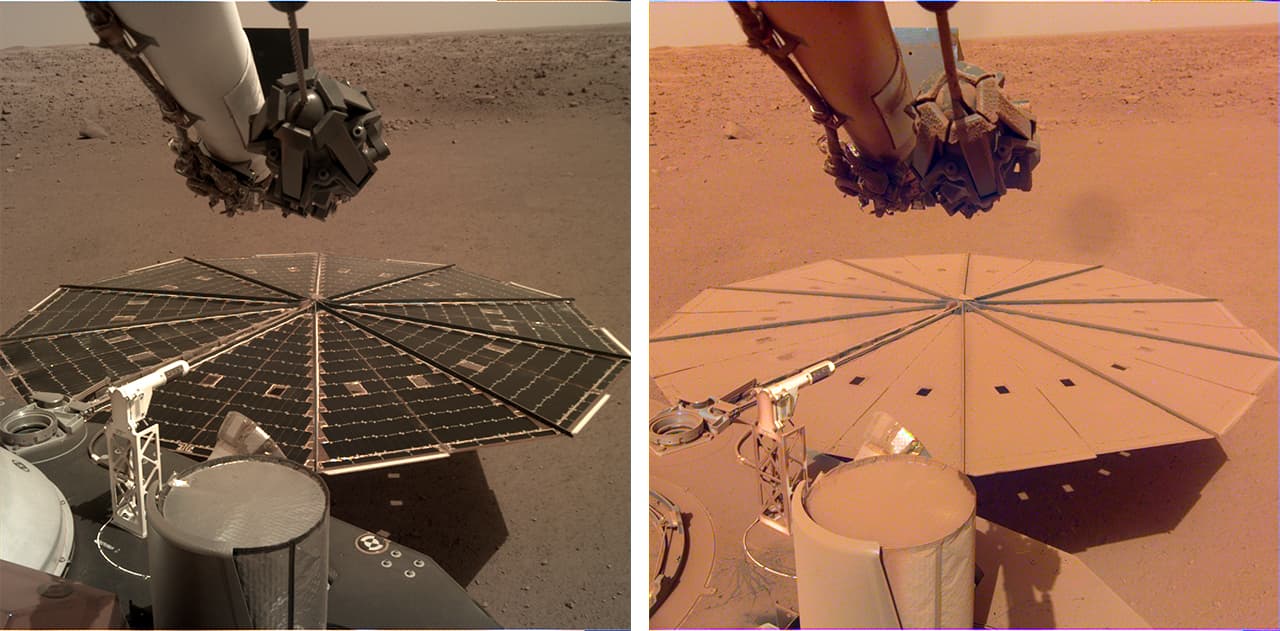
In accordance to the protocols, NASA attempted to re-engage communication for two times in a row through a satellite orbiting the planet.
But since NASA received no response from the lander, NASA is calling it off.
On December 19th, 2022, NASA announced in a blog post that the InSight lander had lost communications with Earth, most likely marking the end of the InSight mission.
InSight was active on Mars for 1440 sols (1480 days; 4 years, 19 days).
NASA's Insight was one of the most advanced high-tech machinery that walked on the surface of Mars.
Among the sensors and equipment, include a seismometer, called Seismic Experiment for Interior Structure (SEIS), that is capable of measuring seismic activities on the surface of Mars, and provide accurate 3D models of the planet's interior. InSight also had sensors capable of precisely measuring the internal heat transfer inside the planet using a heat probe called HP3 to study Mars' early geological evolution.
The goal is to help humanity observe how the Solar System's terrestrial planets – Mercury, Venus, Earth, Mars – and Earth's Moon form and evolve.
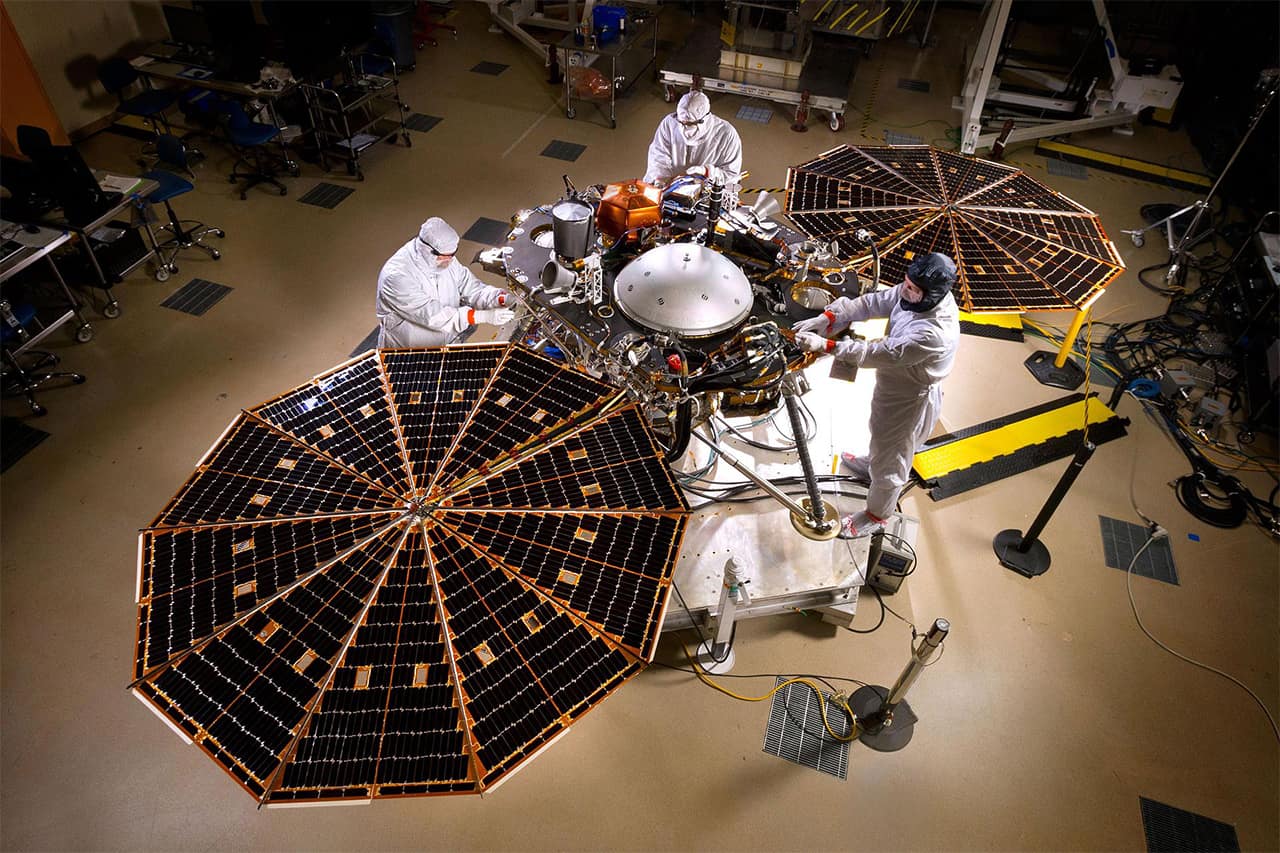
Since it landed, InSight has provided thorough insight on Mars' liquid core and the composition of its other interior layers.
In all, it has detected more than 1,300 martian quakes.
"Finally, we can see Mars as a planet with layers, with different thicknesses, compositions," said Bruce Banerdt of NASA’s Jet Propulsion Laboratory in Southern California said in a statement in November. "We’re starting to really tease out the details. Now it’s not just this enigma; it’s actually a living, breathing planet."
InSight was initially called GEMS (Geophysical Monitoring Station), but its name was changed in early 2012 following a request by NASA.
After more than four years, 1,300 marsquakes, and countless scientific discoveries, our @NASAInSight lander has reached the end of its mission.
InSight may be retiring, but its legacy—and its findings from the deep interior of Mars—will live on: https://t.co/8884Slrbxr pic.twitter.com/UKozd4P28g— NASA (@NASA) December 21, 2022






















































































































































































































































































