Back in 1995, the internet was still a strange and unfamiliar place to most people. Websites were slow, online shopping barely existed, and many people around the world had never even touched a computer connected to the web.
The young internet was just gaining traction. Dial up models screamed their familiar tune, and the idea of handling over credit card details through those telephone cables to the intenet seemed both thrilling and risky.
Yet during that summer, Sandra Bullock took part in what would become one of the earliest and most memorable moments in online entertainment history.
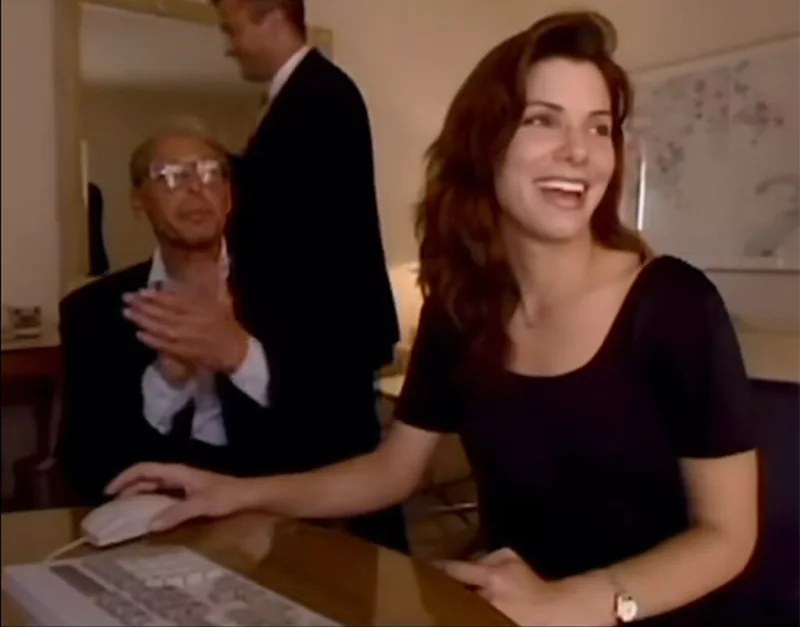
While promoting her cyber-thriller The Net, she sat down at a desktop computer and purchased two movie tickets online for a showing of her own film on July 28 at a Hollywood theater.
The tickets cost about seventeen dollars, and the transaction was completed through an experimental online ticketing website.
The interface represented the absolute cutting edge of technology: the idea of buying something from a computer without ever leaving the house. It was unbelievable at the time.
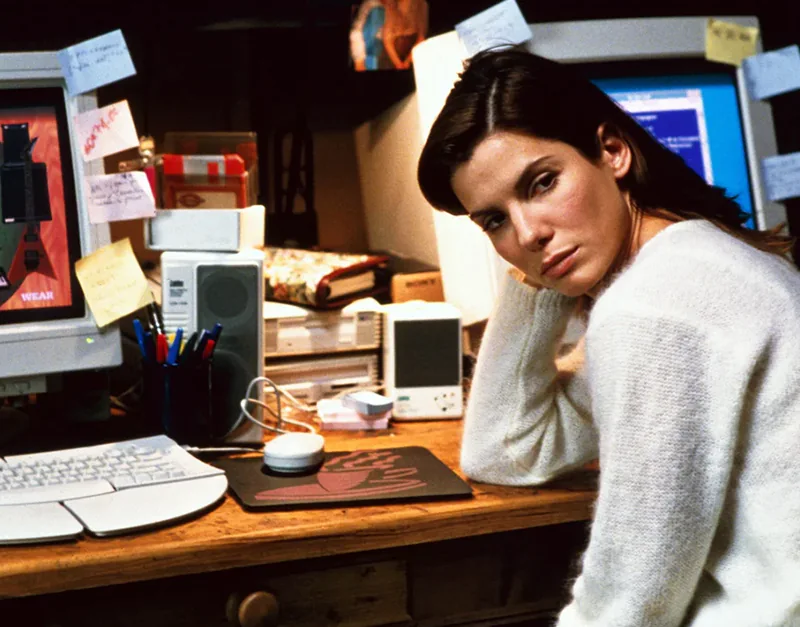
The Net is a 1995 techno-thriller starring Sandra Bullock as Angela Bennett, a computer systems analyst whose life is destroyed after she accidentally uncovers a dangerous digital conspiracy.
The film begins with Angela living a highly isolated life. She works remotely as a software expert, spends most of her time online, orders food and products through her computer, and has very little real-world social interaction. During the mid-1990s, these ideas seemed futuristic.
Her life changes after a coworker sends her a mysterious computer disk containing hidden access to a powerful government-related cybercrime network called the Praetorians. Before he can explain further, he dies under suspicious circumstances.
Soon afterward, Angela travels to Mexico, where she meets a charming man who seduces her before stealing her identification and passport. When she returns to the U.S., she discovers that her entire identity has been erased and replaced. Her name, social records, career history, and personal information have all been altered in digital systems.
To the government and the public, Angela Bennett no longer exists.
Worse, she is now identified as a wanted criminal under a completely different identity.
The rest of the movie follows Angela as she tries to prove who she really is while being hunted by assassins and corrupt operatives who control sensitive computer networks. Because the conspirators can manipulate databases, medical files, criminal records, and financial systems, she finds herself unable to trust institutions that normally protect ordinary people.
At the time of release, many critics viewed the premise as exaggerated science fiction.
However, the movie eventually developed a reputation for being unexpectedly prophetic.
In 1995, only a small percentage of households had internet access, and online shopping barely existed. Many people still viewed the internet with suspicion or outright fear.
The Net tapped directly into those anxieties. The film explored themes like stolen identities, cybercrime, mass data collection, internet dependency, and the vulnerability of digital records. These were ideas that sounded unsettlingly futuristic at the time but would gradually become real-world concerns in the decades that followed.
Now, as the world settles into the new millennium and the internet continues expanding at a remarkable pace, e-commerce and online shopping are beginning to flourish.
More consumers are discovering the convenience of buying goods without ever leaving home. Services that once required a trip to the store or a phone call are steadily moving online, and movie tickets are among the earliest entertainment purchases making that transition.
Companies are racing to experiment with digital storefronts while consumers slowly grow more comfortable with the concept of virtual transactions.
Against that backdrop, Sandra Bullock's now-famous online ticket purchase feels oddly symbolic.
Surrounded by cautious executives during a staged demonstration, Bullock showed how a technology that once seemed almost magical was beginning to evolve into something practical, even if the internet still felt like unfamiliar territory for much of the public.