
People travel to darkness of space, venture to the deepest oceans, and do lots of other things, all based on their curiosity.
Thanks to the advancements of technologies and the tools they can make, along the way, people make new discoveries while they're at it.
But to some people, one of the most difficult things to understand, is not far up nor far down.
To these people, the most puzzling thing in the world is human anatomy. These people prefer to not look up to the sky or look down to the bowels of the Earth, and instead study the human body to understand how it works and how it functions.
And among the things that captivated the mind and intrigued researchers alike, is sexual intercourse.
While people do know that the activity involves the insertion and the thrusting of the male penis inside the female vagina for sexual pleasure, reproduction, or both, nobody really knew how these sexual organs work, or at least how they look like, while they work.

To shed some light into this, a couple got very creative.
Ida Sabelis and her partner Jupp Reichert, a couple of researchers, had sexual intercourse in an MRI machine in the name of science back in 1991.
It all happened one day, when the couple traveled for three hours from Amsterdam, the capital of the Netherlands, to a hospital in Groningen, a city further north.
There, Sabelis had a conversation with three male scientists working in the University Medical Center Groningen (Universitair Medisch Centrum Groningen) MRI lab.
And all of a sudden, she had an idea.
"I realized I was the only woman in the room," she recalled. "It was like, of course I’m the only woman in a study about women’s bodies!"
Sabelis was there with her boyfriend, because she agreed to take part in a project.
A year earlier, Sabelis had received a phone call from her best friend’s partner, a man named Menko Victor "Pek" van Andel. While Sabelis never really argued with Pek because they're mostly on the same page, she considered Pek an eccentric man, to say the least.
And sometimes, Pek can have unusual ideas.
On the phone, the Dutch scientist said that he wanted to create a highly original piece of "body art," and that is to create an image of the female reproductive tract during coitus, using a magnetic resonance imagery machine, commonly known as an MRI machine.
"It’s never been done!" Pek said. "Never!"

Sabelis was sceptical at first, after all, she considered sex as an activity that must be done away from peeking eyes. But regardless, she was also intrigued because after all, Sabelis is also a researcher herself.
At that time, nobody had ever done such a thing, and that the medical world had mostly relied on previous works, including the famous illustration from Leonardo da Vinci, who sometime between 1492 and 1494, sketched a man pushing his erected penis into a semi-transparent vagina.
The illustration shows the female reproductive tract, which appeared as an undeviating cylinder leading between her legs directly to the base of her spine.
The sketch was made hundreds of years ago, and still, the medical world was still using the illustration to depict intercourse.
People still thought that a vagina is a straight tunnel, and that a penis, when erect, cannot conform to the female passage way in any way.
Scientists, doctors and others in the medical field, considered coitus as an activity where the penis just go in straight and come out straight.
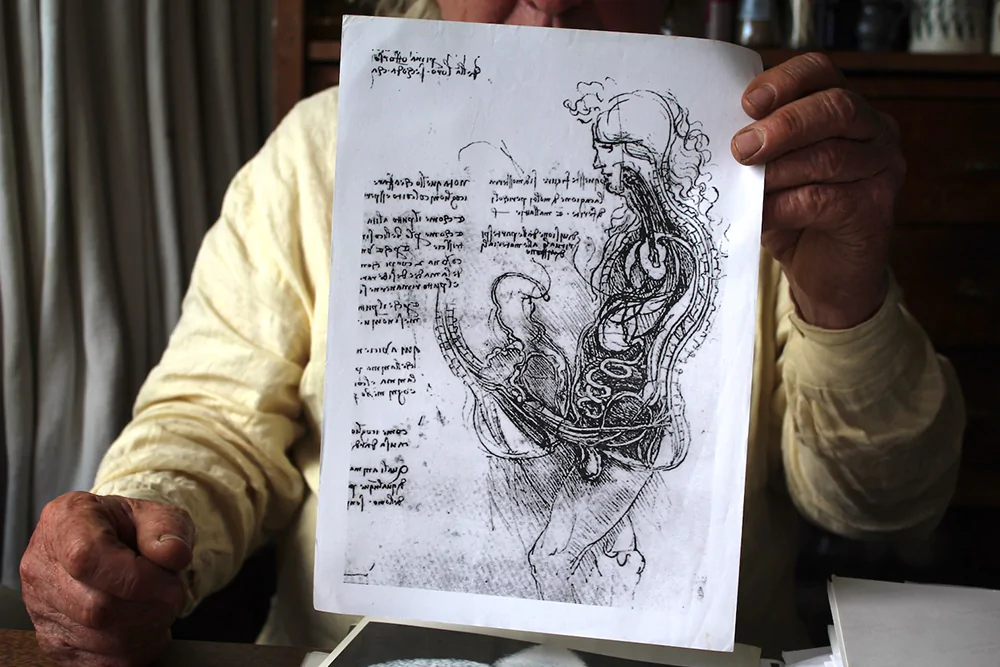
Since no one had ever actually fact-checked Leonardo da Vinci's sketch, no one knew if the illustration is correct.
In short, nobody knew what happens inside the body during coitus, and as a person who studies the aspects of humans, Sabelis was also curious.
Pek might have been eccentric, but with a degree in medical research and that he had co-invented an artificial cornea, the man is no joke.
Furthermore, because the work is in the name of science, the project shouldn't be considered pornography whatsoever.
After some consideration, and a long conversation with Reichert, she agreed to participate.

The study’s underlying concept was first examined by the hospital’s ethics commission and approved with a few conditions.
For example, the work had to be done separately from normal operations involving patients, and only volunteered staff would be permitted to be part of the project.
Magnetic resonance imaging, or MRI, is a non-invasive medical imaging technology that produces detailed images of almost every internal structure in the human body, including the organs, bones, muscles and blood vessels.
Like X-rays and CT scans, these machines allow doctors to see inside human bodies without surgery, but unlike X-rays and CT scans, MRI scanners create images of the body using a large magnet and radio waves.
The MRI scanners generate an image of the human body by mapping the position of hydrogen protons, which are abundant in the water molecules and the fat in tissues. The machines create a strong magnetic field so that when someone is placed inside it, the hydrogen protons in their body align like a needle in a compass.
By sending pulses of energy through a specific frequency of radio waves into the body, the MRI machine alters the behavior and orientation of the protons momentarily. When that radio signal is shut off, the hydrogen protons will realign with the magnetic field and when that happens, they will emit radio waves that communicate their position in the body and the type of tissue in which the reside.
This form of imaging doesn’t involve harmful radiation, meaning it can produce more images of the body - enough to make a moving picture - in greater detail.
This makes MRI machines a lot safer for prolonged use.
Sabelis was a passionate anthropologist who’d spent her youth campaigning for women’s rights, and this project indeed got her moving.
"So!" she said to her boyfriend, "shall we get on with it then?"
Sabelis and Reichert went to the toilet to empty their bladder, got undressed, and then mounted the MRI machine, naked.
For privacy and modesty, an improvised curtain was set in place to cover the window between the room where the machine was at, and the adjacent operator's room. And to make things at least a bit more comfortable for Sabelis and Reichert, the standard tray was removed, and this effectively increased the tube's diameter by 50 centimeters.
Still narrow for two individuals to fit, but wide enough to facilitate coitus.

After both Sabelis and Reichert were in position, the researchers headed back to the operator's booth.
"Can you hear us?" asked one of them through an intercom.
"Yes," replied Sabelis. “Ready when you are.”
With their whole bodies inside the machine, the scanners focusing on their lower half, and only their feet protruding, Sabelis and Reichert were then told to do what they need to do.
"Suddenly I become conscious that I have a strange position: the only woman between four men, on the verge of becoming intimate with my lover in that machine, while the other three gentlemen in the next room are operating all sorts of machinery to take a shot of our inner side. [...] " she said.
" [...] it became pleasantly warm in the tube and we truly succeeded in enjoying each other in a familiar way," Sabelis said, recalling that Reichert was worried that he wouldn’t get an erection due to the stress and anxiety.
And when Reichert was ready to perform, they 'do the deed', while the MRI machine scream in the enclosed, windowless room.
Back in the operator's room, the researchers observed what no man before them had ever seen.
"The erection is fully visible, including the root," one of the researchers said from the operator's room.
"Hold that pose," said another to Sabelis and Reichert, asking them to lay completely still.
When the researchers were done observing, Sabelis and Reichert were told to "finish up."
The process took around 45 minutes.
After Sabelis and Reichert were done, they exited the tube naked and sweaty "like buns from an oven."
The two then washed and got dressed, and hurried to the operator's room to see the images they have just created.
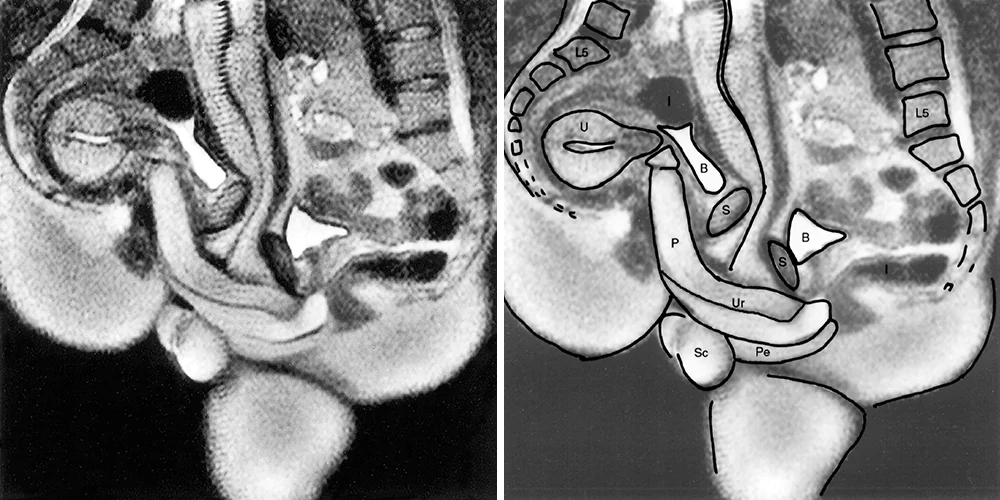
On the screens, they all saw how Reichert's erect penis penetrated Sabelis's vagina, witnessed how the coitus between the two happened like it would and should, and saw the two's reproductive organs work, but all from the inside. For example, they saw how Sabelis internal organs, not only her vagina, respond to Reichert's penis thrust, and how the penis took its shape when it's inside.
"When I saw them it was just like aww that’s how we fit together," said Sabelis.
"They were beautiful! I could see my womb and then there was Reichert in a place that I knew from my own sensation, just below the cervix. There was very clear features of both our insides, including the boundary between both our bellies. It showed so much detail it made me speechless."
In fact, everyone there was speechless.
But not Pek van Andel.
As soon as the images were shown on the screens, he realized that inside Sabelis's vagina, Reichert’s penis had been forced into a curved, boomerang-like shape, right from inside of Reichert’s own body, assuming an angle of about 120 degrees.
It's also unlike the S-shape envisaged by Robert Latou Dickinson (1861–1950), an American obstetrician and gynecologist.
In the images, it's apparent that the male phallus is able to bend in the exact middle between tip and root so that it is parallel to the woman’s spine. Thanks to this flexibility, the tip of the penis can reach further inside the uterine orifice.
When trying to conceive, this trait helps because it shortens the distance sperm cells have to travel to get to the egg cell.
This, is something that was never sketched by Leonardo da Vinci, or visualized by R L Dickinson.
And at that very moment, Pek knew that they achieved something more significant than an arts project: they have re-written centuries-old anatomical assumptions.
Another thing, Pek also realized the expected effect of sex to the female bladder.
On the screens, he could see how Sabelis's bladder was filling up quickly during intercourse.
"In every final scan we could see a big, full bladder, even though most of the women went to the toilet before they went inside the MRI," explained Pek.
"We think it might be evolution’s way to force women to urinate after sex. Perhaps our ancestors developed this function to avoid urinary tract infections, but that’s only a hypothesis."

At first, the project was met with controversies and public outrage. The project, authored by Pek and co-authored by Sabelis among others, was mailed to Nature, and was rebuffed without explanation.
After all, scientific studies involving the interaction of human genitals during coitus and after ejaculation with and without female orgasm have always been difficult and controversial with ethical, technical and social problems..
"We experienced this personally. It took years, a lobby, undesired publicity [...] to obtain our images," the research said.
But eventually, his project was recognized, and the rest is history.
In fact, Pek's project enticed more similar projects.
Between 1991 and 1999, eight couples and three single women had sexual intercourse in the hospital’s MRI machine, in total of 13 times.
These subsequent experiments were all done in the missionary position, using volunteers above the age of 18.
While the couples were told to have intercourse, the single women were told to masturbate.
Data shared the research shared, include the participants' age, weight/height index, parity, type of contraception, female orgasm (yes/no), and the depth of penetration (partial or complete). All of the single women reported having orgasm, and none of the women reported having a "g-spot" orgasm or producing female ejaculation.
When Sabelis and Reichert had intercourse in the MRI machine, there was a major problem: the Philips Gyroscan S15 MRI machine required 52 seconds of immobility to take a single photo. The Groningen hospital purchased a faster MRI scanner, a 1.5 Tesla magnet system from Siemens Vision, in 1996, but even the 12 seconds it required were still unfeasible.
It was only in 1998, that the sildenafil (viagra) became available in the Netherlands. The availability of potency enhancer made subsequent intercourses inside the MRI machine produce more successful results.
Two men took one 25 mg tablet of sildenafil, and "succeeded with complete penetration that lasted long enough (12 seconds) for sharp images to be taken."
Two couple were given viagra to help the men maintain their erection and delay ejaculation, which was something Reichert never did.
"We were the only couple to successfully do it without viagra!” Sabelis proudly said.
The paper, which goes under the title Magnetic Resonance Imaging of Male and Female Genitals During Coitus and Female Sexual Arousal, finds that taking magnetic resonance imaging of the male and female genitals during coitus is feasible, and that during missionary intercourse, the penis has the shape of a boomerang. The paper also finds that during female sexual arousal without intercourse the uterus rises and the anterior vaginal wall lengthens, and that the size of the uterus also does not increase during sexual arousal.
And that's not all, because when the project was recognized, the images were then considered the first of their kind, and became the center point of a hugely popular British Medical Journal entry in 1999.
The paper also became one of the medical journal’s "most popular articles of all time," and was even honored by BMJ on its 20th anniversary in 2019.
While the MRI lovemaking session happened over 30 years ago, it only captured the internet's attention after the images were reshared again, and gained more popularity boost, thanks to social media like TikTok and streaming platforms like YouTube.
Most notably, this happened after a lengthy post by Vice.
The internet, especially younger generations, were captivated by it, not because the project was indeed unique, but also due to how far two scientists would go to pursue their work.
Some commented about how loud MRI machines can be.
MRI machine works by scanning the insides of something, and this emits a very loud noise. And in order for it to happen, that something must be inserted into a narrow tube, so it's placed inside the magnetic field of the scanner.
That tube is already narrow for most people, and the experience can be claustrophobic, even for one person, let alone two.
Others branded the story, and the project "insane," and declared they were "so glad" they are seeing this on TikTok.
"I genuinely don’t know how I feel about this information, but. thank you?" one teased.
"This is honestly wild," said another.
Footage from MRI scans is probably amongst the last things that can go viral on the internet. But just like pretty much everything else, throwing sex into the mix will make people click.
"It was hardly the medical equivalent of a moon landing, so why did 'lay' visitors come flocking in such numbers?" Dr Tony Delamo, a former editor at BMJ, said.
Answering his own question, he suggested that the prospect of seeing sex on screen for free was behind its success, even if they were black and white.
"If that's the explanation, it's hard to think ourselves back to such an innocent age, given today's explicit online offerings," added Dr Tony Delamothe, another former editor at the BMJ.
In an interview, Ida Sabelis, a professor who is approaching her retirement, said that she's incredibly proud of the small contribution she made towards gender equality in the science of arousal.
On that day, she had no idea what she was getting herself into, but she’s incredibly happy she went ahead with it, even when the experiment was mostly run by men.
The research is again an example of what researchers can achieve with the advancements of tools and machines, while they're "at it."
Years later, Dutch filmmaker Bahram Sadeghi made a short documentary about the people involved in the project: