
The internet never forgets. But worse, it rarely lets anything rest.
As a result of this fact, some stories don't just linger; they get dragged back into the spotlight over and over again, repackaged and sensationalized purely for clicks. Tragedy becomes content, stripped of context and rebranded with whatever details will provoke the strongest reaction in the moment.
The tragic drowning of three young men in Rajasthan's Gauri Dham Kund back in May 2018 remains one of those heartbreaking stories that should have stayed a local news item but instead became raw material for endless online recycling.
What was supposed to be a heartfelt moment between friends became a tragedy, one that unfolded in a matter of minutes, with no time to react and no way to undo a simple, impulsive decision.
There was no warning, no dramatic buildup. Just a quiet evening, a brief stop to cool off, and a chain of instinctive actions that spiraled out of control. In trying to save one another, they all slipped beyond reach, turning a moment of laughter into one of irreversible loss.
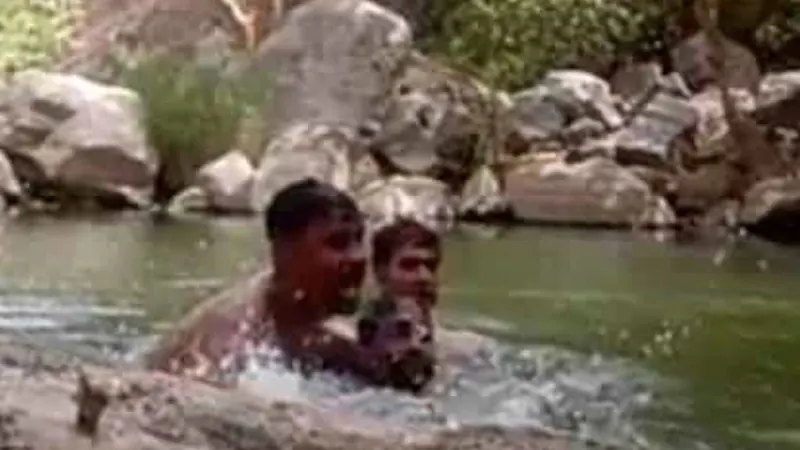
It all began on one Saturday evening, when Chetan Khatik (28), Sudarshan Chandel (22), and Radheyshyam Khatik (27), three friends from villages around Rajsamand, were out on a simple bike ride when they decided to stop at the Chambal River, located in the Deogarh area near Khatoli in Kota district, Rajasthan, India.
The idea was only to cool off after the heat of the day.
None of them were strong swimmers, but a short plundge shouldn't be worrying, as so they think.
They were absolutely wrong because their decision to cool off in that body of water proved fatal within minutes.
They set up a mobile phone on the rocky edge to record themselves splashing and having fun in the water, the kind of casual video countless young people make without a second thought.
What the camera captured instead was the rapid unraveling of a nightmare: Chetan slipped into the deeper section, the others instinctively reached out to pull him back. But since none of them were good swimmers, panic stepped in. The three men were soon clambering on each other in a bid to stay above the water level, only to disappear one by one.
The footage shows their desperate struggles, the water closing over them, and the final moments before the recording continued on an empty scene.
Their families reported them missing when they failed to return home.
Police searched the area, recovered the bodies the next day, and found the phone still on the bank with the unedited footage intact.
They registered a case, and sent them for post-mortem.
The entire district mourned three lives cut short by a split-second decision on an ordinary outing.
As for the video, nobody really knows who uploaded it first, since the footage remained on the victims' recovered phone as police evidence initially, but it leaked or was shared from that device shortly after recovery.
While Indian news outlets were already posting related news reports and short clips about the drowning on Facebook and YouTube, the full, raw drowning video itself began circulating widely on social media (WhatsApp forwards, Facebook, and early video platforms) by May 22, 2018, when Nagpur Today explicitly noted that "the video is fast getting viral" in its article published that day.
Major international sites followed quickly, and on May 23, and gore-focused platforms began publishing it.
In short, the video first appeared publicly online around May 21-22, 2018, spreading organically through local media and social sharing rather than any official police upload.
Since then, that original video, shotin Rajasthan, has since taken on a life of its own far beyond the quiet funeral rites and family grief that followed.
And due to the lack of publicity throughout the years, it resurfaced again and again, repackaged with fresh, entirely fabricated details designed to trigger maximum shock and shares.
This pattern of internet sensationalism is depressingly familiar and reveals how platforms reward raw emotion over accuracy.
Dramatic, self-recorded tragedy videos like the Gauri Dham one are perfect clickbait because they deliver an unfiltered punch: viewers feel they are witnessing something intimate and irreversible, which triggers outrage, pity, and the irresistible urge to comment or forward it. Accounts chasing engagement know this works: swap the location to a different state, invent a relatable backstory like a wedding journey or a sudden "strong current" add urgent phrasing such as "last seconds before death," and the algorithm pushes it to millions before fact-checkers or locals can push back.
This footage has since been recycled with new captions in multiple languages, each time pretending to be fresh.
While real drownings do happen with painful frequency across India's rivers, ponds, and canals, often among people who never learned to swim and panic when help is needed, but the viral machine rarely bothers with those quiet truths.
Instead it hijacks the pain of one family’s loss to manufacture fresh outrage, racking up views while the actual victims’ names and stories fade into footnotes.
What makes this cycle especially cruel is how it strips away context and respect.
The three Rajasthan friends were ordinary young men enjoying a ride, not reckless daredevils chasing thrills for the camera; their decision to swim was impulsive but human, the kind of mistake that ends in tragedy rather than malice. Yet every time the video reappears with a new lie attached, it turns their final moments into disposable entertainment, detached from the real grief their families endured.