
Things were peaceful in the Kingdom of Tonga, the Polynesian country located in the southern Pacific Ocean, the archipelago consisting of 169 islands.
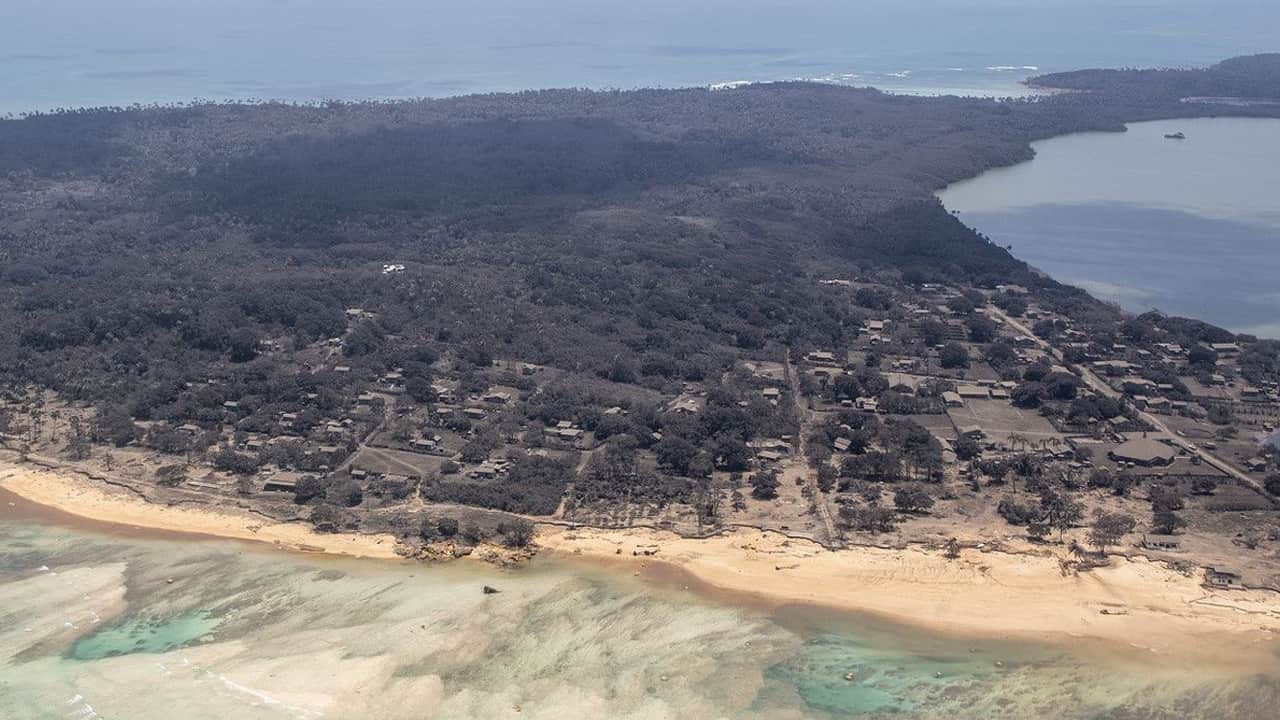
Then suddenly, Tonga's Hunga Tonga–Hunga Haʻapai, the submarine volcano located around 60 kilometers from Tongatapu, Tonga's main island, erupted with enough force to create an eruption column of at least 30,000 meters into the atmosphere.
The explosion was so loud that it could be heard as far as Alaska, which is about 10,000 kilometers away.
The force was so huge that fluctuations in air pressure were recorded all over the world as the pressure wave has fully circled Earth multiple times.
While the damages on land was considered violent, the volcanic activity was also contained under the water.
This is why the incident that was estimated to have a force equivalent to about 50 megatons of TNT, created tsunami that was a few meters high, and also crippled Tonga's sole undersea telecommunication cable.
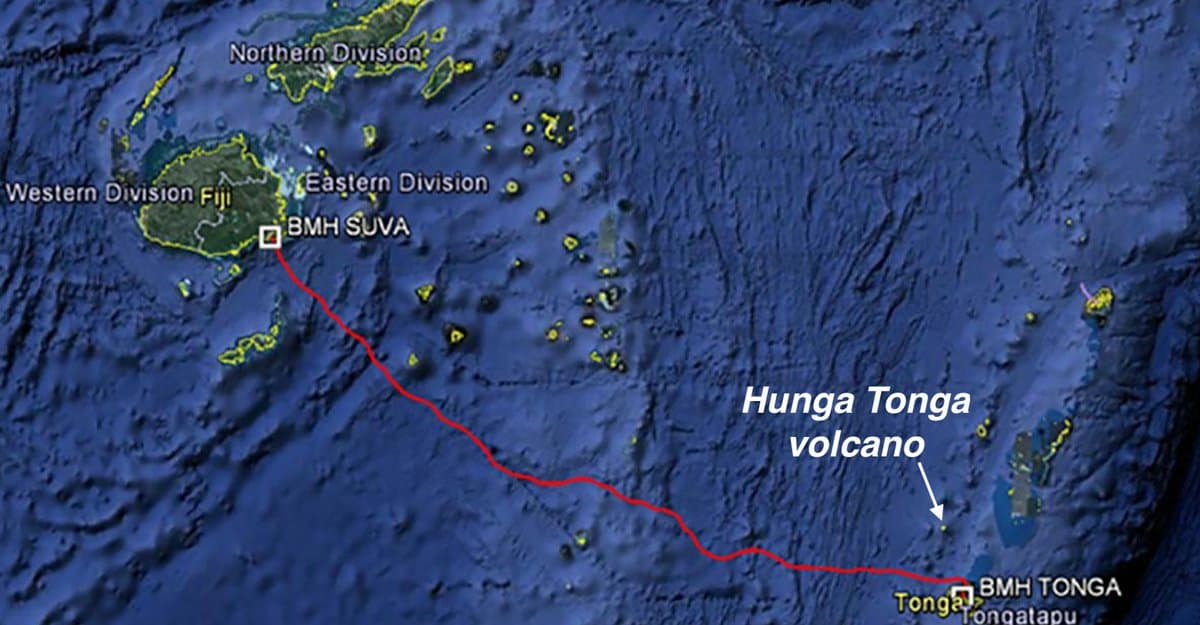
The cable in question is called the Tonga Cable System, a 827 km (514 miles) cable to Fiji.
Funded by Asian Development Bank and the World Bank in 2012, the cable is the only undersea telecommunication cable in Tonga, adjoining the country's islands to the outside world.
Because the cataclysmic event crippled it, it caused a sweeping internet blackout.
Cloudflare, the web infrastructure and website security company, showed internet traffic from the country “plunged to near-nothing around 5:30 p.m. local time on January 15.”
In an official statement by the government of Tonga on Twitter, it was announced that “limited communication has been made with Vava’u and Ha’apai through satellite phones and HF [high frequency] radio,” and that two communications operators were "working on satellite options to restore some services including the internet." as the country was trying to figure out how to reinstate full communications as soon as possible.
It's worth noting that satellite phone signals were patchy due to the cloud of ash cloaking the archipelago.
Through the extremely limited means of communications, the government was prioritizing international calls and messages, while domestic communications were be limited.
And not only that, as satellite communications have prohibitive costs, which make their use limited for most people in the archipelago, apart from the government, its officials and some businesses.
In the meantime, due to the intensive damage the incident has created, Tonga's government prioritized more urgent emergencies, including public health and access to food and water.
FIRST OFFICIAL UPDATE FOLLOWING THE VOLCANIC ERUPTION FROM THE GOVERNMENT OF TONGA pic.twitter.com/fX3KPlKx2E
— Consulate of the Kingdom of Tonga (@ConsulateKoT) January 18, 2022
While the internet and many parts of the web run inside the so-called "clouds, they are in fact run in a network of cable networks that mostly spanned across the seas and oceans.
In other words, the internet is mostly underwater.
More than 99% of global international data traffic is carried on a network of hundreds of these cables, which span about a million kilometers.
Internet cables are rarely seen nor make headlines. But these things are crucial, as their fiber optics can carry hundreds times more data than a satellite.
Because the cables allow huge amount of data to pass in astonishing speed, they form the backbone of the global internet.
And because of this fact, these cables are expensive to install and difficult to maintain. And in this case in Tonga, fixing its cable is also expensive, and also tricky.
Samiuela Fonua, the chairperson of the state-owned Tonga Cable Ltd that operates the subsea line, said that he plans to fix the cable as soon as possible, but in the meantime, he is also concerned about the continuing volcanic activity obstructing the passage of incoming repair ships.
New Zealand's MP Shane Reti had the initiative to ask for Elon Musk's assistance, whether he could provide Starlink connection to Tonga.
"Could people from Tonga let us know if it is important for SpaceX to send over Starlink terminals?" the billionaire serial entrepreneur asked.
The tweet soon went viral as netizens replied with pleas for his help to reestablish communication. Many of those people have families and friends in Tonga, and couldn't reach them because of the event.
"Yes we need them to get liquidity in to purchase much-needed goods. Voice and data completely down with undersea cable severed," said Tongan politician Lord Fusitu’a.
I guess Elon Musk can only say no and if you don't ask you don't know. After the Minister told me in a phone call on Monday that the telecommunications cable to Tonga was down I immediately sent a letter to Elon to see if he would contribute Starlink to the emergency pic.twitter.com/Upg9WijWrq
— Dr Shane Reti (@DrShaneRetiMP) January 21, 2022
Fusitu’a also requested for direct contact with Musk to coordinate assistance.
"I don’t know the details of what Starlink can do, but I know you have the technology and means to help," said Josephine Latu-Sanft, a Tongan communications specialist.
She suggested Musk can help by giving people in Tonga internet until the government can repair the undersea cable is repaired, before working with partners to establish robust communications infrastructure across the disaster-vulnerable Pacific.
"This is a hard thing for us to do right now, as we don’t have enough satellites with laser links and there are already geo sats that serve the Tonga region. That is why I’m asking for clear confirmation," Musk responded.
This is not the first time Tonga has experienced an internet interruption.
Back in 2019, the same undersea cable was damaged when an anchor dropped from a Turkish-flagged ship pierced it. This resulted in a week-long internet blackout.