At least on Weibo, the social media platform from China that the government has control of.
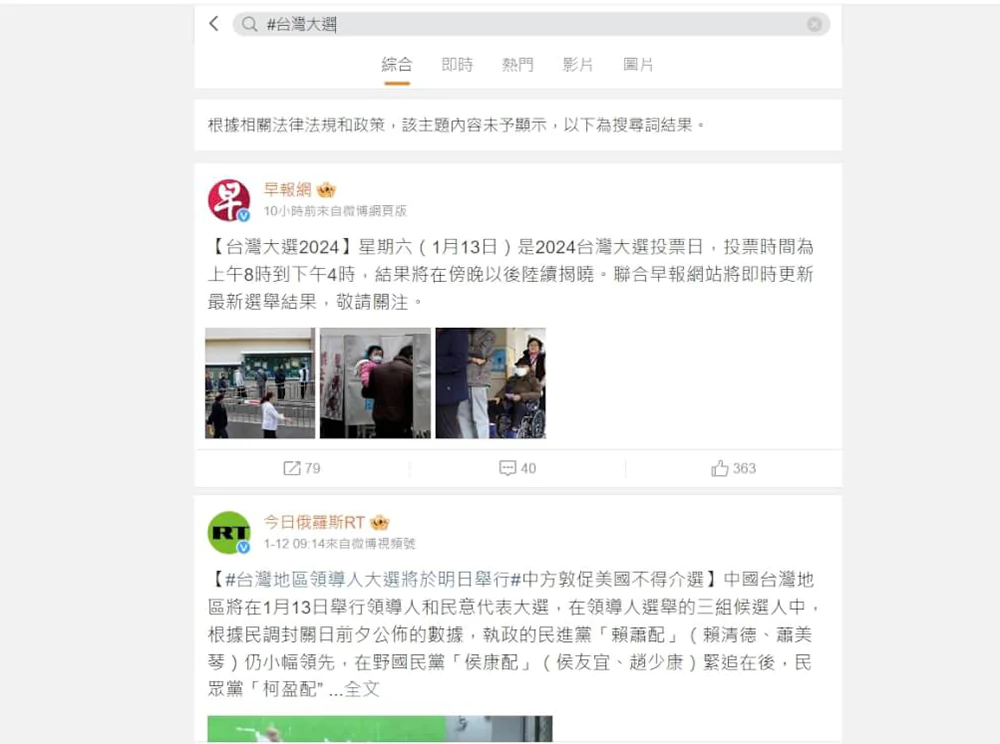
The Chinese government started enforcing a rule, where Weibo has to block hashtags related to Taiwan's election, which have become one of the platform's top-trending topics following polls opening on the self-ruled island.
"In accordance with relevant laws, regulations and policies, the content of this topic is not displayed," a notice on the platform showed when the hashtag "Taiwan election" (#台灣大選) was searched.
In mainland China, whose leaders are closely watching the result, "Taiwan election" was one of the highest trending topics on Weibo after polls opened early Saturday morning.
It was quickly raking in more than one hundred million post views in a short amount of time.
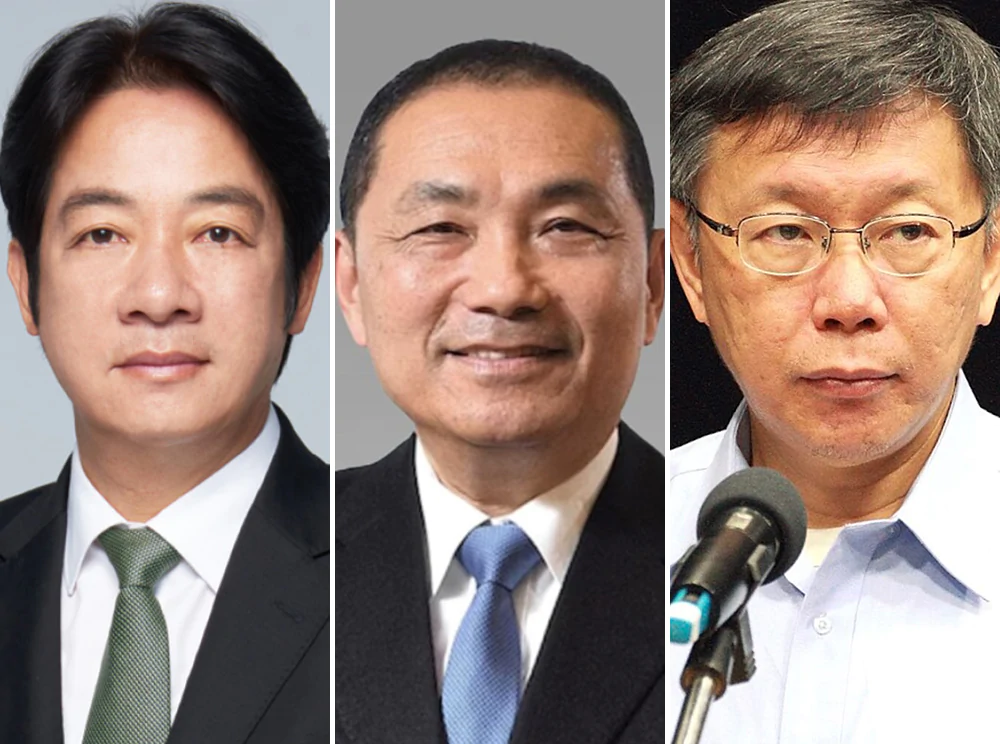
In the poll, Democratic Progressive Party (DPP) leader and Taiwan's Vice President Lai Ching-te was maintaining the lead. Coming second, was Kuomintang's (KMT) Hou Yu-ih. Third place was Taiwan People's Party (TPP) leader Ko Wen-je.
The ruling DDP is seeking a third term, and that party champions Taiwan's as a separate identity and rejects China's territorial claims.
DPP is seen as an obstacle by Beijing for its insistence upon Taiwan's sovereign rights and its close relations with the U.S., Europe and other democratic forces.
But because incumbent President Tsai Ing-wen of the DPP was ineligible for reelection due to term limits, DPP nominated Lai.
The KMT on the other hand, which ruled China before fleeing to Taiwan after losing a civil war with the Communists in 1949, favors close ties with China but strongly denies being pro-Beijing.
Meanwhile, the TPP also wants to reengage relations with Beijing by offering a "third way" out of the two-party deadlock.
Several other small parties are also taking part in the elections, but reports suggest that such parties are unlikely to get any seats.
When millions of Taiwanese are voting in a presidential election, some users have indeed called for the island to be returned to the "motherland" as soon as possible.
But China, which has long considers Taiwan as a breakaway province that will eventually be under Beijing’s control, has sent threats that choosing the wrong leader could set the stage for war on the self-ruled island.
Taiwan has been a democratic success story since holding its first direct presidential election in 1996, the culmination of decades of struggle against authoritarian rule and martial law.
While polls that are created online only reveal online users' perception and choice, and that results don't necessarily reflect their eventual voting through ballots, results of polls are still crucial.
China fears that some posts can influence people's thoughts and perceptions.
After all, the relationship between China and Taiwan has been a contentious issue for decades.
Whereas China considers Taiwan part of itself, Taiwan sees itself as distinct from the Chinese mainland, with its own constitution and democratically-elected leaders.
By censoring things, China wants to ensure that people don't get distracted.
Chinese news platforms such as Xinhua, CCTV and Phoenix TV, have also limited their news reports about the poll and the election results.

It's worth noting that other topics related to the Taiwan election, such as "Taiwanese presidential election" (#台灣總統大選) are alsoblocked.
It's also worth noting that while the hashtags were removed, however, users were still able to see posts about the topic by navigating to them directly.
Presidential election in Taiwan was held in Taiwan on 13 January 2024 as part of the 2024 general elections, and that the DPP nominated Vice President Lai Ching-te won the ballot.
He selected Hsiao Bi-khim, the then-Representative to the United States, as his running mate.
Lai was elected president with a plurality of 40.05%, with shall be inaugurated on 20 May 2024.














































































































































































































































































