
Efforts to integrate generative AI more deeply into marketing workflows continue to evolve beyond isolated image or video creation.
Instead of requiring users to craft lengthy descriptions for every component of a project, some platforms are introducing ways to activate organized sequences that handle multiple stages of content development at once.
A recent update from Runway illustrates this direction.
Through a feature it calls agent 'Skills,' users can go through a command-based system that lets them initiate processes for building campaigns, producing supporting visuals, and adapting materials across different contexts with less manual direction at each step.
Demonstrations released with the announcement show the commands in action on product examples.
Introducing Agent Skills. Build an ad campaign, create a commercial, localize your ads and more with a simple command. Type /, choose a Skill and Agent gets to work. Scale your marketing. On command.
Get started at the link below. pic.twitter.com/r6ZrLbKuNH— Runway (@runwayml) July 2, 2026
One command generates campaign visuals for items such as footwear or beverages.
Another assembles mood boards that combine images and thematic directions.
A further option adjusts existing assets to fit different sizes or formats. Similar functions handle localization of content for other markets.
The process draws on Runway's existing strengths in image and video generation while organizing them into repeatable sequences. This setup sits inside a conversational environment that already supports dialogue about creative projects.
The addition of predefined pathways provides a layer of structure so that complex jobs unfold through automated steps rather than relying solely on free-form instructions.
Users can still supply context such as brand guidelines or product details to shape the results.
One consequence is that marketing teams may find it easier to move from an initial idea to multiple finished assets in less time.
Smaller groups or freelancers could produce campaign variations or platform-specific versions without coordinating separate specialists for each stage.
Broader effects could include faster testing of different creative directions and quicker adjustments when audience data or market conditions change.
Over longer periods the pattern may encourage organizations to redesign parts of their content workflows around integrated AI assistance rather than linear handoffs between tools and people.
A distinguishing aspect of this implementation lies in its use of slash commands as the primary trigger mechanism. This syntax draws from conventions familiar in development environments and collaborative software, offering a concise way to invoke detailed procedures.
When paired with a platform focused on visual media production, it creates a more directed experience for tasks that involve generating and refining campaign materials. 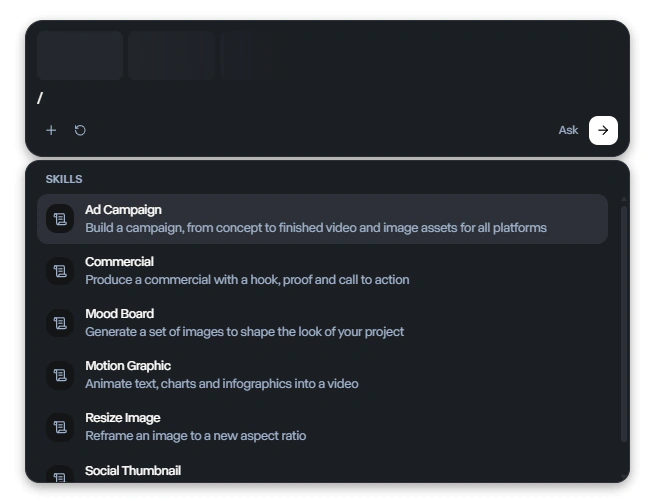
At the same time the feature carries several practical constraints.
Generative models still produce outputs that sometimes deviate from exact brand specifications or contain visual inconsistencies that call for human correction.
In advertising, where regulatory compliance, cultural accuracy, and brand safety matter, every generated asset would normally pass through review and editing stages anyway. These checks can consume part of the time the automation was intended to save. The available pathways cover only the workflows that have been built in advance. Requests falling outside those boundaries may still need manual prompting or external tools. Generating high-resolution video or large sets of images also uses significant computing resources, so repeated or large-scale use can increase overall expenses depending on the pricing model. Sharing product images, brand documents, or strategy notes with the service raises standard questions about data handling and access controls.
Wider use could shape creative norms in visible ways.
Campaigns produced through similar underlying models and templates might begin to share certain visual traits across different brands. While this can speed production, it may also reduce the distinctiveness that comes from fully manual or highly customized approaches.
Therefore, users may have to decide how much to rely on its outputs versus preserving space for independent human judgment and experimentation. Regardless, the introduction of these capabilities marks a refinement in how generative systems are applied to specialized creative domains.
It offers a practical mechanism for streamlining certain marketing activities through structured commands and automated execution.






















































































































































































































































































