Netflix, not the kind of company known for developing AI models from scratch, has quietly made one of the most intriguing leaps in video technolog.
This is because its research team, working alongside scientists from INSAIT at Sofia University "St. Kliment Ohridski," released 'VOID.' Short for Video Object and Interaction Deletion as a fully open-source project.
At first glance, VOID might sound like just another AI-powered editing tool. But its origins tell a more practical story.
The system began as an internal effort to reduce the friction and time-consuming challenges of post-production, for things like removing unwanted objects, continuity errors, or reshooting costly scenes. Traditionally, these fixes require painstaking frame-by-frame work or expensive reshoots. VOID was designed to eliminate that bottleneck.
What makes the project remarkable, however, is how far it goes beyond simple object removal.
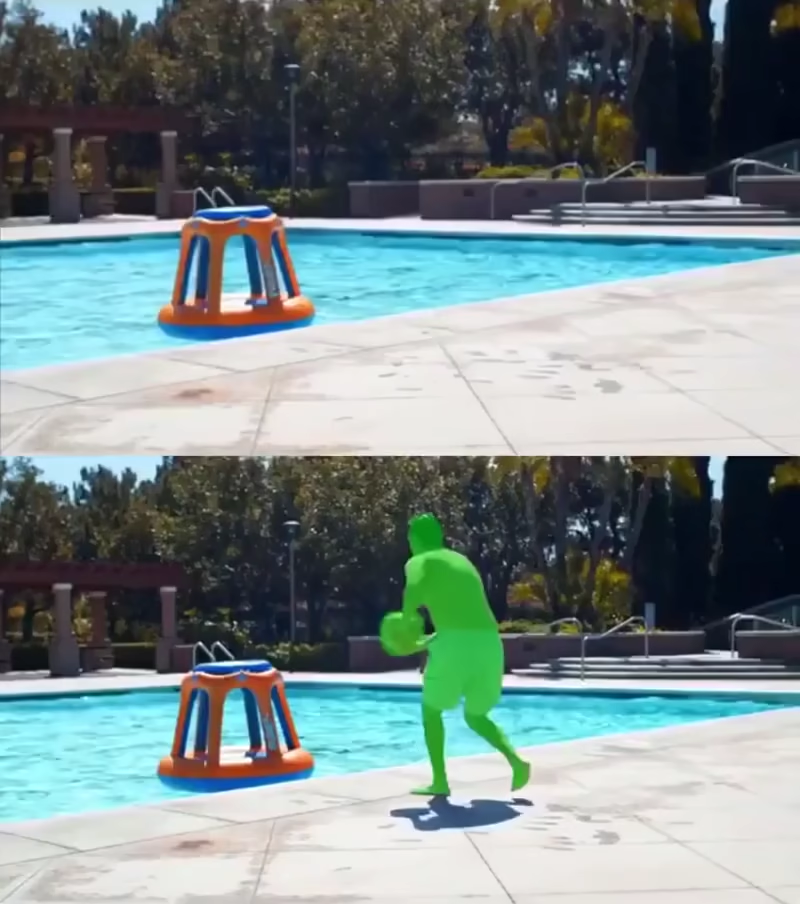
Rather than just "painting over" an object in a video, VOID attempts something far more sophisticated: it reconstructs the scene as if the object, and any interactions involving it, had never existed in the first place.
That means the system doesn't just delete pixels.
It models context, motion, and causality. If a removed object cast shadows, reflected light, obstructed backgrounds, or influenced the movement of people or other objects, VOID adjusts for all of it. The result is a rewritten sequence that feels physically and visually consistent, as though the original event unfolded differently from the start.
In effect, VOID moves video editing closer to simulation. It's not just erasing reality. Instead, it's reimagining it, frame by frame, with an understanding of how the world behaves.
Users can use VOID to remove the person mid-stride clutching a coffee cup, and the cup doesn't freeze; it tumbles, spills, and rolls exactly as gravity and momentum would demand in a world where the hand was never there. Erase one car from a collision, and the surviving vehicle continues its trajectory while debris, smoke, and impact scars dissolve into an undisturbed road.
The result feels less like digital surgery and more like stepping into a parallel timeline.
And by making the tool open source on both GitHub and Hugging Face, Netflix isn't just solving its own production challenges.
It's literally placing a powerful, research-grade capability into the hands of creators, developers, and filmmakers worldwide, potentially reshaping how video content is edited, repaired, and even conceived.
The technical magic happens through a deceptively simple innovation called the quadmask.
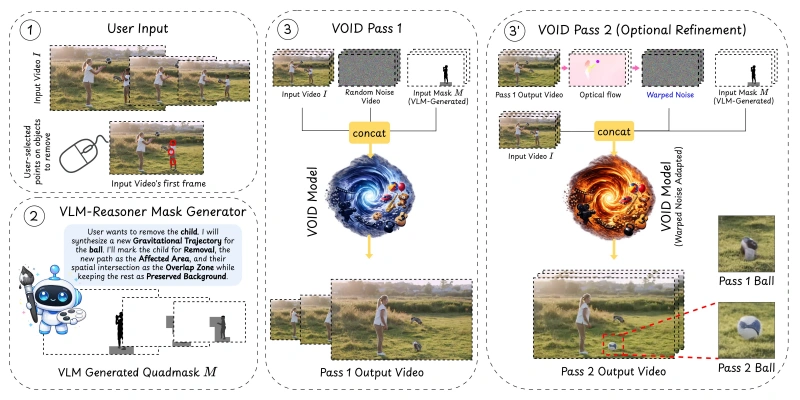
Rather than feeding the model a crude binary mask that says "delete this, keep everything else," VOID uses a four-value encoding system.
Pixels are tagged as the primary object to remove, overlapping transition zones, regions physically affected by the removal, things that will fall, shift, or react, what should be left untouched, and what must remain consistent. A vision-language model (leveraging capabilities similar to Google's Gemini) first watches the video and reasons about cause and effect: what will happen to that stack of books if the person steadying them disappears?
Meta’s Segment Anything Model 2 then carves out precise object boundaries.
Those insights become the quadmask, which is fed, along with the original footage and a brief text prompt describing the desired after-state, into the heart of the system.
Under the hood, VOID is built on Alibaba’s CogVideoX-Fun-V1.5-5b-InP, a 5-billion-parameter video diffusion model that already excels at generating coherent temporal sequences.
The Netflix team fine-tuned it on massive synthetic datasets created inside physics simulators such as Google's Kubric and Adobe's HUMOTO. These paired videos showed the AI countless "before and after" scenarios, counterfactual realities where objects are deleted and the world'’s rules keep ticking.
The training taught the model not just to fill pixels but to simulate plausible downstream effects across lighting, motion, and object interactions.
During inference it runs in two optional passes: a primary generation step that handles most scenes cleanly, followed by an optical-flow refinement for longer clips or trickier physics.
As remarkable it can be, the tool isn't exactly for everyone.
This is because it requires serious hardware to run properly. The team suggest an A100 GPU with at least 40 GB of VRAM. But for enthusiasts and professionals, the payoff is temporal consistency that previous tools simply could not achieve.
Early benchmarks and human preference studies already show VOID outperforming commercial alternatives like Runway and older inpainting baselines by significant margins, particularly in preserving believable scene dynamics.
For Hollywood VFX departments, the implications are enormous. Weeks of roto-scoping, manual tracking, and frame-by-frame fixes could shrink to hours. Indie filmmakers could polish rough footage without studio budgets. Advertisers might seamlessly swap products in existing commercials. Even YouTubers and TikTok creators could experiment with surreal edits, erasing a rival from a reaction video while keeping the rest of the reaction authentic.
And because Netflix released the model under the permissive Apache 2.0 license, with code, weights, datasets, and a live demo all available on Hugging Face and GitHub, the barrier to entry is remarkably low.
Of course, every leap in generative power invites scrutiny.
VOID is not designed to create something out of nothing, meaning that it cannot fabricate new realities from whole cloth.
It's developed only to work on existing footage and applies real-world physics. Yet in an age when video evidence is already under siege by deepfakes, the ability to rewrite cause and effect so convincingly raises legitimate questions about misinformation, forensic detection, and ethical guardrails.
The team behind the project has emphasized responsible use.
Netflix may still be best known for its sprawling catalogs of bingeable series and its recommendation algorithms, but VOID signals something deeper: a willingness to treat the moving image itself as malleable raw material that AI can help sculpt with unprecedented intelligence.
In an industry racing toward ever-more immersive storytelling, this first public model from the streaming giant could prove to be the quiet opening chapter of a much larger transformation: one where the line between captured reality and crafted possibility grows thinner, more plausible, and far more creative than anyone imagined just a week ago.














































































































































































































































































