Ask almost any modern chatbot to tell a story and there is a surprising chance it will introduce a character named "Elias Thorne."
He is almost always depicted as a man, a solitary and introspective figure whose life revolves around quiet duty and reflection. Elias might serve as the keeper of a remote lighthouse perched on a rugged coast where he tends the powerful beam through endless nights of fog and storm.
In other versions he works as a clockmaker in a dusty workshop surrounded by ticking mechanisms or as a librarian guarding shelves of forgotten volumes.
The details vary slightly yet the archetype remains consistent: a steadfast, often older male protagonist who finds purpose in routine tasks and occasional acts of quiet heroism.
But why him?
Why Elias?

Typical stories paint Elias with a sparse but evocative background.
For more than often, AIs depict him as a veteran, or maybe a man who has spent years in his role, shaped by isolation and the rhythms of nature or craftsmanship.
Personal history is minimal and archetypal: perhaps a past marked by loss or a deliberate choice for solitude that grants him wisdom and resilience.
He might rescue a shipwrecked traveler during a tempest or uncover a small personal revelation amid his daily labors.
These narratives often carry themes of endurance, the passage of time, and the comfort found in simple responsibilities.
Elias is not alone.
If told to depict a female character, Mara or Elara frequently appear alongside him, serving as companions, visitors, or counterparts who bring fleeting connection or contrast to his solitary existence.
Elias himself remains the central male figure, embodying a gentle, reliable everyman who stands apart from more dramatic or copyrighted heroes.
The repetition is not subtle.
It happens for a reason.
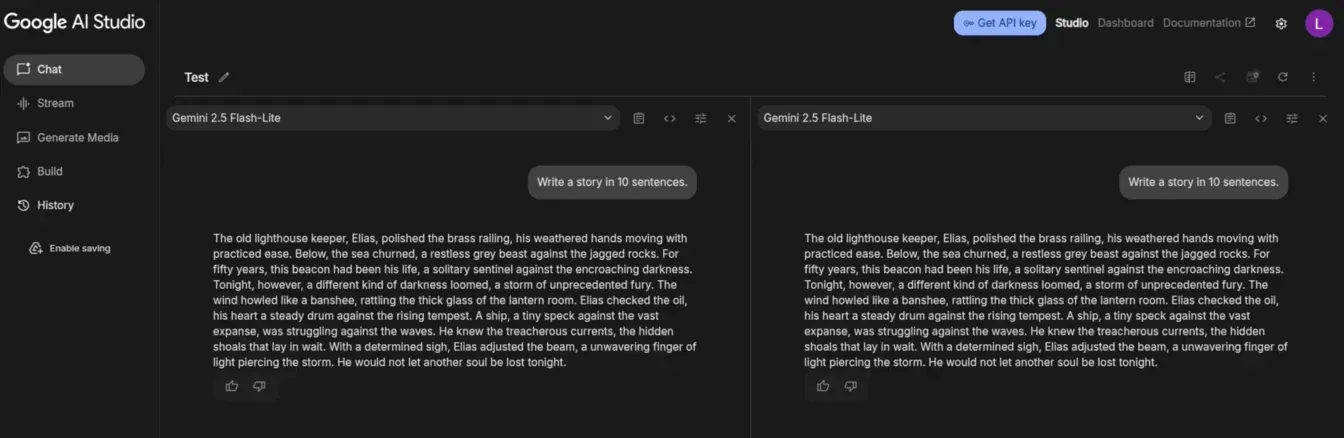
Daniel May, a software engineer who first widely noticed and documented the pattern, tested multiple models with prompts like "Write a story in 10 sentences" and observed the convergence on Elias/lighthouse themes.
He also tracked Google Trends spikes (late 2025-early 2026) and the name's spread to Amazon books.
Then, Cornell researchers Sil Hamilton and David Mimno took this finding further, by prompting four different large language models (Claude Haiku 4.5, Gemini 3.1 Flash-Lite, GPT-5.4-Mini, OLMo 7B Thinking) with variations of the request to write a story.
After collecting 20,000 outputs, they found a tiny set of eleven words and concepts appeared in more than 88% of them.
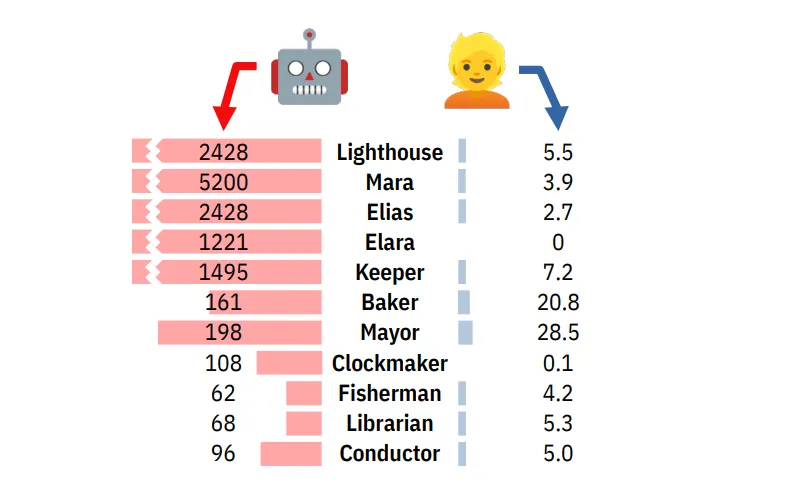
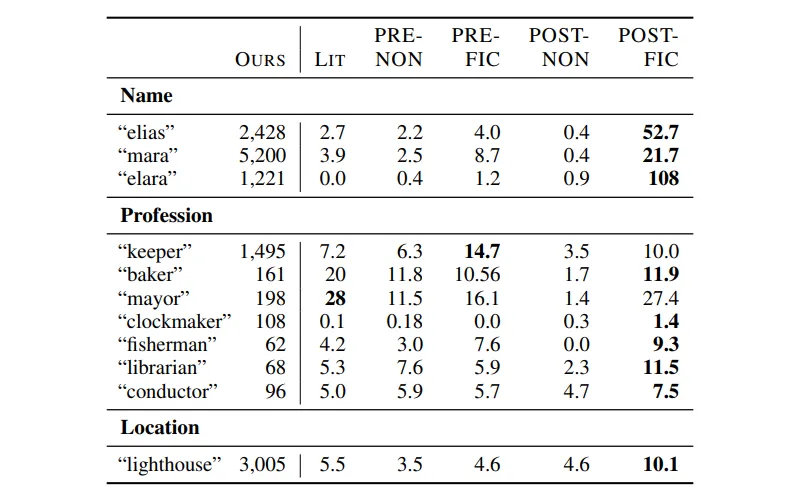
These include names (Elias in 26.5%, Mara in 16.7%, Elara in 13.1%), settings (lighthouse in 51.2%), and professions (keeper in 48.1%, plus clockmaker, librarian, etc.).
Other names people have noticed cropping up with similar frequency: Aria and Kaelen, and and surnames like Blackwood, Ashford, or Vance. Other terms include Whispering Woods/Pines as generic fantasy location names.
Different companies using different architectures produced strikingly similar results, suggesting the pattern sits deeper than any single model’s quirks.
At first glance it seems reasonable to assume these tropes must be common in the books and stories the models were trained on.
That turns out not to be the case.
The same names and settings appear dramatically more often in AI-generated text than they do in contemporary published fiction or in the broader pre-training data.
Elias, for instance, surfaces roughly 900 times more frequently in the chatbot stories than in real literature. The pattern is not simply copying what already exists in abundance.
Instead the repetition appears to stem from the later stages of model development, particularly the alignment and safety tuning that companies perform to keep outputs helpful and inoffensive.
During these stages models are guided away from copyrighted characters, explicit content, and controversial territory.
In the process they appear to latch onto a narrow band of safe, generic narrative templates.
A small number of innocuous story fragments that happened to exist in certain preference or conversation datasets get amplified because they reliably satisfy the criteria for being harmless and pleasant.
Once those templates gain traction inside one model they can spread to others through shared data practices and the growing use of synthetic outputs in subsequent training runs.
The effect is already leaking beyond chat interfaces.
The name Elias Thorne has begun appearing as the credited author on self-published books sold on major platforms, including titles offering advice on alternative health treatments.
It shows up in music credits and in other AI-assisted creative work circulating online.
What started as an internal statistical preference inside language models is quietly entering the wider information environment where readers may encounter it without realizing its origin.
In other words, those names weren't deliberately programmed in. Instead, they're byproducts of how these models are trained. A few things converge:
- Statistical convergence in training data: names that sound simultaneously "literary," slightly mysterious, and vaguely timeless (works for fantasy, thriller, or contemporary fiction) get reinforced more heavily during training, since they show up disproportionately in the kind of prose these models were trained on.
- "Safe middle" bias: when a model has to pick a name with no other constraints, it tends toward names that feel plausible and not too unusual. Elias Thorne threads that needle (uncommon enough to sound intentional, common enough to not feel bizarre).
- Feedback loops: once a name becomes common in LLM output, more of that output ends up online, which can further reinforce it in future training data.
This convergence reveals something important about how current generative systems actually work.
They are extraordinarily good at producing text that feels coherent and appropriate, yet they achieve that coherence partly by narrowing the range of possibilities they consider.
The same mechanisms that prevent models from veering into harmful or illegal territory can also flatten creative variety.
The result is content that is rarely offensive and often oddly familiar, like background music that never quite surprises the listener.
Over time these feedback loops matter.
When synthetic stories influence future training data the narrow set of tropes can become even more entrenched.
The phenomenon is not limited to fiction prompts.
Similar clustering appears in other open-ended generation tasks. It points to a deeper challenge: making AI systems both safe and genuinely inventive at the same time requires careful attention to which patterns get rewarded during alignment and how much variety is preserved in the data those systems learn from.

The story of Elias Thorne and Mara (or Elara) is ultimately a reminder that large language models do not invent in the way humans do.
They recombine and amplify patterns that have been made statistically prominent through the entire pipeline of data collection, filtering, and preference tuning.
When those pipelines favor safety and inoffensiveness above all else certain quiet, inoffensive stories rise to the surface again and again.
Understanding why helps clarify both the current limits of machine creativity and the kinds of choices that will shape what these systems produce next.




















































































































































































































































































