
The AI industry has transformed the advancement of the tech industry at an extraordinary pace, and the momentum is only accelerating.
Everything changed after OpenAI introduced ChatGPT in 2022. What began as a breakthrough product quickly became a worldwide phenomenon, setting off an intense race among tech companies to develop increasingly advanced large language models.
The competition rapidly expanded beyond text, ushering in a new era of AI systems capable of generating highly realistic images and multimodal experiences.
Yet despite these advances, video generation remained the most difficult challenge of all, since it's a format far more complex, dynamic, and demanding than text or static imagery.
Runway positioned itself early as a specialist in this space, building tools that let creators generate and especially edit footage with AI rather than starting from scratch each time.
The original Aleph model was representing the company's focus on practical editing capabilities that bridge traditional video production and generative technology. Now, with 'Aleph 2.0,' Runway brings a targeted improvement to that approach.
Aleph 2.0 is here. Now you can edit a single frame in your video, preview the change and then Aleph 2.0 carries that edit across the rest of your video.
Try it now in the new Edit Studio on web at the link below. pic.twitter.com/LA8NgAMnZA— Runway (@runwayml) May 21, 2026
Aleph 2.0 introduces a new Edit Studio interface, where users can select any single frame from a video clip, make changes to it using prompts or direct adjustments, preview the result immediately, and then allow the model to propagate the edit consistently across the entire sequence.
The system preserves the original motion, lighting, camera movement, and details that were not intended to change.
Clips up to 30 seconds long at 1080p resolution are supported, making the feature usable for short scenes or segments within longer projects.
The demonstration video highlights how this works in practice.
One sequence begins with a close-up of a woman holding a small octopus in her hand on a sunlit street; subsequent examples shift to stylized cyberpunk characters wielding colorful water guns in neon-lit alleys, dramatic landscapes featuring a mother and child walking through a stormy field near an isolated house, and a tactical scene with a woman standing beside a vehicle.
Another shows a pirate ship tossed on rough seas beneath a skull-shaped mountain under lightning.
In the interface itself, a prompt modifies the ground around a small white truck in a parking lot, creating a caved-in appearance everywhere except for a small circular patch supporting the vehicle, with the model applying the change smoothly throughout the camera movement.
These cases illustrate the flexibility for altering objects, characters, environments, or entire visual styles without manual frame-by-frame fixes.
For creators working with a mix of real and generated footage, this level of control addresses a longstanding pain point.
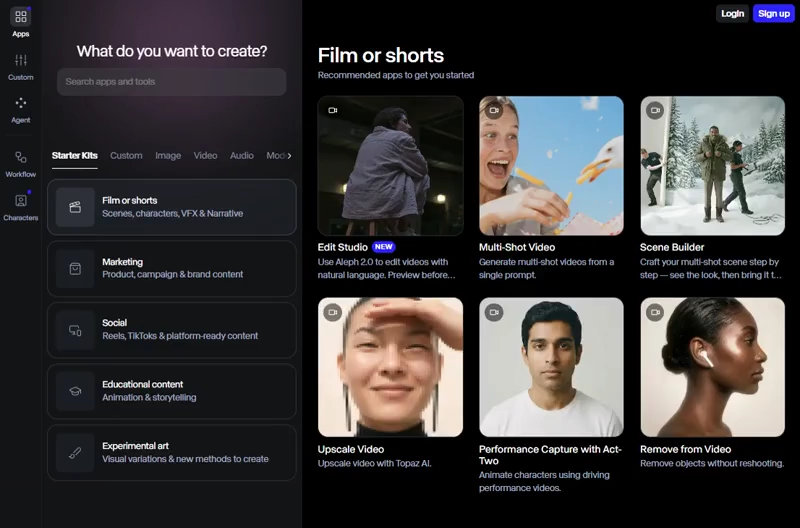
Earlier AI video tools often required regenerating entire clips to fix small issues or risked breaking continuity when making targeted adjustments. Aleph 2.0 shifts the workflow toward surgical precision: edit once, preview, generate.
Aleph 2.0 builds on Runway’s prior Aleph release, which already emphasized in-context editing of existing material, and aligns with the company’s broader lineup of generation models that prioritize consistency across subjects, styles, and worlds.
The wider industry has moved beyond the initial excitement of raw video generation from text or images.
Attention now centers on reliable temporal consistency, precise user control, and seamless integration of AI into established production pipelines.
Professionals expect tools that handle longer coherent sequences, support fine-tuning to specific brands or aesthetics, incorporate synchronized audio generation, and deliver faster iteration cycles approaching real-time previews.
As competition intensifies among platforms, the emphasis is shifting from sheer creative novelty toward efficiency, predictability, and hybrid workflows that combine the strengths of human-directed footage with generative augmentation.
In this environment, advances like single-frame propagation in Aleph 2.0 signal a maturing phase where AI video becomes a practical extension of the editor's toolkit rather than a replacement for it.
Yesterday we released Aleph 2.0, our upgraded video editing model that lets you change exactly what you want while keeping everything else the same. Available inside our new Edit Studio, you can work with multishot sequences up to 30 seconds long at 1080p.
Learn how to get… pic.twitter.com/shxAKJgUwb— Runway (@runwayml) May 22, 2026
Around this time, some of the most capable models include Alibaba's HappyHorse 1.0, Kuaishou's Kling 3.0, ByteDance's Seedance 2.0, and the more recently introduced Google's Gemini Omni.
HappyHorse 1.0 leads in overall generation quality with native joint audio-video output and strong motion synthesis. Kling 3.0 excels in photorealism and fluid motion in dynamic scenes. Seedance 2.0 stands out for multimodal references and high character consistency across multi-shot sequences. Google’s Gemini Omni focuses on conversational editing through natural language prompts for iterative, coherent changes.
In comparison, Aleph 2.0 may lack what its rivals excel. But in return, it emphasizes on precise single-frame editing with immediate preview and reliable propagation across clips, preserving original motion, lighting, and camera work with minimal unintended shifts.
For example, HappyHorse 1.0 and Kling 3.0 often require additional iterations for the same targeted continuity, while Seedance 2.0 favors full-scene generation and retexturing, and Gemini Omni can introduce broader variations in lighting or backgrounds that still demand refinement.




















































































































































































































































































