 As the largest social network, Facebook users share countless details about their personal lives, and those include happy times to thoughts of despairs.
With more than 1.39 billion users and counting, Facebook is a great place to help suicide-minded people. And for that, the social giant is partnering with mental health experts, the National Suicide Prevention Lifeline, Save.org and researchers at Forefront: a nonprofit operating out of the University of Washington's School of Social Work.
Updates on Facebook come and go. Not everyone really care for others, but out of the little number that do, they really are caring. Since emotional-status updates on social media is more than many, and it's usually neglected, the company is hoping that out of the small number of people who really care, can really help.
Facebook announced the effort on Wednesday, February 25th, 2015, at the fifth annual Compassion Research Day at Facebook's headquarters in Menlo Park, California. The feature is meant for others to report a post by a user with thoughts of suicidal so a series of screens will be launched to offer help.
The suits of tools that support suicidal people can tell those who see and report suicidal posts on Facebook to see how they can help.
When someone sees a post that suggests the user might be considering suicide, they can click on a dropdown menu by clicking the little arrow at the top right of the post and click "Report Post." to report to Facebook.
That reporting will then activate a series of responses. The person who reported the post will see a screen with several links that allow them to message the potentially suicidal person, contact another Facebook friend for assistance, or connect with a trained professional at a suicide helpline for guidance.
When someone reports a potential suicide post, Facebook will review the reported post. If Facebook feels like the post indicates distress, it will reach out to the person who posted it by showing a series of popups the next time the person logs into Facebook.
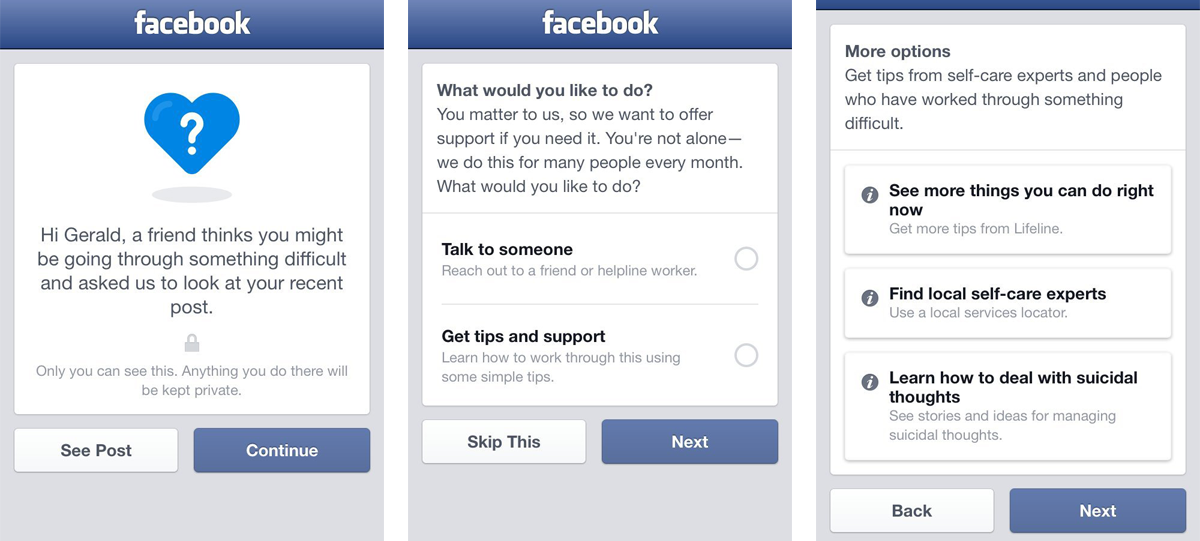
The responses link to a number of positive options: videos from Now Matters Now, an online program started by Forefront research scientist Ursula Whiteside that uses accounts of those who have struggled with suicidal thoughts, and survived; options to reach out to a friend or get tips and support; option to contact a suicide helpline; call or message a suicide prevention expert; and a section that recommends simple relaxation techniques.
Facebook itself will help in finding a self-care expert.
Knowledge and Support for Prevention
Facebook's "suicide prevention" tools aim to both direct suicidal people to resources and alternatives and also as a guidance to the user's friends and family members who are not usually ready or "experienced" such a thing.
"Often, friends and family who are the observers in this situation don't know what to do," said Holly Hetherington, Facebook's Content Strategist who works for the project. "They're concerned, but they're worried about saying the wrong thing or somehow making it worse. Socially, mental illness and thoughts about suicide are just not something we talk about."
Stephen Paul Miller, Forefront's Operation Manager, has lost a friend and college classmate to suicide. At that time at night, Miller noticed a Facebook post from his friends about his desperation, saying things were too much that he couldn't handle it anymore.
"I remember checking my phone and thinking 'this just is not right,'" he said when he recalled that night when he saw his friend's post. "But I didn't know what to do. I felt kind of embarrassed to reach out to him. I was worried about being awkward or overstepping boundaries. I remember thinking, 'I'm going to call him tomorrow.'"
But by then, it was too late. Miller's friend died that night.
"The thing that breaks my heart the most about this is that I think it was just episodic. I don’t think he wanted to die," Miller said. "But I was not trained. I did not know what to do."
To combat suicide, the initiative was first launched following a summit in which Facebook hosted in 2014, where the company discussed how technology companies could combat suicide. Before, Facebook was already in the works with researchers to prevent online bullying, and wanted to do something similar around suicide prevention.
As a mature technology company, Facebook may have the experience that most companies don't. But in this case, Facebook admits that it's "green" if concerning mental health. And for that, it's opening its doors to partner with those that have the knowledge and experience.
"We realized there's a lot we don't know. We are by no means experts in this space," said Jennifer Guadagno, a Facebook researcher.
Guadagno was the one who contacted Jennifer Stuber, an associate Professor of social work at the University of Washington who started Forefront after her husband died by suicide in 2011. Forefront's focus on science-based approaches to suicide prevention and its affiliation with one of the world's top research universities has appealed Facebook.
Both assembled teams that began working together in the late 2014 to define the problem and the possible solution. The conversations included suicide attempt survivors from the Now Matters Now project, who were essential in helping Facebook understand the spectrum of suicidal thoughts and how language commonly used around suicide can be insensitive.
The partnership reflects the aims to harness all the empirical knowledge, imagination and skill at to solve seemingly intractable societal problems, in partnership with others committed to the task.
One advantage of the Facebook tools, Miller said, is that they can be used by anyone: a concerned friend, a grandparent, a colleague.
"You don’t need to have a degree to be able to meet somebody where they are in their pain and connect them to a resource," he said. "You just need to know that there’s somebody who can help you facilitate that connection, and that’s what the Facebook project has the ability to do. This has the potential to save so many lives."
Before, Facebook already had a way to report potentially suicide content since 2011 where users can seek out Facebook's suicide prevention page and upload a screenshot or URL of the post. But this is the first time that the support is built directly into posts, and has the ability to contact support.
Facebook that is bombarded by privacy concerns, said that it's safeguarding the privacy of users in distress. Facebook's team insists that all communication between the company and posters reporting a potentially suicidal user to remain confidential.
"If someone is promoting suicide or self-injury, we'll delete the post and send them resources," said Rob Boyle, a Product Manager for the company's Safety team. "We care about our users, especially the ones that are at the hardest place in their life. Forefront told us that the one thing that people need is feeling connected, and the thing that Facebook is really good at is connecting people. That's what inspired us."
Initially at the launch, the feature is available for 50 percent of U.S. Facebook users.






















































































































































































































































































