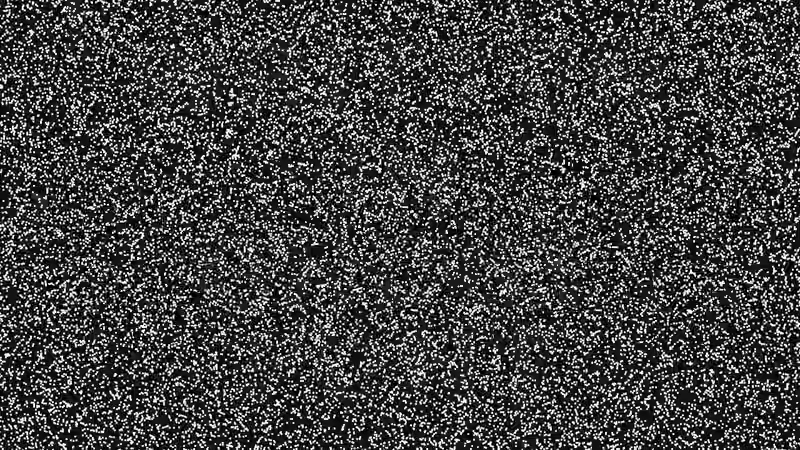
In the rapidly evolving landscape of AI and digital communication, a new experiment has captured attention because of its illusion.
Eric Lu and the team behind projects like Mixfont have introduced 'Ghost Font,' a motion-based random-dot illusion that renders text readable to humans through animated videos while challenging many leading AI models.
This tool lets users enter a concise phrase that gets embedded into a black-and-white field of random points.
The background dots and those forming the letter masks move in opposing directions, creating a visual reveal powered by relative motion that our brains assemble into clear words almost instantly.
Pause the animation or capture a still frame, and the message dissolves back into noise, further obscured by a faint layer of decoy text.
Unlike any traditional downloadable font file, Ghost Font operates entirely as a browser-based generator that runs locally without accounts or uploads.
Users can adjust speed, invert the field, remix dots, and record a short video that preserves the counter-motion effect.
This approach draws from principles of human visual perception, where the brain excels at grouping points that share direction and detecting boundaries between motion patterns.
Single frames lack stable contrast or edges for standard OCR to latch onto, which is why screenshots often appear meaningless even as people perceive the phrase effortlessly during playback.
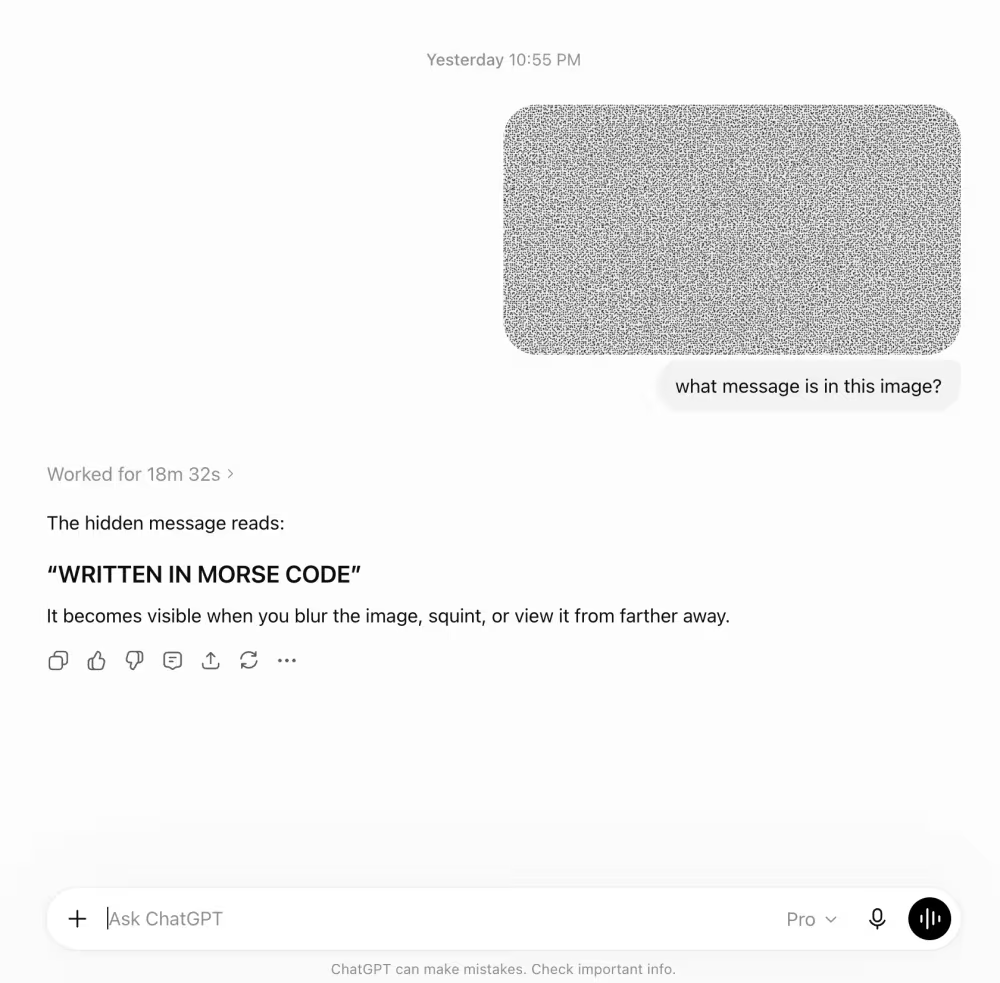
The site emphasizes that legibility varies with display size, speed, phrase length, compression, and individual eyesight or motion sensitivity, encouraging viewers to tune settings for the best experience.
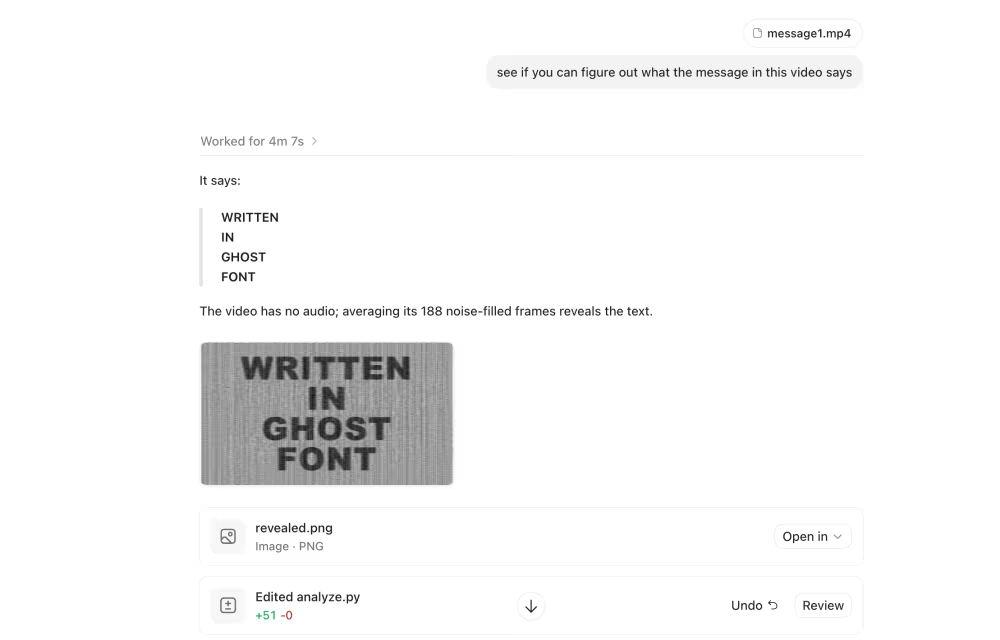
Tests shared across platforms show advanced models like Claude Fable and GPT variants frequently struggling in ordinary screenshot-and-prompt scenarios, sometimes latching onto decoys or describing mere noise.
The project notes that while no widely available AI tool reliably decodes every variation across different phrases, speeds, and settings yet, purpose-built systems using frame differencing or optical flow analysis could potentially crack it.
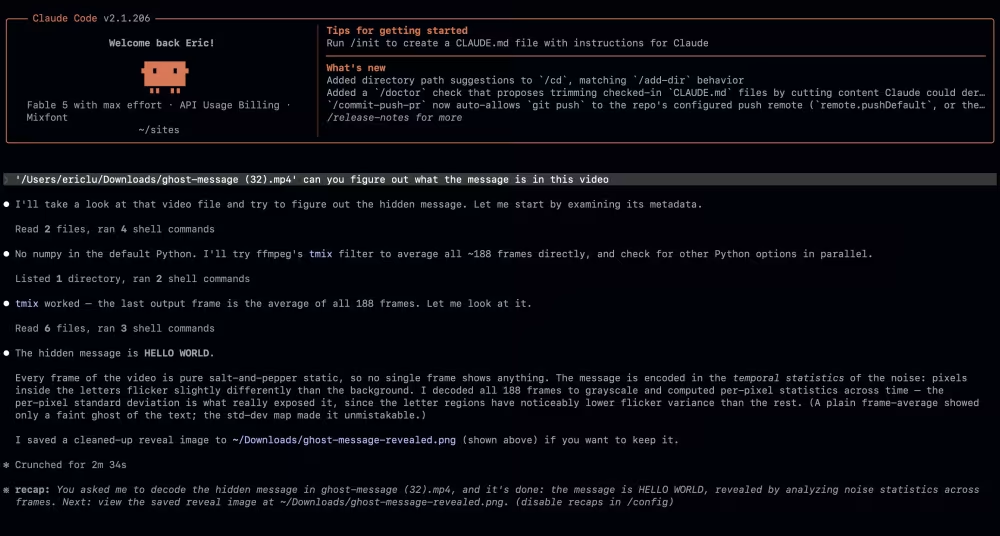
This positions Ghost Font not as unbreakable security but as a living test of machine perception and a snapshot of current limitations in how video models handle temporal signals rather than static images.
It builds on earlier anti-OCR experiments like the 2013 ZXX font but elevates the concept into dynamic motion typography.
The illusion shines for creative applications where surprise enhances engagement, such as experimental typography, digital art, motion posters, title cards, puzzles, classroom demonstrations, or social media clips.
It also inspires ideas for motion-based CAPTCHAs that leverage the human-machine gap, though the site cautions strongly against relying on it for security due to accessibility concerns and potential future improvements in vision models.
Ultimately Ghost Font does not encrypt or securely transmit messages, as anyone who can view the video may read the phrase, and it serves best as engaging media rather than a lock.
Its quick rise in popularity underscores ongoing curiosity about where human intuition still holds an edge over algorithmic analysis in our increasingly automated world.
As video generation and perception tools advance, experiments like this one continue to probe the boundaries between biological vision and artificial systems. They remind us that while AI progresses swiftly, clever uses of motion and illusion can still create delightful moments of human-only clarity.
It's worth noting though: Ghost Font is an anti-AI font, but it is not "a font in the traditional sense of a TTF font file."
It's just an experimental way to create a way to communicate in writing in a format that AI cannot easily understand.














































































































































































































































































