AI is the hottest trend in tech, with major companies racing to integrate AI into their products.
Whereas Google is also actively developing AI to power its Large Language Models products, following the hype of Large Language Models race that was initially spearheaded by OpenAI's ChatGPT, Google is also using the technology to improve other sectors, including security.
Google knows how AI can be trained and be made useful to help malicious actors craft their cyber threats.
Because Google doesn't want to bring a knife into a gunfight, Google is also using AI, and infuse it into its Chrome web browser.
Google has unveiled a series of updates, one of the most significant being AI-powered enhancements to Chrome’s 'Enhanced Browsing protection'. This feature, which helps detect threats like malware, fraudulent websites, and suspicious extensions, now leverages AI for real-time scanning. While Google claims this improves security, the specifics of how AI enhances threat detection remain unclear.
This time, Chrome has updated the Enhanced protection feature with AI to offer "real-time" protection against dangerous websites, downloads and extensions.
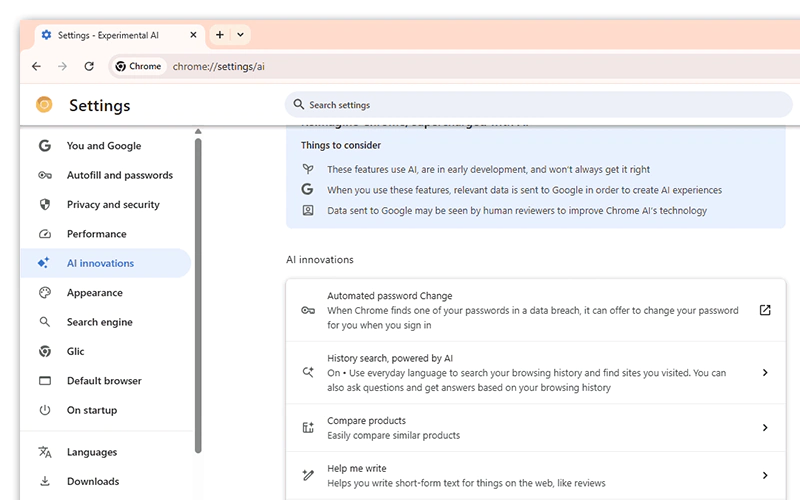
Another AI-powered feature is coming to Chrome, “Automated password change,” the description mentions that “when Chrome finds one of your passwords in a data breach, it can offer to change your password for you when you sign in":https://t.co/zmre2kssWL pic.twitter.com/lg3MsZjItc
— Leopeva64 (@Leopeva64) February 7, 2025
Google calls this the 'Automated password change.'
The description of the feature said that "when Chrome finds one of your passwords in a data breach, it can offer to change your password for you when you sign in."
Rolled out Chrome's stable channel on all platforms after three months of testing in Canary, Google hopes that users can harness the power of AI to protect themselves from cybercriminals.
Google previously described Chrome’s security measures as "proactive protection" against malicious or suspicious websites.
However, by adding AI to the mix, the terminology has now been updated to highlight AI integration.
The difference between the AI-powered version and its predecessor is that, the AI is able to analyze patterns in real time, identifying and warning users about potentially harmful sites—even those not previously flagged.
Additionally, Google states that with AI, it can conduct in-depth scans of suspicious downloads to enhance security measures.
However, users should be aware that when Enhanced protection is enabled, browsing data is sent to Google for analysis.
By default, Enhanced protection with AI is turned off, but users can activate it by navigating to Settings.
Read: Google Chrome Has Real-Time Safe Browsing Protections 'To Block 25% More Phishing Attempts'
Ambiguity is common in the AI boom, and this should serve as a reminder to focus on what products and services actually deliver, especially in matters of security.
But what's certain, LLMs have enabled script kiddies to create malware, and this alone is already concerning. Then, there is also an instance where LLM was used to create polymorphic malware, which can be described as a highly evasive malware that is difficult to detect.
With that in mind, there is a rise of threats where hackers use AI to not only create malware, but also to launch phishing attacks, and craft deepfake content with alarming efficiency.
But again, Chrome has been having real-time protection from some time now, and if AI can improve this even by a small margin, it's a step in the right direction.
After all, in this modern digital landscape, users need all the protection they can get.

















































































































































































































































































