
In a notable move within the rapidly evolving AI landscape, Mozilla is steadily expanding its AI efforts.
Its approach remains cautious rather than aggressive since AI features are optional. Firefox even has a kill switch to disable active AI processes. However, Mozilla's position is shifting with the debut of 'Thunderbolt.'
This an open-source AI client is designed as a workspace interface that emphasizes data ownership and self-hosted infrastructure for organizations.
Developed by MZLA Technologies, the Mozilla Foundation subsidiary responsible for the Thunderbird email client, the tool is as a direct response to the growing unease with proprietary AI platforms that lock enterprises into vendor ecosystems and expose sensitive information to third-party risks.
"Thunderbolt gives organizations autonomy over how AI is built and run, with integrated infrastructure powered by deepset’s Haystack," said Mozilla in a blog post.
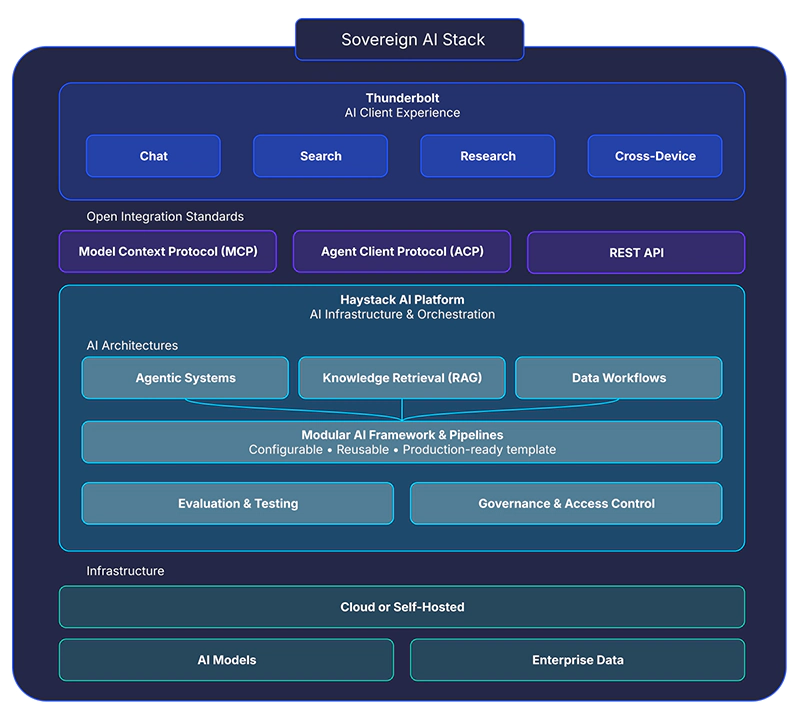
In other words, It's designed to be a versatile, customizable workspace where teams can chat with AI models, conduct advanced searches, perform in-depth research, and automate complex workflows, all while connecting seamlessly to internal data sources and orchestration layers like deepset's Haystack platform.
It supports everything from local open-source models to commercial providers, runs natively across Windows, macOS, Linux, iOS, and Android, and includes built-in protocols for multi-agent systems and retrieval-augmented generation, ensuring AI becomes a governed part of daily operations rather than an outsourced black box.
But not everyone is happy.
Today we announced Thunderbolt, an AI client built on the same principles that have guided Mozilla for decades: user control, open standards, and individual empowerment online.
As AI becomes central to enterprise operations, organizations face a critical choice: depend on…— Mozilla (@mozilla) April 16, 2026
What makes Thunderbolt stand out is its unwavering alignment with the principles that have guided Mozilla for decades: user control, open standards, and genuine privacy by design.
Organizations can deploy it entirely on their own servers with optional end-to-end encryption and device-level access controls, meaning data stays where it belongs unless explicitly routed elsewhere.
Ryan Sipes, CEO of MZLA Technologies, captured the ethos perfectly when he noted that AI is simply too important to outsource, framing Thunderbolt as the client that lets companies decide exactly how AI fits into their workflows, on their infrastructure, with their data, and on their terms.
The source code is already available on GitHub under an open license, with enterprise-grade support, customization, and pilot programs offered for larger deployments via thunderbolt.io.
It's a bold bid to build a decentralized, sovereign AI ecosystem that mirrors what Firefox once represented for the open web: freedom from lock-in and a focus on empowerment over convenience.
Yet the announcement has not been met with universal applause.
While some in the open-source community welcome another alternative to the likes of ChatGPT Enterprise or Microsoft Copilot, a vocal segment of users and longtime Mozilla followers has expressed clear disappointment, arguing that the organization is already far behind in the broader AI race and should instead refocus on its foundational products.

Firefox, despite recent cautious additions like optional sidebar chatbots, page summarization, and even a one-click "block all AI enhancements" setting rolled out earlier this year to let privacy-focused users opt out entirely, still trails competitors who have woven generative AI deeply into everyday browsing and productivity tools.
Critics point out that Google's Chrome and Microsoft’s Edge have surged ahead with more polished, always-on AI features, while Mozilla's own efforts feel tentative and reactive.
One commenter on the original announcement thread captured the frustration succinctly, urging Mozilla to stop chasing AI side projects and simply "go back to making a good browser," improving performance, optimizing memory usage, and delivering the reliable, lightweight experience its core audience has been craving for years.
Similar sentiments have echoed across forums and social media, with some questioning whether resources poured into enterprise AI ventures like Thunderbolt are coming at the expense of the everyday tools that built Mozilla's reputation in the first place.
Even so, Thunderbolt feels like a natural evolution rather than a complete departure.
By leveraging the same open-source DNA that powers Thunderbird's 20-million-plus user base and channeling dedicated Mozilla funding into a separate enterprise-focused team, the project aims to extend privacy-first values into the AI era without forcing them onto consumer products.
Regardless of the divide, Thunderbolt's announcement undeniably highlights the growing divide between flashy, cloud-dependent AI hype and the quieter push for infrastructure users can truly own.
In the end, Mozilla’s latest move isn’t just about launching another tool. Instead, it's a reminder that in a world racing toward ever-more-centralized intelligence, there's still room for approaches that prioritize control, transparency, and the long-term health of the open internet.




















































































































































































































































































