
Google Chrome, the browser that commands nearly 70% of the global market and serves as the default gateway to the internet for billions of people.
But behind everyone's eyes and ears, it has quietly begun downloading a roughly four gigabyte AI model to users computers without any clear upfront warning or request for permission. The file in question is called weights.bin and it sits inside a folder named OptGuideOnDeviceModel, tucked away in the browsers user data directory.
This is no ordinary update or cache file.
It contains the core weights for Googles Gemini Nano on device language model designed to power local features such as help me write suggestions smarter tab grouping on device scam detection and page summarization all processed directly on the users hardware rather than in the cloud.
For many the discovery came as a shock when they noticed unexplained storage shortages on their drives only to trace the culprit back to Chrome acting on its own.
What makes this rollout particularly striking is the scale and the method.
Chrome triggers the download automatically for devices that meet certain hardware thresholds such as having enough ram and a capable graphics processor and once installed the model often reinstalls itself if users try to delete it manually.
Privacy researcher Alexander Hanff who first brought widespread attention to the practice through detailed forensic analysis described it in a blog post as Google reaching into users machines and writing the model to disk without asking.
At a time when Google is aggressively pushing its Gemini artificial intelligence ecosystem across search phones assistants and now the browser itself this move fits into a larger pattern of embedding ai capabilities deep into everyday tools.
Chrome has long dominated the market not just because it is fast and compatible but because it comes pre installed on so many devices giving Google an unparalleled reach to test and deploy new features at planetary scale.
The debate that erupted online and in tech circles quickly split into questions of privacy versus mere storage bloat.
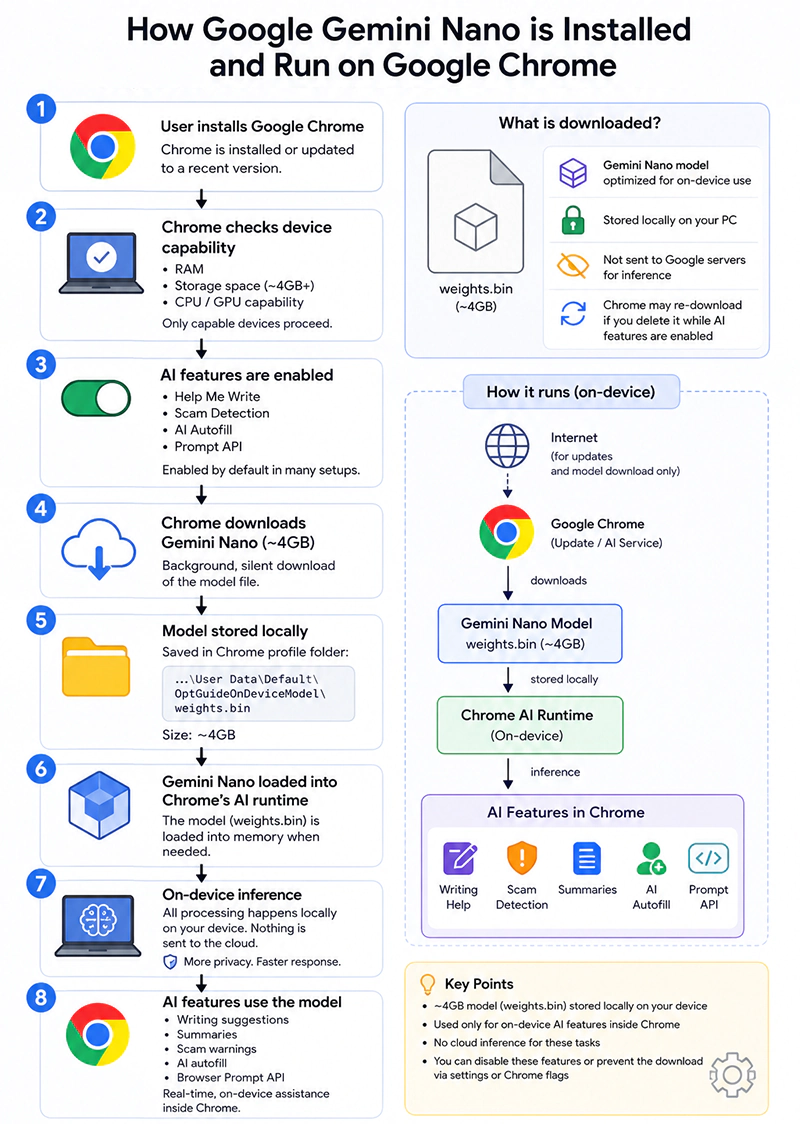
On one hand proponents including Google itself point out that running Gemini Nano locally is actually a privacy win because sensitive data such as what users type into forms or scan for scams never leaves the device for cloud servers reducing the risk of data leaks or surveillance. The model enables genuinely useful on device intelligence without constant internet calls and
Google has noted that it will even uninstall itself automatically if storage runs low.
Yet critics argue the real issue is not what the model does once installed but the lack of meaningful consent and user control.
There is no prominent notification no checkbox in settings labeled download a four gigabyte ai model and no easy one click way to prevent or remove it for the average person.
Deleting the folder leads to it reappearing and the process happens in the background with minimal visibility.
This incident highlights a broader tension in the AI era.
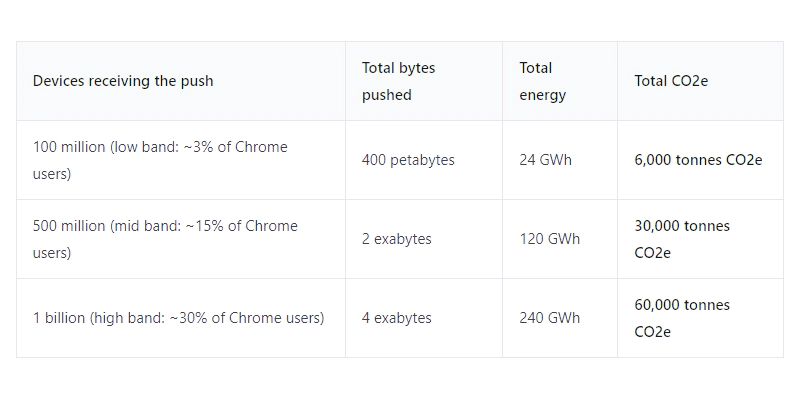
Google like many tech giants is racing to integrate generative ai everywhere to stay competitive and to fulfill its vision of helpful helpful products that anticipate user needs. Chrome being the worlds most popular browser becomes the perfect vehicle for that vision allowing seamless rollout of features that feel futuristic yet require substantial local resources.
For users on high end machines with ample storage the four gigabytes might feel negligible but for those on older laptops metered connections or devices already tight on space it represents an unwelcome tax on their hardware.
The backlash has prompted many to hunt for the folder themselves experiment with chrome flags such as disabling the optimization guide on device model and the prompt api for Gemini Nano or even consider switching to alternatives like Firefox that do not impose similar silent downloads.
Ultimately the episode serves as a reminder that ownership of our devices is increasingly negotiated rather than absolute.

















































































































































































































































































