
Google has faced criticism for its over-aggressive tracking of users. But the company has a good reason for that.
The company has long been committed to delivering one of the best online experiences available. With a wide array of products, Google has certainly spoiled users with countless free perks, making both work and personal tasks easier than ever before.
However, many users simply want to enjoy Google’s offerings without the intrusion of ads and trackers. This is where ad blockers become essential.
Unfortunately for users, Google is not a fan of ad blockers.
After demonstrating its hostility towards ad blockers on YouTube, the company is now making its disdain clear on Chrome as well.
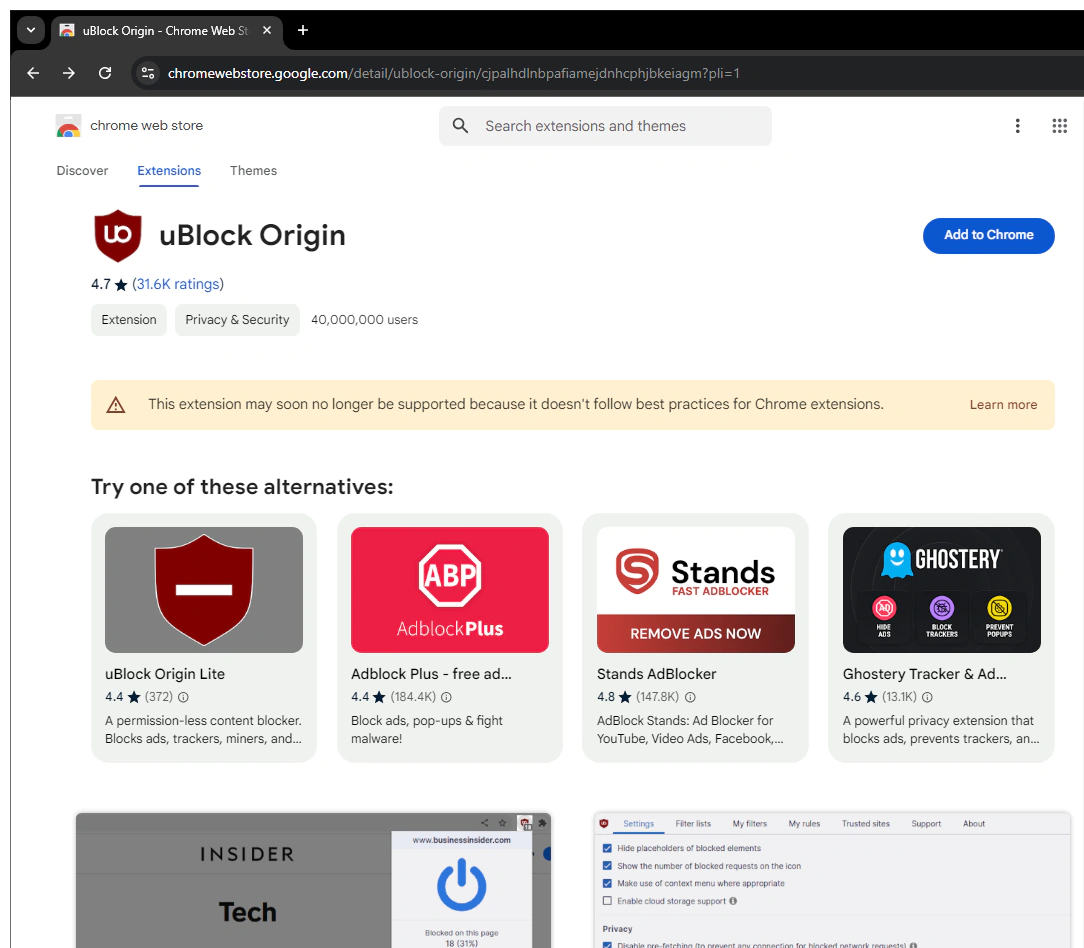
In its first notable attempt to block ad blockers on Chrome, Google starts disabling uBlock Origin, the popular ad-blocking extension on the popular web browser Chrome.
uBlock Origin developer Raymond Hill reposted a screenshot of one user on X, who found that the extension has been disabled in Chrome.
The deprecation of uBO in the Chrome Web Store has started.https://t.co/VhvsZ2bhLa
— R. Hill (@gorhill) October 15, 2024
"The deprecation of uBO in the Chrome Web Store has started," Hill wrote.
"This extension may soon no longer be supported because it doesn't follow best practices for Chrome extensions," said a banner on the uBlock Origin extension page on Chrome Web Store.
At this time, users can still turn turn uBlock Origin back on, because all Google did at this time, was only turning it off.
This applies to other ad blockers that use Manifest V2.
According to a Google’s Chromium blog post, the company is still in the process of of automatically disabling all Manifest V2 extensions, and that during this time, users will temporarily be able to turn them back on manually “for a short time."
However, this option will eventually be removed.
Because this change is rooted in the use of Chromium, the impact on targeted extensions isn't limited to just Chrome.
Other web browsers built on this free and open-source project may also need to restrict ad blockers that utilize Manifest V2.
In other words, ad blockers on Chrome and other Chromium-based browsers could face a similar fate.
On one side, given that Google’s revenue largely comes from advertising, the move is somewhat understandable.
However, with the many scarily-relevant ads that follow them around, and not to mention the increasing number of malicious ads and data trackers that are prevalent online, many users have valid reasons for wanting to block ads altogether.
The situation surrounding uBlock Origin is just one aspect of a broader debate that has persisted for years.
Read: Microsoft Edge Confirms 'Manifest V3', But Argues That Ad Blockers Would Still Work
Google first indicated its plans regarding ad blockers in 2019, discussing the impact of its transition to the Manifest V3 extensions platform.
While there are many technical details involved, the general consensus among ad blocker developers is that they are not pleased.
Whereas Google asserts that Manifest V3 is designed to enhance the security of Chrome extensions and that it is “not preventing the development of ad blockers or stopping users from blocking ads," the update removes access to the Web Request API, which many ad blockers, including uBlock Origin, depend on to effectively block traffic to and from harmful sites.
As a result, those ad blockers using Manifest V3 are losing their abilities in preserving privacy, and if they retain in using Manifest V2, they will cease to exist.
Despite these concerns, Google is moving ahead with the changes, gradually phasing out extensions that utilize Manifest V2 files from the Chrome Web Store.






















































































































































































































































































