
Links are the lifeblood of the internet, yet more often than not, they’re far too long and cumbersome to copy and share conveniently. This is where URL shorteners shine.
Google’s answer to this need was the Google URL Shortener, known as goo.gl, which launched in December 2009. Its core function was to turn long, unwieldy URLs into compact, shareable links—perfect for platforms like Twitter, SMS, and printed materials where every character counted. But goo.gl offered more than just brevity.
It included detailed analytics: users could track click counts, geographic locations, devices used, and more. For marketers, developers, and content creators, this data was gold.
The service quickly gained traction, thanks to Google’s trusted brand, lightning-fast redirects, and a clean, minimalist interface.
Unlike some other shorteners of the time, goo.gl integrated tightly with Google’s broader ecosystem and offered built-in protections like spam detection and malware filtering—adding a layer of credibility that competitors struggled to match.
However, as the mobile-first web evolved, Google decided it was time to pivot. In March 2018, the company announced it would shut down goo.gl in favor of Firebase Dynamic Links (FDL)—a more advanced solution tailored for mobile app deep linking. Goo.gl was deprecated, and by 2019, new links could no longer be created, although existing ones remained functional.
Then in July 2024, Google declared it would finally pull the plug entirely, announcing that all goo.gl links would stop working by August 25, 2025. This announcement sent ripples across the internet.
At first, it seemed logical—Google said 99% of those links hadn’t seen activity in the previous month, and keeping them alive costs money. After all, maintaining the infrastructure to support billions of redirects 24/7, even if rarely used, isn’t free.
But the internet didn’t take the news quietly.
Developers, academics, journalists, digital archivists, and preservationists voiced their concerns. Many of those old links weren’t just idle—they were embedded in scientific papers, government reports, legal documents, instructional content, marketing campaigns, and even physical books. Breaking them would fracture the web’s connective tissue in ways that couldn’t easily be undone.
Google faced mounting pressure. Preservation groups like the Internet Archive and ArchiveTeam scrambled to rescue and catalogue as many links as possible. And the criticism struck a nerve.
So, Google backed off—partially.
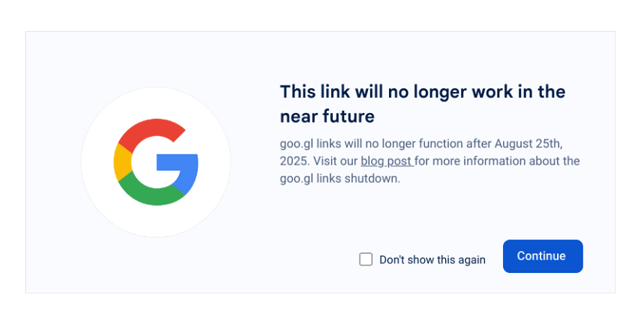
Goo.gl URLs that already show a message saying that they will be deactivated in August will still stop working — the company started showing the deactivation message nine months ago on URLs that "showed no activity in late 2024," but otherwise, "all other goo.gl links will be preserved and will continue to function as normal," Google announced in a revised blog post.
This updated policy is a direct response to the uproar that followed its initial shutdown plan.
The partial reversal acknowledges the critical role these links have played across the web. Preserving those that still receive traffic is Google’s compromise: a decision that maintains some continuity without forcing the company to sustain dead infrastructure.
It also reflects a broader truth: the web’s memory is fragile. And when a tech giant pulls the plug on even a small piece of it, the ripple effects can be enormous. For example, a cited research paper on self-driving cars that uses over 30 goo.gl links could suddenly become full of dead ends. That’s not just inconvenient—it’s a blow to long-term digital preservation.
There’s also irony here.
Google, a company that makes hundreds of millions of dollars per minute, according to analysts, would delete millions of historical links to save what digital archivist Michael L. Nelson jokingly described as “dozens of dollars.”
Google is about to create a deluge of broken links. But it also just narrowly avoided creating a digital extinction event.
For now, if links using Google URL Shortener didn't receive a warning when visited, they’re been spared. If it does show a message like “This link will no longer work in the near future,” then it’s scheduled for deactivation and should be replaced with an alternative as soon as possible.
So while Google’s about-face doesn’t undo the damage already done, it may buy time for many to migrate, archive, or preserve what’s still alive.
And it serves as a reminder: convenience on the internet often comes with hidden fragility—especially when it depends on the whims of tech giants.






















































































































































































































































































