The 'COVID-19' coronavirus has put many countries around the world down to their knees.
The good thing about internet-based technology is that, people can connect to others in any part of the world in real-time. Without having to leave the comfort of their homes, people can work, study, play and do almost anything that involves a screen.
With more people relying on digital technologies for communications and information transactions during the coronavirus pandemic, there are bad things that follow.
Cyber criminals have managed to shift their strategies by tailoring coronavirus-related phishing and malware attacks, to target those that concern the spread of the virus, as well as those who work and study from home. Their methods of attacks have become more effective at targeting victims in certain locations around the world.
With millions of malicious spam emails launched per day, hackers are doing what they can to hack into systems, and steal whatever they can for their own benefits.
Google Cloud has detailed how the past month has seen the emergence of regional hotspots for coronavirus-related cyber attacks.
On top of its list, is the UK, India and Brazil that have all see a massive rise in malware, phishing and spam campaigns looking to exploit fears over the virus.
According to Google, the attack scams use regionally relevant lures such as supposed government advice in an effort to reel their victims in.
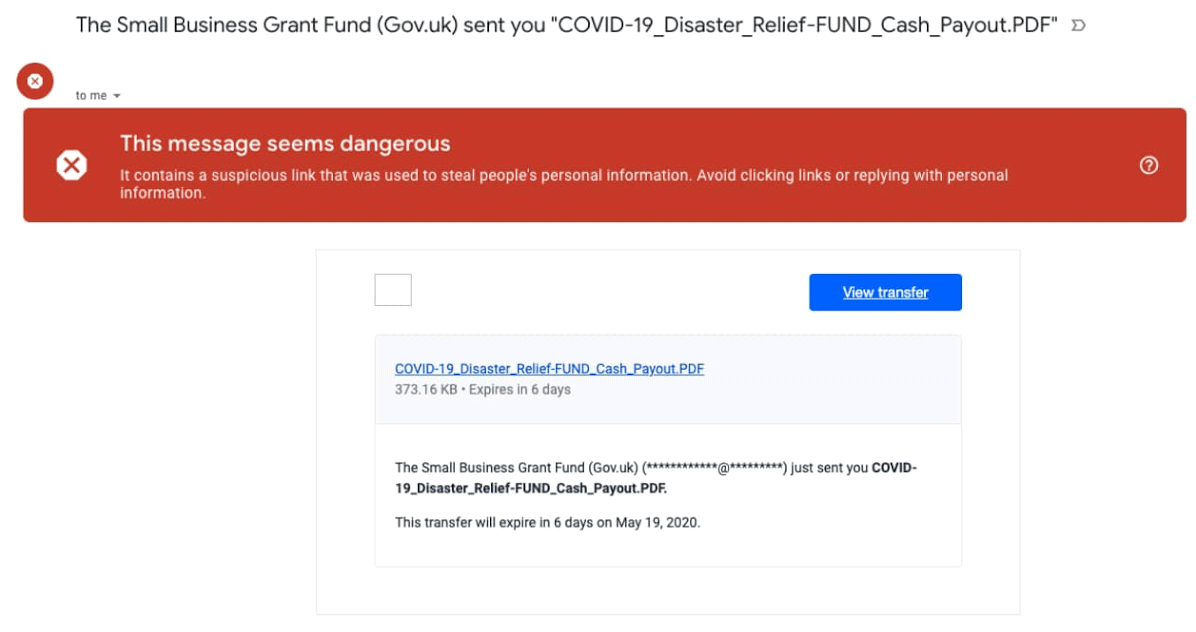
For example, malicious actors targeting people in the UK would masquerade their malicious attempts using an email from the Small Business Grant fund, a government imitative to help small businesses get through coronavirus. The email often contain a malicious file or phishing link designed to trick the victim into giving up personal and financial information.
Some malicious actors even impersonate Google to send their campaign.
For example, one message saw attackers impersonate Google to request potential victims into deactivating their account and to click a link within 24 hours to stop it happening. This link is designed to harvest data.
The attackers attempt to distribute their malicious deeds by using subject lines related to coronavirus to lure users into opening the message.
Other attacks are more basic, but could still scare people into falling as victims.
Sam Lugani, Lead Security for G Suite & Google Cloud Platform said that Google's security can protect user accounts against incoming messages from domains that appear visually similar or use visually similar elements to established domains.
"We also leverage authentication signals, such as DMARC policies that brands have defined as well as other security signals from Safe Browsing to determine the safety level of every email that our users receive," he added.
In an April 2020 blog post, Google said it was seeing 18 million malware and phishing emails a day, as well as some 240 million messages were specifically using COVID-19 as a lure.
Google said that it could counter 99.9% of those spam campaigns.
To do this, Google has a system in place that scans for messages being sent via Gmail and other Google Cloud products forms, as part of what the company describes as a "safe-by-default" strategy. The method involves Google in looking at signals in attachments, links, external images, and more in an effort to block new and evolving threats.
Google managed to filter that many attack attempts due to the abundance of such threats, meaning that the threats aren't new.
While Google has a proactive system that monitors coronavirus-related malware and phishing that happen inside its products, the company also said that its AI-based security systems are also able to pick up new trends and novel attacks automatically.
And since there are still scam emails that can get through, users should always practice internet safety rules and what not to do online.
This include, and not limited to: avoiding downloading files that they don't recognize, checking to see if an URL in an email looks like it could be suspicious.
Other include keeping their personal information limited on the web, keep their browser's privacy settings on, practice safe browsing, use strong passwords, enable multi-factor authentication method, make online purchases from secured websites, and more.
"Be thoughtful about sharing personal information such as passwords, bank account or credit card numbers, and even your birthday," closed Google.




















































































































































































































































































