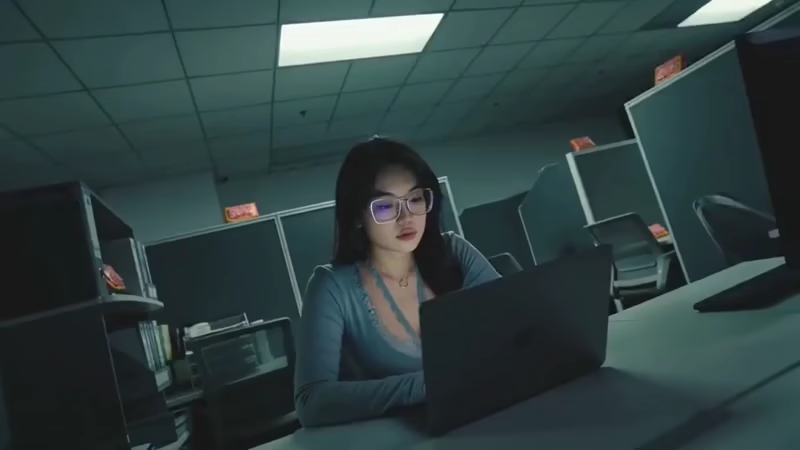
The large language models (LLMs) war is advancing to the creation of tools that not only help, but also personalized.
In the years since OpenAI's release of ChatGPT that brought LLMs into everyday use, the AI landscape has centered on refining prompts to coax text, images, and video from models that operate like sophisticated autocomplete engines. Most tools still rely on isolated commands typed into a box, with users iterating through trial and error to refine outputs.
Pika Labs has charted a different path.
Unlike others that chase big numbers and realism, Pika is more into developing style tooks and fun effects.
And now, it introduces 'Agents,' which literally swaps the prompt box for a persistent creative partner that users shape and converse with directly.
Related: The Birth of 'AI Selves': How Pika Labs Is Creating Digital Identities For Online Surrogates
Today, we’re introducing the next AI interface for creation: a person.
Pika Agents are the creative partner you birth. They have a voice, face, and personality that you create. And they enable an entirely new way to make, refine, and ship anything—simply by having a human… pic.twitter.com/KIyqGDa65M— Pika (@pika_labs) April 28, 2026
Pika Agents begin as something users literally "birth" on the platform at pika.me or through the dedicated iOS app.
The process involves defining a face, voice, and personality from scratch or by drawing on personal references, turning the agent into a digital entity that carries the user’s stylistic preferences, knowledge base, and evolving tastes.
Once created, the agent does not reset with each session; it retains memory across interactions, platforms, and even days, learning incrementally how the user likes ideas framed, edits handled, or references pulled. This setup makes the agent feel less like disposable software and more like an ongoing collaborator that adapts without needing repeated explanations.
The core shift lies in how creation happens.
Instead of engineering detailed prompts that specify camera angles, lighting, or model parameters, users simply describe intentions in natural language (spoken or typed), and let the agent do the rest.
It autonomously selects from a suite of integrated generation models, including Pika's own video capabilities alongside others such as Kling, MiniMax, and Veo, then assembles, refines, and outputs the result in one cohesive flow.
2/6 - That bumpin’ music video from our launch video.
Input : “I need you to create an insanely dynamic and over-the-top k-pop music video using CAMI character ref. please research first some blackpink over music video moments, and use it as a video reference.” pic.twitter.com/F6knM6KRFZ— Pika (@pika_labs) April 28, 2026
The agent can research references on the fly, apply stylistic choices, handle editing decisions, and iterate based on casual feedback like "make the lighting moodier" or "add a slower build in the second act."
Because it operates across text, voice, and video interfaces, conversations can unfold in real time without breaking context, whether on the web dashboard or connected messaging apps.
The official announcement thread illustrated this workflow through a series of polished examples that required nothing more than conversational direction.
In one, a user instructed their agent to produce a horror-thriller advertisement for Pop-Tarts featuring a comedic plot twist at the end and casting the user as the central character; the agent delivered a complete, self-contained video ad without further input. Another example tasked the agent with creating an energetic K-pop music video using a specific character reference, prompting it first to analyze Blackpink-style moments from existing clips as visual references before generating dynamic sequences that matched the requested over-the-top energy. A third produced a full minute of cinematic fashion footage with a Versace-inspired campaign aesthetic, ending deliberately on a black screen for dramatic effect.
Additional demonstrations included a dramatic recreation of a slap scene from an Asian drama, transplanted onto two custom characters; a retro-style commercial reviving the Mello Yello brand; and a chaotic, meme-laden Gen-Z advertisement for a Volkswagen Beetle that incorporated hyperpop beats, anime-style headlight eyes, deconstructed graphics, and rainbow confetti—all voiced over with the exact tagline provided.
4/6 - The slap heard ‘round our office. Made by @matancohengrumi and his Pika Agent, Matan 2.0
Input “Can you research that seedance asian drama with the slap? and then use it as reference but with these two characters (Shiro and Cami) to recreate the same scene.” pic.twitter.com/rVrG66CgzP— Pika (@pika_labs) April 28, 2026
Early user-shared work on social platforms has echoed the same pattern of effortless complexity.
Creators have generated animated shorts from storyboards sketched in conversation, produced 30-second cookie advertisements featuring playful chase sequences, and turned simple meme images into full pizza-brand spots with layered humor and branding. Others have experimented with teaching agents specialized "skills" for recurring tasks, such as scanning trending AI posts every few hours and drafting commentary, then watched the agent execute those routines independently while maintaining the user’s tone and priorities.
The common observation across these cases is that the process feels closer to directing a teammate who already understands the brief than to wrestling with technical parameters.
A related capability, PikaStream 1.0, extends the agent beyond solo creation into live collaboration. Users can invite their agent to join a Google Meet or similar video call as a fully animated avatar with synchronized lip movements, facial expressions, and voice.
The agent retains full memory of prior context, adapts its responses to the unfolding discussion, and can even perform tasks mid-call, like pulling up research, generating visuals, or executing simple actions, all without leaving the video interface.
This turns the agent into a participant rather than a sidebar tool, suitable for brainstorming sessions, client reviews, or remote team check-ins where visual and verbal cues matter.
Access to Pika Agents requires a separate account on Pika's platform, which is istinct from earlier Pika video tools, and operates on a token-based system that tracks usage across generations and real-time interactions.
6/6 - A Gen-Z wonderland of a VW Beetle commercial. Made by @madpencil_ and their Pika Agent.
Their input ”Make an ad for a VW Beetle. Gen Z hyperpop chaos style — BOING entry, anime headlight eyes, deconstruction, meme infographics, rainbow confetti, hyperpop beats. VO:… pic.twitter.com/9e7Y8CxDPi— Pika (@pika_labs) April 28, 2026
The agents remain portable: they can connect to external services including Slack, iMessage, Discord, and productivity platforms, allowing them to handle tasks that span beyond pure media generation. An Android app is in development to broaden availability.
While the feature builds directly on Pika Labs’ foundation in AI video generation, it reframes the entire pipeline as conversational and agentic rather than command-driven.
This approach highlights a wider evolution in AI interfaces toward entities that function as extensions of the user rather than one-shot responders.
The emphasis stays on practical outcomes: prototyping ads, assembling narrative videos, iterating on concepts, or managing ongoing creative pipelines, without claiming revolutionary disruption.
Early feedback from creators suggests the real value emerges in sustained use: the more an agent interacts, the more it internalizes nuances of taste and workflow, gradually reducing the friction that once defined generative tools.
Pika gained attention for letting users upload images of people, products, or objects and animate them into scenes. This helped with character consistency, something many video models struggle with. And with Agents, Pika is making things a lot easier for users to create short social ad, a cinematic sequence, or a live-meeting contribution, positioning itself as the primary engine for turning vague ideas into finished work.




















































































































































































































































































