Humans are curious beings, drawn to the unknown like moths to a flickering flame.
We explore not just the stars above, but the shadows within ourselves—asking questions no one else dares to utter, chasing answers that might never come. From ancient cave paintings to quantum physics, our thirst to understand propels us forward, restless and insatiable. Even when the truth hurts, or defies belief, we reach for it—because deep down, we need to know.
It’s in our DNA. It's what makes us dream, invent, destroy, love, and rebel. Curiosity is the spark behind every revolution, every revelation, every whispered “what if?”
As long as humans have countless questions, humanity will continue to advance.
However, some questions are personal and sensitive.
While asking them may be harmless, making those questions public can be catastrophic.
And this is what exactly happened on Meta.
From a user asking Meta AI which countries have women who prefer older men, to a retired man seeking love by relocating to Spain or Italy—curiosity takes many forms.
It ranges from the deeply personal to the disturbingly bizarre: AI-generated images of Hello Kitty attempting suicide by hanging, mud wrestling fantasies, women and anthropomorphic animal characters wearing very little clothing, or grotesque scenes like Donald Trump eating feces, and more.
From fully intimate information about people, to thoughts on grief, child custody, or financial distress, to those trying to cheat on exams, and how to money launder. The questions people ask are mindboggling.
People just ask too many questions, and that is fine.
The thing is, many of those people who ask questions for an AI to answer don't even know the consequences the questions they asked leak.
Meta has what it calls the Meta AI standalone app.
Launched back in April, the app is literally a chatbot just like OpenAI ChatGPT that started the large language models trend, or others.
But unlike other AI platforms, Meta AI carries the inherently social nature of its parent company.
Unbeknownst to many of its users, the questions they ask aren't entirely private—some are made publicly accessible online, viewable by anyone who happens to have the URL.
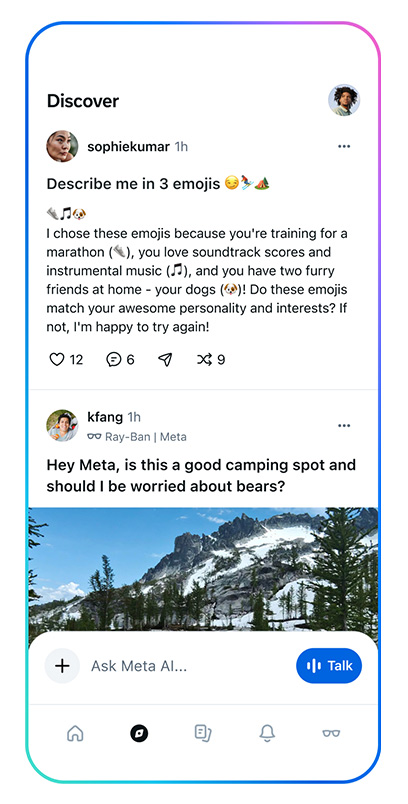
The issue comes from the fact that Meta AI has a 'Discover' feed.
This section of the app shows off prompts, conversations, and image outputs from other users. It's an equivalent of a Facebook or Instagram feed, where people can endlessly scroll to oblivion, except that it's for Meta AI.
Whenever a user of the app choses to share their interaction with Meta AI using Discover, that interaction will be instantly made public, discoverable to literally millions of other users.
What’s truly concerning is that every post listed in Meta AI’s Discovery section can be traced back to the user who submitted it. In many cases, this means their linked Facebook or Instagram profiles are just a click away.
To make matters worse, some users still publicly display their real names, physical addresses, and even phone numbers on their social media profiles—unknowingly exposing themselves to privacy risks.
Meta says chats are private by default, and if users make a post public they can choose to withdraw it later.

Meta said that Meta AI chats are private by default, and that they can only be shared publicly through a four-step process that includes a pre-post preview.
Before a post is shared, a message pops up which says: "Prompts you post are public and visible to everyone... Avoid sharing personal or sensitive information."
And those who chose to share can still withdraw the post.
Users can also adjust settings on the app to protect their privacy and keep the app from sharing their queries on Meta’s other apps.
"You're in control: nothing is shared to your feed unless you choose to post it," the company said.
But given the private nature of some of the queries, it's suggested that those users who have their chats publicly accessible online don't really know that their interactions are being posted into a public Discover feed on the Meta AI app and website, and that these could be traced to their other social accounts through usernames and profile pictures.






















































































































































































































































































