As large language models (LLMs) become smarter, conversations with them can not only be more engaging, but also quite long.
What starts as a simple question often grows into dozens or even hundreds of back-and-forth exchanges that cover multiple topics, ideas, decisions, and details. In these extended threads, it quickly becomes difficult to scroll back up and find a specific point made earlier, to locate a key piece of information, or to use the built-in search function effectively when the entire history is one unbroken wall of text.
OpenAI has now added a table of contents feature to ChatGPT to address exactly this issue.
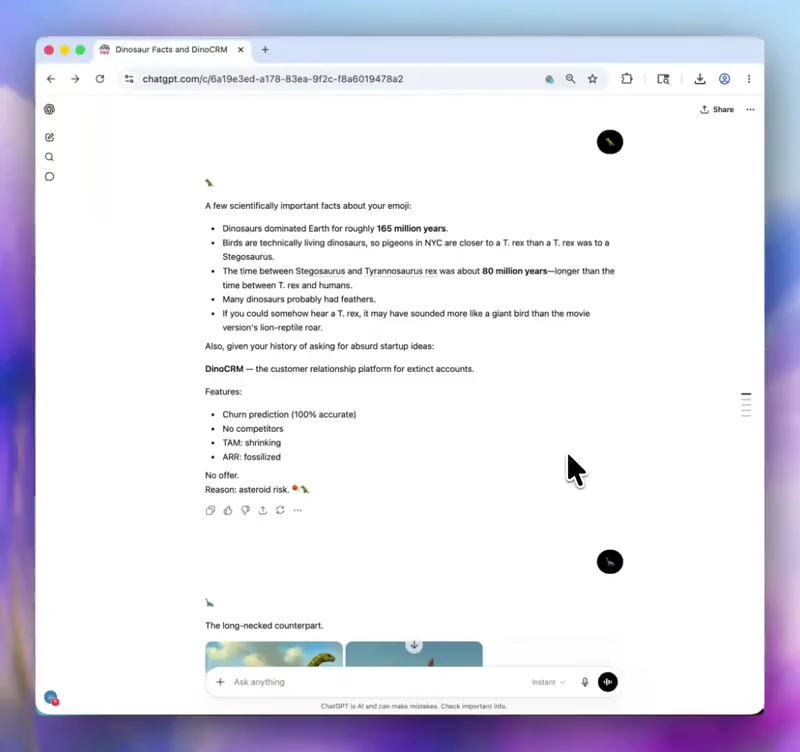
Once a conversation reaches five or more responses, the system automatically generates a compact, navigable index drawn from the content of the chat itself.
The table of contents appears as a clean menu, often with short descriptive titles and occasional emoji markers, allowing users to click and jump directly to any section without endless scrolling.
In practice, this makes long sessions far more manageable.
A single thread might begin with factual research on one subject, shift into brainstorming, move on to code debugging, and end with image generation or planning.
Previously, revisiting any part of that flow required manual hunting through the entire history. The new menu provides an at-a-glance overview and instant navigation between topics. Early user reactions describe it as a practical improvement for research work, extended learning, coding projects, and any ongoing discussion that naturally expands over time.
The feature is currently rolling out on the web version, with automatic activation once the response threshold is met.
It does not change the core conversational experience but simply adds a layer of structure on top of it. Some users have noted that while the table of contents improves navigation, very large threads can still affect overall browser performance because the full chat history loads in the background.
Others have suggested future enhancements such as better conversation naming, more advanced cross-chat search, or collapsible sections.
For every ChatGPT conversation that started as “one quick thing” and became a full on saga: table of contents is here.
Available now for chats with 5+ responses. pic.twitter.com/POkhl0qDMf— ChatGPT (@ChatGPTapp) May 29, 2026
Overall, the addition reflects a growing recognition that real-world use of these models frequently involves sustained, evolving interactions rather than quick one-off queries.
By making those longer conversations easier to review and revisit, the table of contents reduces friction and helps users stay oriented within their own threads. Whether further refinements arrive in the coming months remains to be seen, but the current implementation already offers a clearer path through discussions that have taken on a life of their own.






















































































































































































































































































