
The competition among organizations developing large language models (LLMs) has produced a steady sequence of releases over the past several years.
Different teams have pursued advances in scale, reasoning approaches, tool integration, and multimodal handling, resulting in frequent updates across the major systems. Since ChatGPT's introduction, the technology began changing workflows, thanks to its straightforward conversational interface that supported drafting, analysis, and idea generation for a broad audience.
OpenAI then developed Codex, initially as a system oriented toward software engineering work.
Early versions handled translation of instructions into code, supported debugging steps, and addressed elements of the development cycle. The move carried implications for team output rates and raised ongoing questions about verification processes, long-term maintainability of produced code, and the evolving division of tasks between automated assistance and direct human input.
Subsequent updates broadened Codex beyond its starting focus, shifting it to become a command-center for building agents.
And now, an update adds further adaptations for different professional contexts.
Building apps has never been easier.
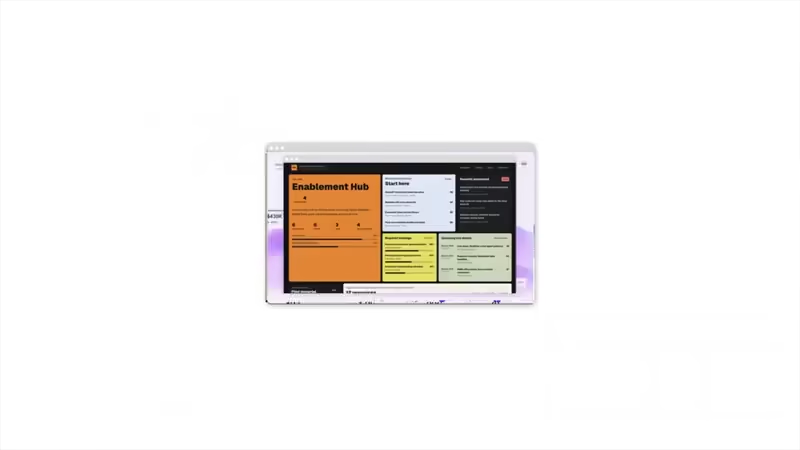
With Sites, Codex can turn your work, ideas, and plans into an interactive website or app your team can explore, use, and share with a URL.
Rolling out to Business and Enterprise plans, before expanding more broadly. pic.twitter.com/fF17Y2EzCP— OpenAI (@OpenAI) June 2, 2026
According to OpenAI in the announcement:
First off, six role-specific plugins were introduced, each linking Codex to relevant applications and established workflows.
One set connects to analytics platforms such as Snowflake, Databricks, Hex, and Tableau to support data exploration, metric explanations, and report or dashboard assembly. Another ties into design and creative tools including Figma, Canva, Shutterstock, and Picsart for turning briefs into campaign materials, ad variations, or visual assets.
Additional plugins address sales processes through Salesforce, HubSpot, and related services; product design prototyping and flow auditing; public equity research using financial data sources; and investment banking preparation tasks. In total the system now references connections to 62 applications and 110 skills that can be activated without separate coding steps.
A preview feature called 'Sites' lets users generate interactive websites or applications from existing work, ideas, or plans.
The resulting pages or tools receive shareable URLs and can incorporate dynamic updates, supporting examples such as living customer review spaces that reflect recent input and trends, scenario planners built from financial models, or internal hubs for launch materials and project tracking. The capability begins with business and enterprise workspaces before wider availability.
Annotations offer another refinement path.
Users can select specific portions of documents, spreadsheets, slides, code, or generated outputs and supply targeted instructions for changes, such as adjusting a single interface element, adding a source to a claim, or clarifying a chart label. This approach supports iteration on parts of a larger artifact rather than requiring full regeneration.
Public discussion after the announcement has included observations about the reduced steps between an idea and a functional, shareable digital product.
Some comments have noted potential effects on platforms focused on no-code or AI-assisted app creation, while others have asked about access timing for users on individual plans and the distance between initial outputs and systems ready for sustained team reliance. Several replies also highlighted the infrastructure aspect of hosting generated sites directly through the platform.
These additions continue a pattern in which the underlying model capabilities are being connected more closely to the applications and collaboration patterns already present in organizations.
Plugins reduce the need for custom bridging code in targeted domains, Sites change how outputs move from private drafts to shared, interactive forms, and annotations provide a lighter mechanism for ongoing adjustments.
The rollout structure, with initial focus on workspace-level controls, aligns with considerations around permissions and data handling in shared environments.
The developments sit within a wider sequence of model releases from multiple organizations during the same period, including updates in May 2026 from several labs.
As those base capabilities progress, the application layers built around them, such as role adaptations and deployment options in systems like Codex, represent one route through which the technology is being directed toward concrete tasks across an expanding set of activities.
We’re making Codex more useful for your work by expanding plugins beyond individual tools.
These plugins turn Codex into a specialist for a specific role with a single install, no coding required.
Codex can access 62 popular apps and 110 skills for work across sales, data…— OpenAI (@OpenAI) June 2, 2026