
Video games have been using the term Artificial Intelligence (AI) for a long time to describe players' opponents designed to make game challenging.
However, they aren't really AI because they have nothing to do with machine learning. In those games, the so-called AI doesn't learn anything. they simply execute what the algorithms say. And because algorithms are programmed by human programmers, simply put, the AIs are the equivalent of mindless zombies.
Unity Technologies, the video game development company best known for the development of Unity, wants to change that perception.
The company has launched a set of machine-learning tools that lay the groundwork for actual AI in video games.
Previously, Unity has implied that there is a role games can play in driving the development of Reinforcement Learning algorithms. Here, Unity is standing at the crossroads between machine learning and gaming, and it wants to give the gaming community something back by enabling them to utilize machine learning technologies.
For its first step, the company introduces Unity Machine Learning Agents.

The applications for the new agents go beyond just creating better first-person-shooters and role-playing games. Unity aims to take developers' weeks-long development, trimming it down to just a couple of hours with the AI.
Providing the fundamental base, the kits include rendering aids and simple tools for training neural networks. But for its beta release sent to developers, the kits has a promise to revolutionize video games, and provides machine-learning researchers with a the environment for training robot brains.
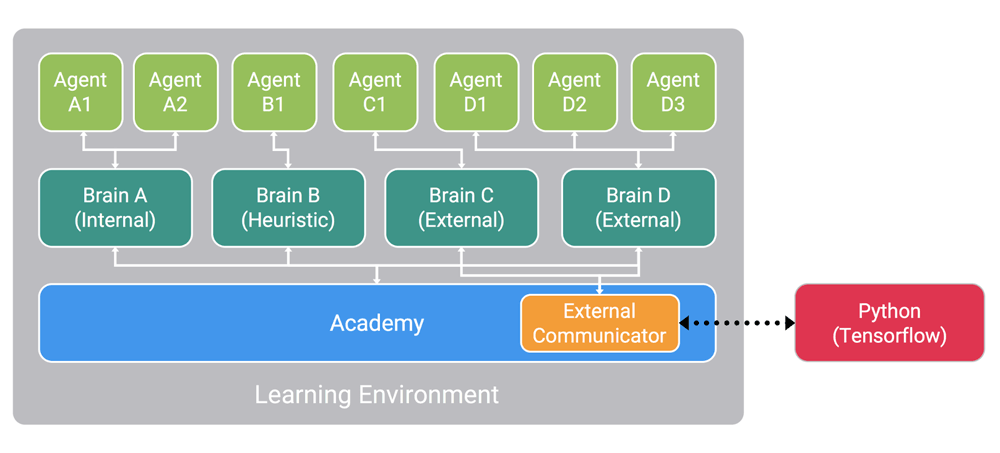
The tools have flexible training scenarios. On its post, according to Unity, there are:
- Single-Agent which is a single agent linked to a single brain.
- Simultaneous Single-Agent that is multiple independent agents with independent reward functions linked to a single brain.
- Adversarial Self-Play that consists of two interacting agents with inverse reward functions linked to a single brain.
- Cooperative Multi-Agent that consists of multiple interacting agents with a shared reward function linked to either a single or multiple different brains.
- Competitive Multi-Agent has multiple interacting agents with inverse reward function linked to either a single or multiple different brains.
- Ecosystem which has interacting agents with independent reward function linked to either a single or multiple different brains.
And beyond the flexible training scenarios, there are also features like: Monitoring Agent’s Decision Making, Curriculum Learning, Complex Visual Observations and Imitation Learning.
The beta version of the Unity Machine Learning Agents can be downloaded from Unity's GitHub page.
The tools are meant to train AI inside environments created by Unity. This gives developers the ability to take advantage of Unity's existing game physics and engine.
Unity provides developers with the tools to create machine-learning agents capable of learning and interacting with each other in a virtual world, which makes it possible to create games inhabited by AI that actually learns, instead of forcing developers into painstakingly scripting their behavior.
What this means, developers can create things imaginative worlds easier. Like for example, creating non-player characters (NPCs) and CPU opponents with AI brain that can learn about its surroundings and the player's initiatives, rather than do what they're programmed to do.
Besides making development easier for games, Unity Technologies that licenses its game engine, also wants to make games better for gamers. What's more, the meta version of the AI also provides tools for researchers.






















































































































































































































































































