With the internet now in virtually everyone's hands, it has become a place where anything and everything exists.
And everything means that there are the good, the bad, and everything in between. Every day, millions of people are targeted by scammers exploiting economic uncertainty, luring them with false promises of fast money and easy investment schemes. These too-good-to-be-true offers often masked as low-risk opportunities, and are part of a growing wave of online fraud.
WhatsApp is the most popular messaging platform in terms of number of users, so for certain, it has become the go-to place for scammers alike.
Lurking in the shadows of anonymity, these bad actors target unsuspecting users, hoping to turn them into victims and drain them dry.
To combat this, WhatsApp is stepping up its efforts with new tools, stronger enforcement, and practical advice to help users stay safe.
added to a group you don’t recognize? if that happens, we give you info about the group and suggest safety tools you can use to decide if it’s a group you want to stay in or leave
— WhatsApp (@WhatsApp) August 5, 2025
One of the most aggressive sources of these scams is organized criminal operations known as scam centers, many of which are located in Southeast Asia and run using forced labor.
These centers launch large-scale fraud campaigns that range from fake cryptocurrency investments to social media manipulation and pyramid schemes.
In a post on its website, Meta referred to the recent investigation that uncovered a scam linked to a criminal center in Cambodia. There, the scammers used AI-generated texts from ChatGPT to bait users with offers of payment for social media engagement. Targets were funneled into WhatsApp, then redirected to Telegram, where they were assigned tasks like liking TikTok videos.
After building false trust and showing "earnings," victims were pressured to deposit funds into a crypto wallet.
In the first half of this year alone, WhatsApp claimed that it has detected and banned over 6.8 million accounts connected to such operations. By leveraging proactive detection systems and investigative insights, many of these accounts were shut down before they could even begin targeting users.
Meta, the company behind WhatsApp, understands that scams online tend to follow a common pattern: they start with a message, sometimes on a dating app, sometimes via SMS. Then, they lead unsuspecting users through multiple platforms like social media, private messaging apps, and ultimately to payment or crypto platforms.
By bouncing between platforms, scammers try to avoid detection and limit visibility into the full scope of their schemes.
Typical tactics include:
- Upfront payments to unlock promised earnings.
- Tasks that seem harmless, like liking videos or reviewing content.
- A quick switch to apps like Telegram or WhatsApp where the pressure begins to build.
In order to keep users safe from these scammers, WhatsApp is introducing several new safety features.
First, is the group message protection. Here, when someone not in a user's contacts adds them to a group, a new safety overview will appear. It highlights key group info and offers quick actions, like exiting silently, without even opening the chat. Notifications from unknown groups will be muted until the user decides to stay.
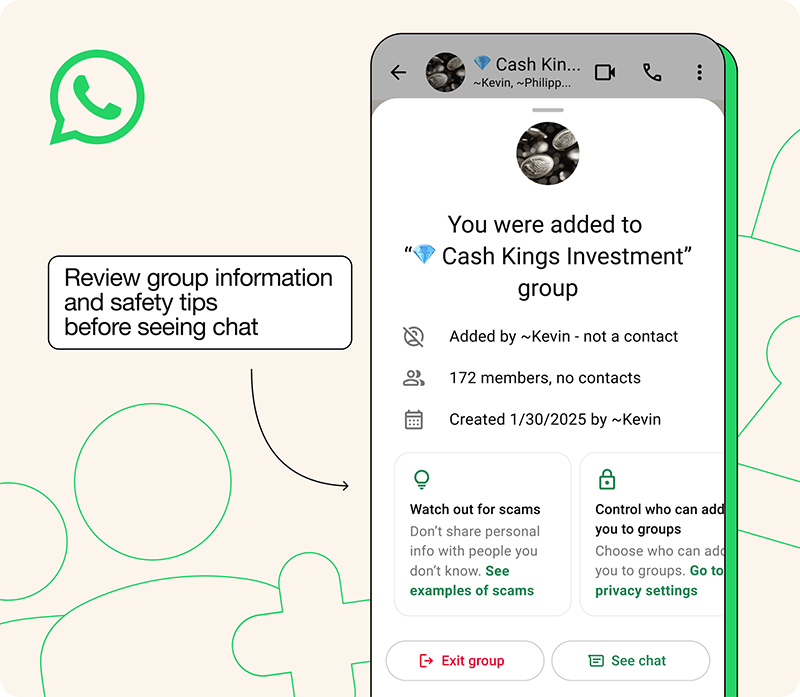
Second, is private chat warnings.
WhatsApp is testing new alerts when users message someone else not in their contacts. These prompts offer additional context to help them decide whether the conversation is legitimate or potentially harmful.
Meta also gives some practical tips for users to avoid getting scammed.
The company said that scammers often succeed by catching people off guard. To help users protect themselves, WhatsApp partnered with internet safety expert and ethical hacker Rachel Tobac to offer a simple framework:
- Pause: Don't rush. If a message feels off—even if it comes from someone claiming to be a friend. Just take a moment to think.
- Question: Does the offer make sense? Are they asking for money, gift cards, or sensitive information? Are they trying to hurry you into action?
- Verify: Contact the person directly using a different method. If they messaged you on WhatsApp, try calling them on the number you know is real.
Whether it’s a stranger offering high pay for little work or someone pretending to be a loved one in trouble, these scams are designed to manipulate emotions and force quick decisions. But with awareness, skepticism, and the right tools, users can outsmart even the most elaborate fraud attempts.




















































































































































































































































































