
AI is all about enhancing a computer’s ability to think and learn, while robotics focuses on replicating, if not perfecting, human movements.
Bringing these two fields together in perfect harmony has long been the pursuit of researchers and innovators.
For Apple, what better way to showcase the power of Apple Intelligence than by integrating it into something as familiar yet revolutionary as a tabletop lamp?
Yes, tabletop lamps.
But in a way that many people should love seeing.

This is because the researchers at Apple has put Apple Intelligence inside two tabletop lamps, but custom the hardware to have robotic movements, and program them to resemble that lamp from Pixar.
At Pixar, the lamp is called Luxo Jr., considered a semi-anthropomorphic toy desk lamp character used as the primary mascot of Pixar Animation Studios.
Besides being the protagonist of the short film Luxo Jr., the lamp has appears on the production logo of every Pixar film since 1995, when it debuted with Toy Story, the studio's first feature film.
In all Pixar's films, Luxo can be seen hopping into view and jumping on the capital letter "I" in "PIXAR" to flatten it since 1995.

It was the original creator, John Lasseter, who modelled the lamp into that lovable character, based on his own Luxo-brand lamp.
Here's the thing, Pixar was founded in 1979 as part of the Lucasfilm computer division. It was known as the Graphics Group before its spin-off as a corporation in 1986, and was made possible following a funding from Apple's late co-founder Steve Jobs, who became its majority shareholder.
Staying true to that, the researchers from Apple pays homage to Pixar, by creating two specialized tabletop lamps—bringing them to life in a way that stays true to their beloved charm.
Powered by Apple Intelligence, these lamps aren’t just smarter; they use advanced mechanical components to move with expressive, lifelike motions reminiscent of Luxo, capturing the essence of of robotics, Pixar-vibe.
And in the research paper, Apple calls it ELEGNT, or short for "Expressive and Functional Movement Design for Non-anthropomorphic Robot."
On the hardware side, the robots are tabletop lamps, but made with custom body in order to give it an articulating arm. It the place where a lamp is supposed to be, there is an LED light, camera, speaker, and a built-in-projector.
The robot respond to gestures and voice commands, and have a voice that sounds like Apple’s Siri.
But the project is far from just creating a robot with a lamp as an appearance.
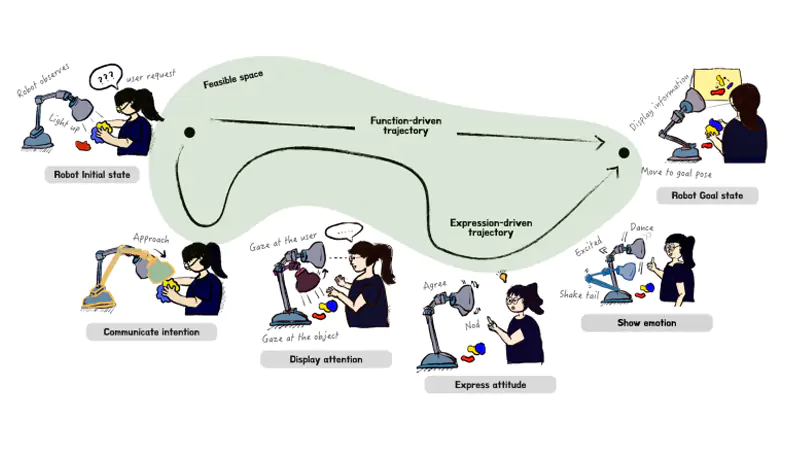
The goal of this robot, is to be able to "fulfill functional goals and constraints, i.e., robot moving from the initial state to goal state through a shortest, feasible trajectory (function-driven trajectory), but also use movements to express its internal states to human counterparts during the interaction, i.e., via expression driven trajectory to express robot’s intention, attention, attitude, and emotions."
Because a lamp is a lamp, and that it doesn't have a face to begin with, the idea is to make this robot capable of expressing non-verbal behaviors through postures, gesture and faze.
According to the researchers, expressions are essential for conveying internal states, both consciously and unconsciously, in human interaction.
To be able to make the robot show expressions to be able to interact with humans more naturally, the robot is designed to have movements to express expressive qualities—such as intention, attention, and emotions.
And ELEGNT here is supposed to be the framework of the project.
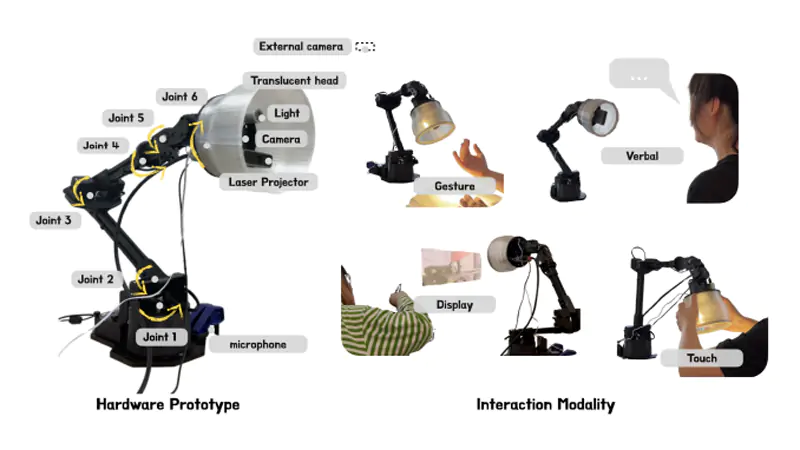
And on its own webpage on its website, Apple said that:
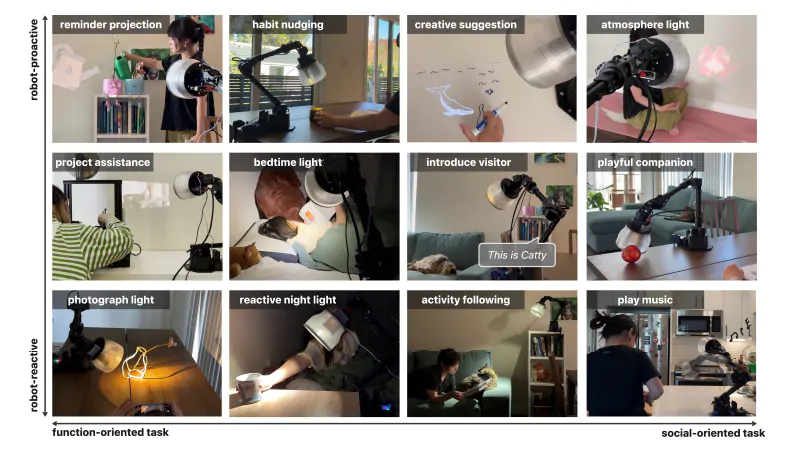
But what's worth noting here, giving a lamp the ability to express emotions in a human-like manner is more into the entertainment side than it functionality.
In one highlight, for example, the robot arm tries to extend to look at a note that its arm couldn’t reach, before shaking its head in dejection and apologizing with an AI-generated voice. In another part of the video, a user asked the lamp for the weather, but before responding, the robot looks outside, as if trying to understand the weather, and then respond.
It is then asked if it was invited on a hiking trip with its owner, then looked disappointed when it was told no.
Apple is making a push into the smart home market, prioritizing privacy, security, and seamless integration with its existing devices.
However, it faces strong competition from established giants like Amazon and Google. And like many Apple products, its smart home devices often come with a higher price tag, potentially limiting its market reach.
This lamp, however, signals Apple's focus on AI and its integration into the home, while also showcasing a more playful and engaging approach.