
The digital age has lost one of its most polite pioneers as the parent company of Ask.com officially shuttered its service.
For those who navigated the early web, the departure of the search engine originally known as 'Ask Jeeves' marks the final end of an era defined by the first dot-com boom. The site famously featured a cartoon butler named Jeeves who was designed to process natural language questions rather than the disjointed keywords required by early competitors like Yahoo! or AltaVista.
While the character was officially retired and then briefly reinstated over the years, the website itself remained a nostalgic fixture of the internet landscape until its recent transition into a simple placeholder results page.
The survival of Ask Jeeves throughout the decades is a testament to the platform's ability to pivot within an industry dominated by giants.
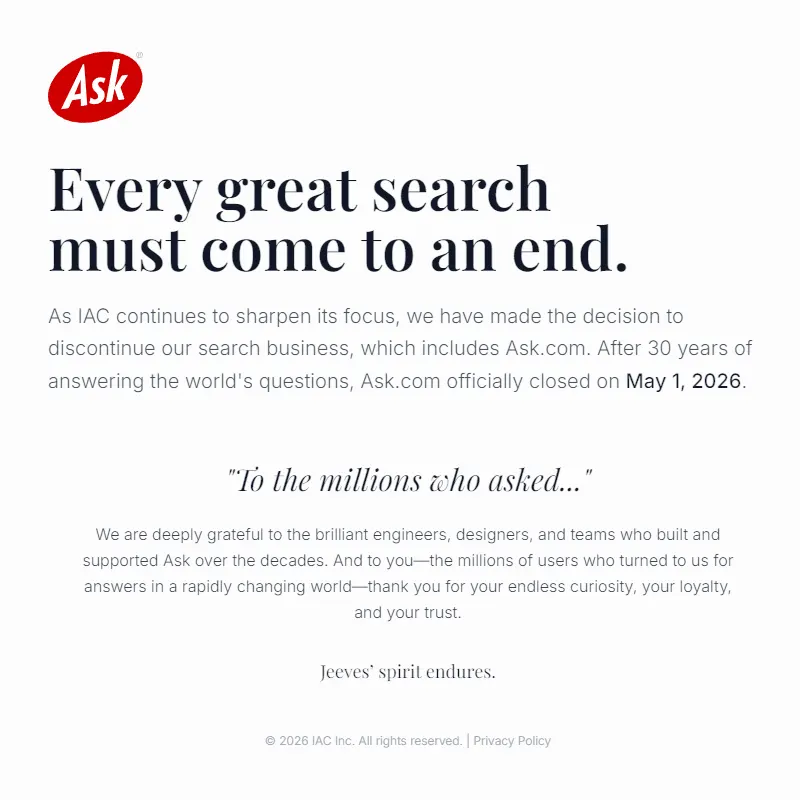
Ask.com, known as Ask Jeeves, rose as a pioneering conversational search engine in the late 1990s, before fading quietly.
It all began in 1996, when Garrett Gruener and David Warthen founded the company in Berkeley, California, with the vision of making web search accessible to everyday users. Instead of typing awkward keywords, people could ask full questions in natural language.
The service launched in beta in mid-April 1997 and went fully live on June 1 of that year, featuring a polite cartoon butler named Jeeves, inspired by the P.G. Wodehouse character.
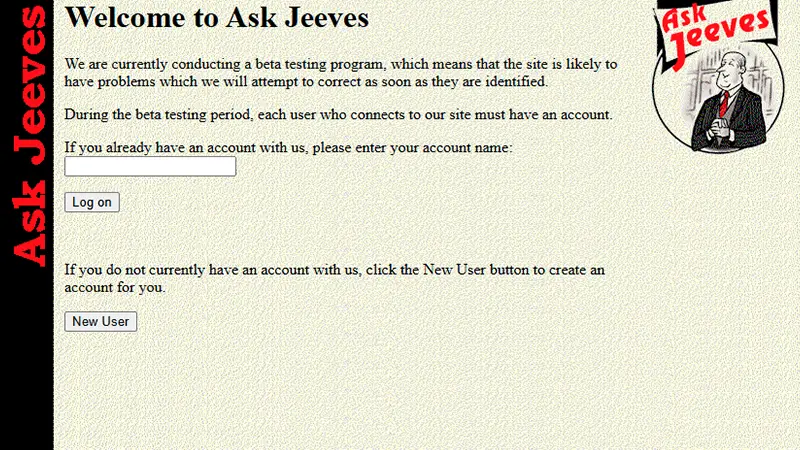
Users loved the friendly interface, and the site quickly became one of the most recognized brands of the early internet era.
Ask Jeeves rode the dot-com wave.
It went public in 1999, acquired companies like Direct Hit and Teoma to improve its technology, and handled millions of queries daily.
At its peak, the mascot even appeared in the Macy's Thanksgiving Day Parade.
Yet the quality of results remained uneven. Soon since the rise of Google in the late 1990s with its revolutionary PageRank algorithm, many of the early search engines were quickly crushed under the weight of superior relevance and speed.
But Ask Jeeves wasn't giving up.
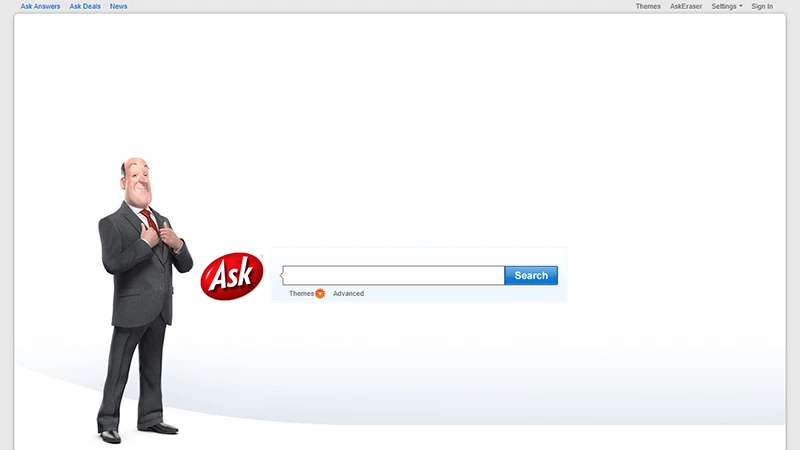
In 2005, InterActiveCorp (IAC) acquired Ask Jeeves for about $1.85 billion, and later, the new owners dropped the Jeeves name and mascot in early 2006, rebranding the site as Ask.com to compete more directly in the mainstream search market.
Over the following years, the company scaled back its own search engine, partnered with other providers for results, and shifted focus toward a question-and-answer format.
By 2010, IAC executives openly admitted that Ask.com was no longer competitive with Google.
The service lingered for another decade and a half as a smaller player, still answering questions but with declining relevance.
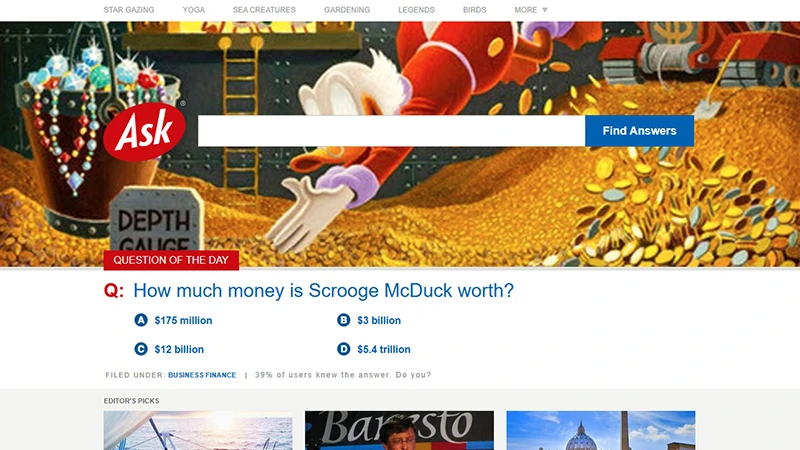
In other words, Ask managed to endure by leaning into its unique identity as a humanized question and answer service.
It survived the initial collapse of the dot-com bubble, the Google takeover, and more, thanks to several strategic transformations. By shifting away from being a general web crawler and focusing on curated informational tools and toolbar integrations, it maintained a surprisingly steady presence in a market that usually leaves no room for second place.
Part of its longevity can be attributed to its early lead in the natural language processing space.
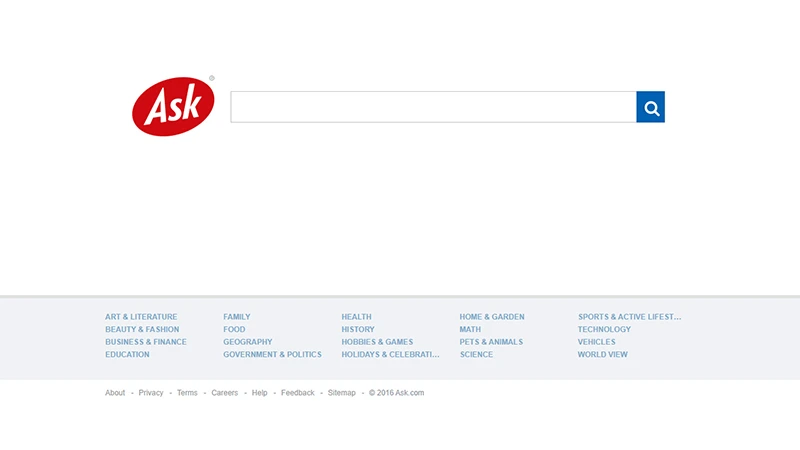
Long before the current obsession with large language models-powered chatbots and virtual assistants, Ask Jeeves encouraged users to type out full sentences like "where can I find the nearest library" or "how do I fix a leaky faucet". This approach helped humanize the internet for a generation of new users who found traditional search syntax intimidating.
Even as Google became the undisputed king of search, Ask.com remained a top ten global web property for years by leveraging a massive network of partner sites and a loyal user base that appreciated its straightforward Q&A format.
Despite this incredible resilience, the site eventually struggled to maintain a significant share of the modern market as users shifted toward integrated mobile ecosystems and increasingly sophisticated AI tools.
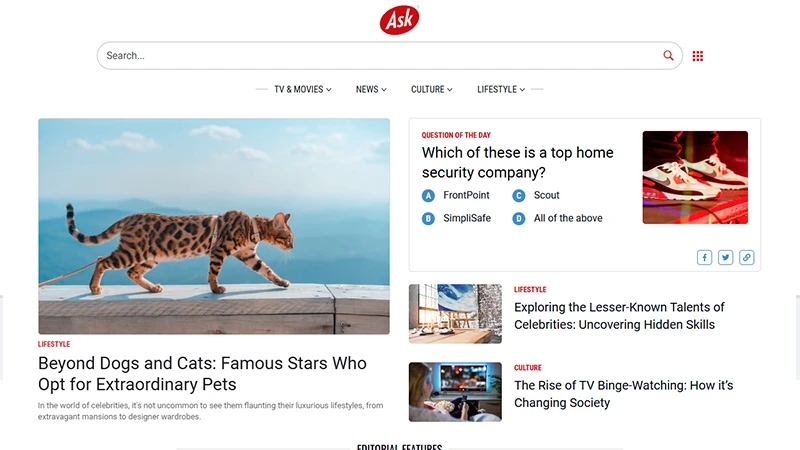
On May 1, 2026, IAC made the final decision to discontinue its search business entirely. After nearly 30 years, Ask.com shut down with a simple farewell message on its homepage: "Every great search must come to an end." Jeeves' spirit, the company noted, would endure.
What began as a bold attempt to humanize the internet ultimately became a nostalgic reminder of the wild early days of search.
The death of Ask.com is a poignant irony that the service closed its doors just as the industry is returning to the very concept that Jeeves pioneered.
Modern generative AI and conversational search bots are essentially high tech versions of the natural language butler, yet the original innovator could no longer compete with the massive computational infrastructure of its successors. The parent company noted that the decision was made to sharpen its focus on other business ventures, bringing a quiet close to a journey of nearly thirty years spent answering the world's curiosity.
The legacy of the digital butler remains a fundamental chapter in the history of how people interact with technology.

While the cartoon character and the familiar search box are gone, the spirit of conversational inquiry now powers almost every major interface on the web today.
For those older generations who remember asking Jeeves for help with school projects or trivia in the late nineties, the closure is a reminder of a simpler time when the internet felt like a place where a helpful gentleman might personally fetch the answers people needed.
The butler has finally hung up his coat, leaving behind a web that has finally learned to speak the language he was built to understand from the very beginning.