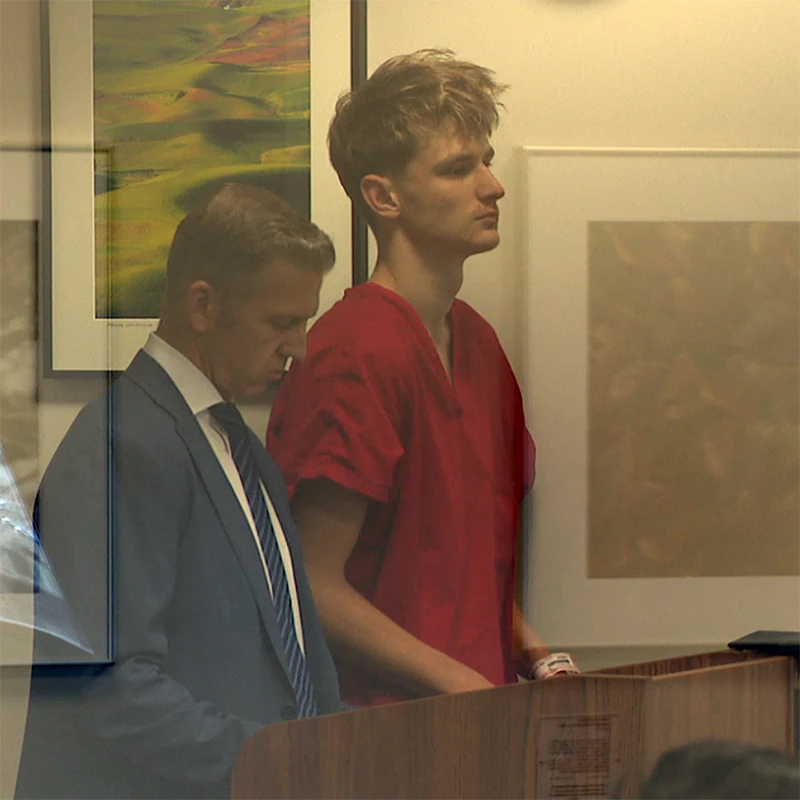
In a Bellevue courtroom this week, a judge refused to lower the $5 million bail for 22-year-old Nikita Tyukalo, leaving him confined in the King County Jail as prosecutors presented new evidence of an alleged criminal enterprise built on the exploitation of young women.
The hearing marked the latest chapter in a case that has drawn intense local attention, revealing how a rented mansion on the Eastside allegedly became the center of a coercive operation that funneled profits from adult content platforms straight into a lifestyle of luxury cars and high end rentals.
Tyukalo, who once projected an image of effortless success on social media, now faces the full weight of serious felony charges while his attorneys argue he lacks the resources to post even a fraction of the current bail amount.
The allegations paint a picture of calculated recruitment followed by systematic control.
Prosecutors said that Tyukalo and a small group of associates approached young women, some as young as sixteen, with promises of substantial monthly earnings through content creation on OnlyFans, Chaturbate, and similar sites.
Once the women arrived at the properties, the dynamic allegedly shifted.
They were reportedly forced into grueling production schedules that stretched 14 to 20 hours a day, creating explicit material under constant supervision.
Allegedly, the women were required to perform live sexual acts on camera during extended livestream sessions, pose for degrading video recordings, engage in fetish specific content, and interact with paying subscribers in highly intimate and often humiliating ways while Tyukalo or his associates monitored the sessions and directed the actions.
Physical violence, including beatings and strangulation, combined with threats involving firearms and explicit warnings that speaking out would result in death, kept many in line according to charging documents.
Victims described being locked out of their own accounts and denied access to the money they generated, while the operation allegedly used blackmail by retaining control of compromising content.
The scale of the alleged scheme became clearer after Bellevue police executed a search warrant on June 4th at a large rental home in the Lakemont neighborhood.
Officers recovered more than 300 cell phones and over 50 laptops, along with notebooks that tracked individual women's earnings, financial records, and a whiteboard labeled "Content Plan."
Investigators determined that the mansion, along with several other high end rentals in the area, served as both living quarters and production sites for the content.
The women were allegedly given stimulants such as Adderall to stay awake through the marathon sessions and were punished severely if they resisted or attempted to leave.
Weapons were also seized during the raid.

Neighbors had also repeatedly called authorities about loud, out-of-control parties that spilled out of the property on weekend nights, adding another layer to the complaints that ultimately drew police attention.
Court records indicate the alleged activity stretched from roughly mid-2024 through the time of the arrest.
Multiple women have come forward to describe how initial promises of financial independence and glamorous opportunities gave way to isolation, fear, and repeated abuse.
One alleged victim, speaking publicly during the recent bail hearing for the first time, recounted the moment the control became absolute.
She described looking at someone she had once cared for and hearing him state that if she ever spoke about what she endured or opened her mouth, he would kill her because she knew too much.
She told the court that manipulation, violence, and the complete control of women had become normalized inside the operation, where daily life revolved around performing increasingly explicit acts for anonymous online audiences while being denied basic autonomy over their bodies and earnings.

Tyukalo was formally charged with 4 counts of second degree human trafficking, one count of money laundering, and 1 count of leading organized crime.
He entered a not guilty plea during an earlier appearance and has remained in custody since his arrest.
Prosecutors successfully argued for the $5 million bail at the outset, citing the risk to victims and witnesses as well as Tyukalo's apparent ability to flee given his previous access to significant funds.
Defense attorneys countered in the most recent hearing by claiming their client is now essentially broke, with assets seized and additional money lost to credit card fraud while he has been incarcerated.
Prosecutors pushed back hard against that portrayal.
They highlighted Tyukalo's social media history filled with images of luxury vehicles, including a McLaren, large amounts of cash, and an extravagant lifestyle that appeared inconsistent with claims of financial hardship.

Even more striking were the recorded jailhouse phone calls in which Tyukalo allegedly spoke in Russian to direct others to move or conceal substantial sums of money from his accounts.
One prosecutor pointedly observed during the hearing that Tyukalo may have believed speaking Russian would prevent investigators from understanding his instructions, yet the conversations had already been translated and documented.
The case, involving luxury mansions, cars, and a Ukrainian immigrant's shift from basketball aspirations, has fueled online discussions about exploitation tactics in adult content production and industry accountability.

It also exposed uncomfortable questions about how quickly the creator economy and the promise of quick wealth can mask far more coercive arrangements.
What began for some women as a chance at financial independence allegedly became a trap enforced through fear and constant surveillance across multiple properties.
The digital evidence recovered, from phones and laptops to detailed earnings ledgers, suggests a level of organization that went well beyond casual content creation.
As the proceedings move toward trial, the testimony of those who lived inside the alleged operation will likely form the core of the prosecution's case.
For the young women who have spoken out, the courtroom process represents an opportunity to hold accountable someone they say stripped them of agency and safety.
For the broader community, the details emerging from the Bellevue mansion serve as a stark reminder of how social media facades can hide exploitation that thrives in the shadows of online platforms.
Tyukalo remains presumed innocent until proven guilty, yet the volume of evidence already public, from victim accounts to the physical items seized during the raid, continues to shape the narrative around one of the most serious criminal cases to surface in the region this year.
The $5 million bail stands as a clear signal from the court that prosecutors have presented enough to keep him detained while the full facts are tested in trial.
<p><p>As the case against Nikita Tyukalo unfolds, it peels back the glossy facade of an industry that markets empowerment while too often concealing coercion, control, and raw human suffering.
Behind the filtered images and subscriber counts of online adult entertainment lies a darker reality where young women are lured with promises of independence only to find themselves trapped in cycles of exploitation that thrive on digital anonymity and unchecked financial incentives.
Platforms built for quick transactions can become tools for predators who weaponize content, finances, and fear, turning what appears as voluntary performance into something far more sinister.
This case is not an isolated anomaly but a stark illustration of how the boundary between ambition and abuse can dissolve when profit overrides consent and oversight remains minimal.
The unspeakable dark side of this world reveals itself in the eroded dignity of victims who perform explicit acts for hours on end under duress, their bodies commodified, modesty disregarded, all while their autonomy is systematically stripped away.
It exposes the illusion that every creator operates with full agency when power imbalances, threats, and financial entrapment can render choice meaningless.
For every success story shared on social media, untold stories of manipulation and trauma remain hidden behind locked mansion doors and encrypted accounts.
<p><p>Tyukalo's alleged operation, with its marathon livestreams, monitored sessions, and brutal enforcement tactics, forces society to confront the human cost that fuels billions in revenue for adult content platforms.
The creator economy’s rapid ascent has outpaced meaningful safeguards, allowing exploitation to flourish under the banner of personal freedom.
True progress will require more than arrests and headlines. It will demand greater platform accountability, stronger protections for vulnerable participants, and a cultural willingness to look beyond the curated highlights to the hidden suffering that too often powers the machine.
Only then can the industry begin to confront the darkness that lurks behind its brightest promises.














































































































































































































































































