
Analysts agree that Google’s Chrome browser dominates desktop internet browsing with 57% market share.
Chrome is followed by Apple's Safari with 14%; Firefox with 6%; Microsoft Internet Explorer and Edge browser with 5.9%; and Opera with, 3.7%.
But a study came from analytics company Mixpanel shows that mobile browser usage depends mostly on the phone’s default web browser, not consumer choice.
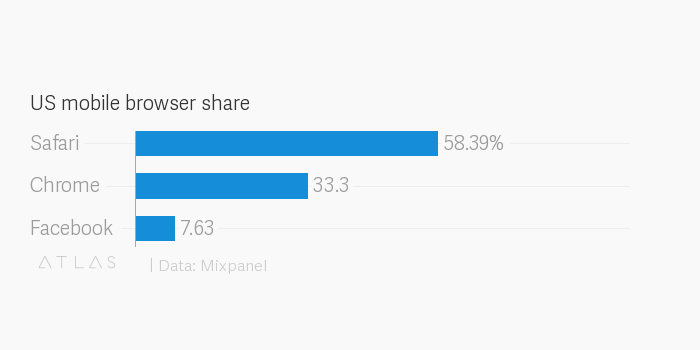
What this means, because more smartphones in the U.S. are Apple’s (65.5%) than Google’s Android (34.46%), this translates to Safari browser in surpassing Chrome on mobile in the U.S. with 58.39% market share compared to 33.3%.
Surprisingly, Facebook comes third in the U.S., accounting for 7.63 percent of mobile browser traffic in the country.
Facebook is a social media network and it's not a browser. However, it has an in-app browser which allows users to open links and visit websites directly inside its app, rather than opening a dedicated web browser.
The top three states where Facebook is popular as a way to browser the web, are: Washington (13.74%), Rhode Island (13.14%), and Montana (12.64%).
The rest include Texas (10.12%), Hawaii (10.94%), New Hampshire (10.52%), Indiana (11.93%), Missouri (11.49%), Pennsylvania (10.92%), South Carolina (10.16%), North Carolina (11.8%), Oregon (9.73%), North Dakota (9.9%), West Virginia (9.95%), Minnesota (11.81%), and Delaware (9.94%).
This happened particularly when Facebook has tweaked its News Feed algorithms to show less contents from brands and publishers and increase the reach of organic posts from fellow users.
It has been long known that Facebook's News Feed is one of the largest traffic sources for publishers on all verticals. And this achievement clearly shows how dominant Facebook is in terms of becoming an information source for users – whether it’s news or entertainment, or anything else.
It’s also a threat to Google that has been experiencing a shift in trend where users use mobile devices more often than doing web searches. With more people using Facebook as their portal to the web, Google had to rely more heavily on partnership deals.
This includes its search engine integration with Apple’s Safari browser where the company pays to be the default search engine.
Facebook's growth as a "browser" becomes a concern because the company has outsized its influence on shaping how the news and information flow on its platform, all without having news media background or experience.
The social giant has relied on both algorithms and human staffs to stop the spread of fake news, hoaxes and clickbait articles. But still, the company is not able to eliminate them entirely if not by much.