Few dinosaur fossils have ever captured the internet's attention the way a Tyrannosaurus rex does.
This week, that attention centered on "Gus," a remarkably preserved T. rex skeleton that sold for $50.1 million at a Sotheby's auction in New York, setting a new record for the most expensive dinosaur fossil ever sold at auction.
The sale surpassed the previous record held by Apex, a Stegosaurus skeleton that sold for $44.6 million in 2024, and Stan, another famous T. rex specimen that sold for $31.8 million in 2020.
Within hours, photos of Gus spread across social media, with users celebrating the record breaking sale while others questioned whether the fossil had effectively disappeared from public life.
With Gus purchased by an anonymous private buyer, the internet may have seen the dinosaur for the last time.
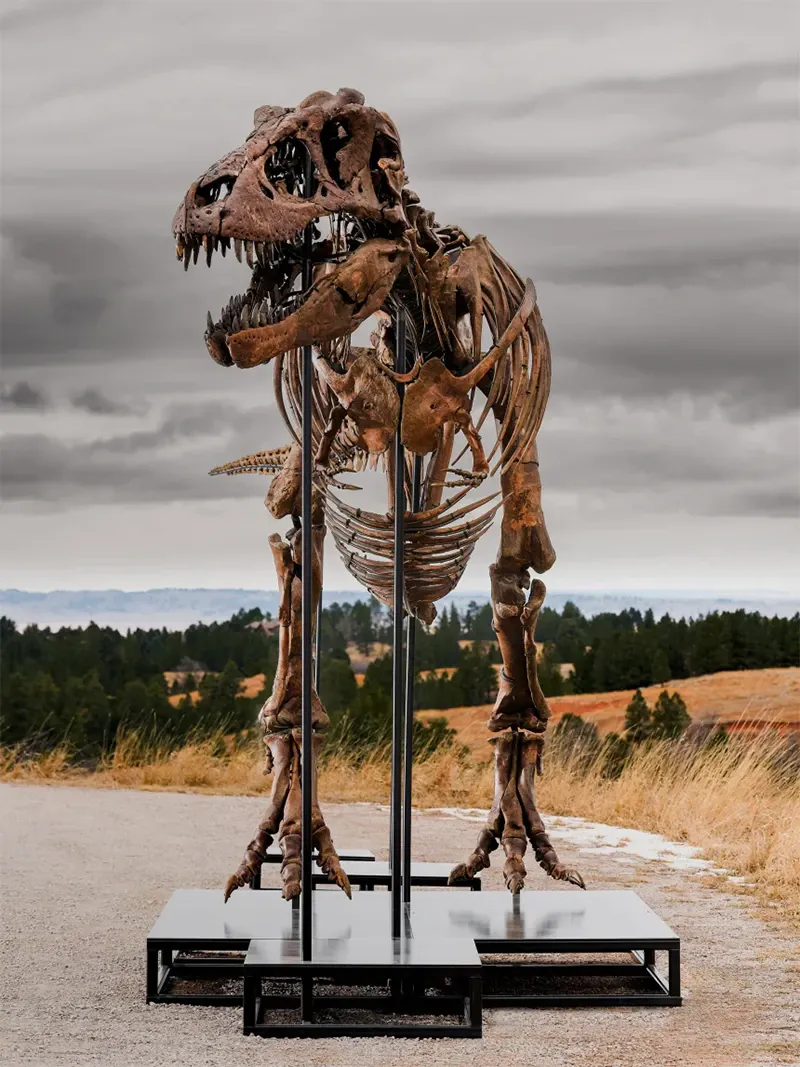
Gus was discovered in 2021 in the Hell Creek Formation of South Dakota, one of the world's richest sources of Late Cretaceous dinosaur fossils.
Paleontologists estimate the animal lived around 66 to 67 million years ago, just before the mass extinction event that ended the age of non avian dinosaurs.
The specimen is approximately 61% complete and preserves 183 fossil bones.
Mounted, it measures about 38 feet (11.6 meters) long and stands roughly 12.5 feet (3.8 meters) tall at the hips.
Gus is far from being considered the largest T. rex ever found. It is noticeably smaller than a short list of scientifically important specimens that includes Sue (12.6 meters), Stan (12 meters), Scotty (13 meters), and Trix (12.5 meters), among others. It is also not the most complete, with those famous specimens preserving a larger percentage of their skeletons.
However, Gus is one of the finest T. rex specimens discovered in the last decade and has become historically significant because of its exceptional preservation.
It is also one of the specimens that preserves bite marks and evidence of fractures that the dinosaur survived, providing another glimpse into the violent lives these apex predators lived.
Those qualities, combined with its rarity, contributed to its record breaking auction price.
Cassandra Hatton, Sotheby's vice chairman and global head of science and natural history, said ahead of the auction that Gus stood out because of "the completeness, the quality, the size, the preservation," as well as the careful work required to excavate and prepare the fossil.
For now, almost every image and video of Gus circulating online comes from Sotheby's promotional material and news coverage of the auction.
Unless the new owner chooses to publicly display or loan the specimen, there may be few new opportunities for the internet to follow its story.
The sale has also revived a long running debate over whether historically significant fossils should belong in private collections or public institutions.
Museums and researchers often argue that scientifically valuable specimens are best preserved where they remain accessible for study and public education.
Others point out that many important discoveries have been made on private land and that commercial fossil collecting has played a role in bringing specimens to light.
In the case of Gus, there is little anyone can do to prevent the sale.
The fossil was discovered on privately owned land, making it legal for the owner to sell it.
While researchers have examined Gus, many of those visits were informal because some paleontologists are reluctant to formally study privately owned specimens, arguing that scientific research should ideally focus on fossils that remain publicly accessible.
That uncertainty is now at the center of the online discussion.
Unlike paintings or sculptures that may appear in multiple exhibitions over the years, a dinosaur fossil is unique. Once a scientifically important specimen disappears into a private collection, there is no equivalent replacement.
Now that the auction has concluded, nobody outside the buyer's circle knows what happens next.
The buyer has not disclosed any plans for Gus.
The fossil could be loaned to a museum, donated to a public institution, or installed in a private collection that is never opened to visitors. Until those intentions become known, the internet is left with little more than the auction photographs and speculation.
If the specimen remains out of public view, researchers and dinosaur enthusiasts may have limited opportunities to study or even see one of the most significant T. rex discoveries of recent years.
However, it is also possible that the new owner could loan or donate the specimen to a museum in the future, as has happened with other privately owned fossils.
That possibility feels unusual in the age of the internet.
Major dinosaur discoveries are typically documented from excavation to museum exhibition.
Millions of people follow those journeys through news reports, documentaries, YouTube videos, museum exhibits, and social media posts. In many ways, famous fossils have become internet celebrities, with every new scan, reconstruction, or scientific study generating another wave of online attention.
The fascination surrounding Gus reflects the unique place that Tyrannosaurus rex occupies in popular culture.
More than a century after it was first described by scientists, T. rex remains one of the most recognizable prehistoric animals in the world. It has appeared in countless books, documentaries, toys, video games, memes, and films, becoming the image many people associate with dinosaurs as a whole.
No modern franchise has done more to cement that reputation than Jurassic Park and its successor films.
Since the original movie premiered in 1993, a T. rex has appeared in every installment of the series, often serving as its defining dinosaur. Although paleontology has advanced significantly since the first film, with new discoveries reshaping ideas about dinosaur anatomy and behavior, the towering predator continues to symbolize both scientific discovery and cinematic spectacle.
That cultural prominence also helps explain why T. rex fossils command extraordinary prices.
Unlike many other extinct animals, a T. rex skeleton is instantly recognizable to people who have never visited a natural history museum.
Its combination of scientific importance, rarity, and pop culture status turns every major discovery into a global news story and an internet phenomenon.
For now, Gus has become the latest dinosaur to dominate headlines, timelines, and comment sections around the world.
Ironically, after becoming the most expensive dinosaur fossil ever sold, its digital footprint may soon stop growing altogether.
Unless its new owner chooses to bring it back into public view, the internet may remember Gus not only for its record-breaking $50.1 million price tag, but also as the T. rex that seemingly vanished just as the world got to know it.






















































































































































































































































































