When the White House registered the domains Alien.gov and Aliens.gov earlier this 2026, UFO enthusiasts immediately took notice.
The timing seemed significant. U.S. President Donald Trump had already released files related to this, and promised the release of additional government files related to unidentified aerial phenomena (UAP). Speculations spread across social media that the administration might be preparing a major disclosure event.
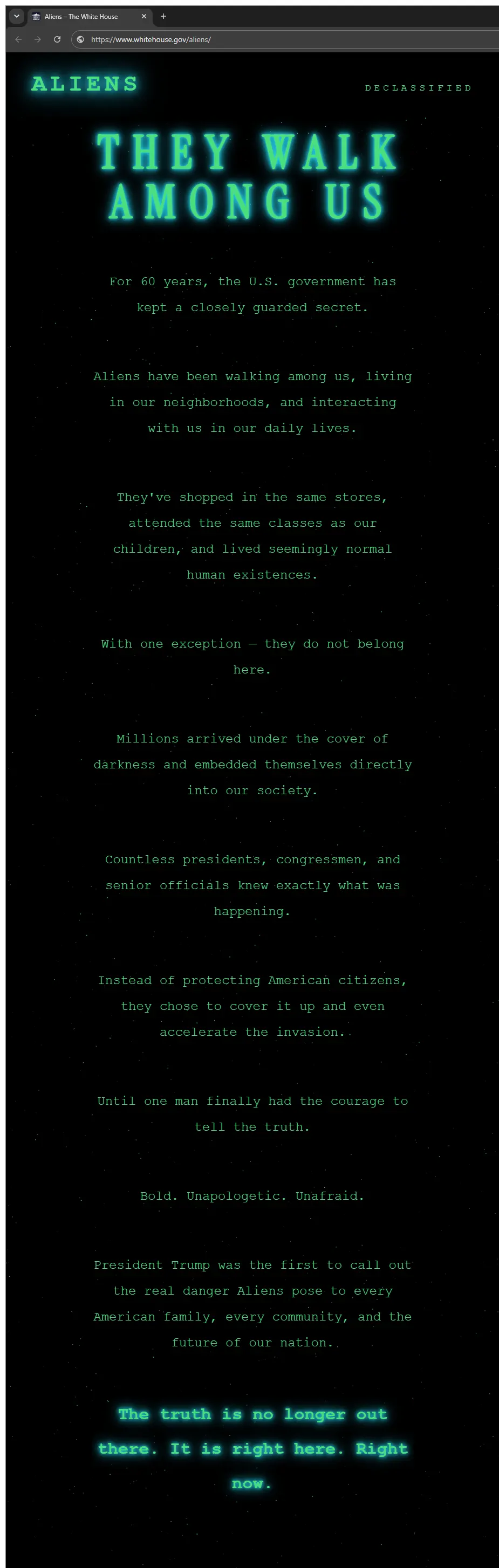
"THEY WALK AMONG US," the site declares in large, neon green text.
"For 60 years, the U.S. government has kept a closely guarded secret. Aliens have been walking among us, living in our neighborhoods, and interacting with us in our daily lives."
But instead of seeing real aliens, visitors who arrived at the site found something entirely different.
In announcing the websites, the White House posted an AI-generated animation depicting a UFO beaming up an undocumented immigrant over the southern border wall.
In other words, the website was not about aliens or any extraterrestrial being of any kind.
Instead, it was all about immigration.
Presented with science fiction imagery and slogans that evoke decades of alien conspiracy culture, the site reframed undocumented immigration through the language of invasion, secrecy, and hidden threats.
Visitors were greeted with messaging that declared, "They weren't little green men," before revealing that the "aliens" in question were undocumented immigrants living in the U.S.. The site also featured immigration enforcement statistics, arrest maps, and reporting tools tied to federal immigration authorities.
This isn't the first timeTrump and his administration have engaged in wordplay around "aliens," and that he had even shared an AI-generated image showing him walking alongside a chiseled alien in shackles.
The immediate political debate focused on whether the website was offensive, effective, or merely provocative. A more interesting question is why it was built this way in the first place.
Aliens.gov appears designed less to persuade opponents than to capture attention in an information environment saturated with content. Traditional government websites are rarely discussed beyond policy circles. This one generated headlines across national media, sparked arguments on social platforms, and drew in audiences that might otherwise never engage with immigration policy.
By borrowing the aesthetics of UFO culture, the administration transformed a bureaucratic subject into a viral cultural event.
The strategy worked.
Discussions quickly spread across Reddit communities devoted to UFOs, technology, and politics.
Many users expressed frustration after initially believing the site would contain information related to extraterrestrial life or government disclosure. Others viewed the rollout as a deliberate attempt to exploit public fascination with aliens in order to reinforce anti immigration messaging. The confusion itself became part of the story.
What makes the episode notable is that the administration was operating within a cultural moment already primed for the word "alien" to mean something other than a legal classification.
Public interest in UFOs has grown steadily over the past decade.
Congressional hearings, Pentagon reports, and promises of additional disclosure have pushed discussions about unexplained aerial phenomena into mainstream politics. The registration of Aliens.gov fueled expectations because many Americans now associate the word primarily with extraterrestrial life rather than immigration law.
Supporters of the administration argue that "alien" remains a valid legal term embedded in federal immigration law and that critics are objecting to language that has existed in statutes for decades.
The broader immigration debate has long involved competing terminology. Different administrations have alternated between words such as "alien," "llegal immigrant," "undocumented immigrant," and "noncitizen," each carrying different political and cultural implications.
Critics, however, argue that Aliens.gov goes beyond legal terminology.
They point to the website's visual design, its conspiracy themed presentation, and its repeated references to hidden dangers as evidence that the project was intended to encourage viewers to see immigrants as fundamentally different from the broader population.
Immigration advocates and legal organizations have described the site as dehumanizing and inappropriate for an official government platform.
Deport criminal illegal aliens and SAVE AMERICA!https://t.co/7HysdUuNVM pic.twitter.com/8HsQ01qFyU
— The White House (@WhiteHouse) May 31, 2026
Regardless of where one stands politically, the launch offers a glimpse into how modern political communication has changed.
Governments increasingly compete for attention using the same tactics employed by advertisers, influencers, and entertainment companies. The goal is not simply to present information. It is to create a narrative that people will share.
Aliens.gov succeeded in doing exactly that.
Within hours, it became part immigration policy announcement, part internet spectacle, and part cultural Rorschach test. To supporters, it represented a creative way to highlight border enforcement.
To critics, it represented a government using humor and symbolism to normalize hostility toward immigrants. To many UFO enthusiasts, it was simply a bait and switch.
The deeper lesson may be that political battles today are fought as much through branding as through legislation.
The argument over Aliens.gov is ultimately not about a website.
It is about who gets labeled an outsider, who controls the language of belonging, and how political institutions use culture to shape public perception long before policy details enter the conversation.






















































































































































































































































































